Significant Safety Differences by Cathode Material Composition and Form Factor
Rising Consumer Expectations... Need to Share Detailed Information
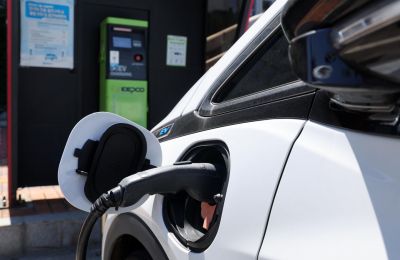
The government has recommended that automobile companies voluntarily disclose battery information following the electric vehicle fire incident in Incheon. However, there is criticism that the limited disclosure of only battery manufacturer information by automakers is ultimately a 'half measure.'
On the 14th, the government held a vice-ministerial meeting of related ministries and decided to recommend that all manufacturers selling electric vehicles domestically voluntarily disclose battery information. This decision follows the electric vehicle fire accident that occurred on the 1st in the underground parking lot of an apartment complex in Cheongna International City, Incheon. The government plans to recommend that electric vehicle manufacturers transparently disclose information about battery producers and related parties for electric vehicles sold domestically.
Automobile manufacturers operating in Korea have been successively disclosing the battery manufacturers installed in their electric vehicles. Hyundai Motor Company, which holds over 50% of the domestic automobile market share, was the first to disclose the battery manufacturers for 13 of its electric vehicle models, followed by Kia, Mercedes-Benz, BMW, and others. So far, three domestic automakers and four imported car companies have participated, with a total of 40 electric vehicle models disclosed.
Disclosing battery manufacturer information is a necessary measure to address concerns about electric vehicle safety and the public's right to know. However, there are voices suggesting that more detailed information disclosure is needed for increasingly discerning electric vehicle consumers. Batteries are a crucial component, accounting for 30-40% of the cost of an electric vehicle. Safety varies significantly not only by manufacturer but also by the constituent materials and form factor (physical classification).
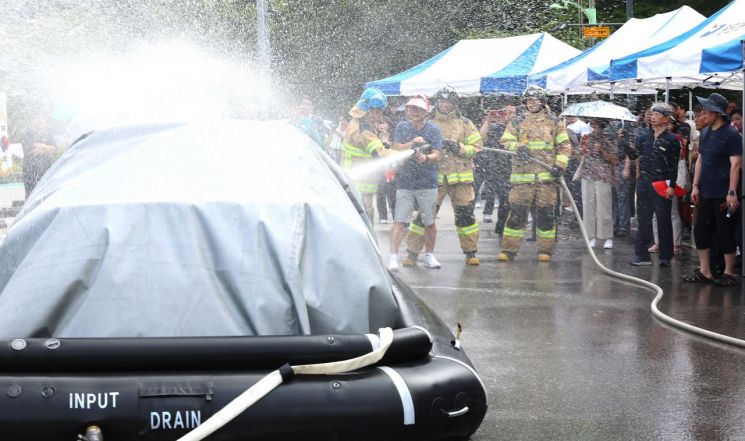 On the morning of the 13th, a resident participated in a joint public-private training for electric vehicle fire response held at the parking lot of the Songdo 2-dong Administrative Welfare Center in Yeonsu-gu, Incheon. The training included a simulated demonstration of electric vehicle fire suppression using firefighters' smothering extinguishers and electric vehicle water tanks.
 [Image source=Yonhap News]
Batteries are broadly classified based on the materials composing the cathode into NCM (Nickel-Cobalt-Manganese) and LFP (Lithium Iron Phosphate) batteries. NCM batteries have a high nickel content, resulting in high energy density but chemically unstable characteristics. They are the most suitable batteries for enhancing electric vehicle performance but require careful management of safety. LFP batteries have lower energy density but are chemically more stable, resulting in a lower risk of fire. Regarding form factors, prismatic and cylindrical batteries are considered safer as they are resistant to external shocks and less likely to spread fire to external cells. On the other hand, pouch-type batteries have high energy density but are also considered vulnerable to external shocks and fire.
Professor Lee Ho-geun of the Department of Automotive Engineering at Daeduk College said, "If information is opened and consumers can choose batteries, differentiating vehicle prices accordingly could be an excellent marketing strategy," adding, "Transparent information disclosure and granting consumer choice are necessary measures for the popularization of electric vehicles."
© The Asia Business Daily(www.asiae.co.kr). All rights reserved.


















