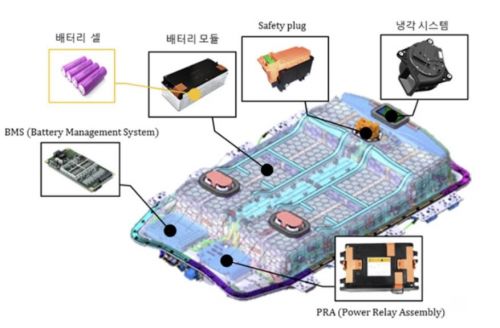
Battery Management Systems (BMS) are emerging as a key technology to prevent electric vehicle fires. The government is considering including BMS in electric vehicle safety standards.
According to government and expert groups on the 14th, the government's plan to strengthen electric vehicle safety management is expected to include measures to advance BMS. The Ministry of Trade, Industry and Energy is likely to support research and development (R&D) on BMS, while the Ministry of Land, Infrastructure and Transport is expected to add BMS to future electric vehicle safety standards.
BMS refers to the integrated hardware (HW) and software (SW) that attach various sensors to an electric vehicle's battery to monitor and manage its condition. Although BMS is already installed in electric vehicles, it currently remains at a basic level, such as monitoring battery charge level (State of Charge, SOC), driving range, and energy efficiency calculations. For example, electric vehicles sold domestically by Hyundai Motor Company and Kia manage battery charging within a range of 4% to 97%, which is also a function of the BMS.
By advancing BMS, it will be possible to monitor battery voltage, current, temperature, and other factors, and to equip functions that display warnings on the vehicle's dashboard or automatically report to the driver when abnormal signs occur during charging or discharging. Measures can also be implemented to delay the time it takes for thermal runaway?when a specific battery cell explodes?to spread to adjacent cells, preventing a larger fire.
Professor Kim Jong-hoon of the Department of Electrical Engineering at Chungnam National University explained, "To enhance electric vehicle safety, it is necessary to improve BMS functions that can detect and respond to abnormal signs in battery cells." He added, "In the future, BMS could be linked with cloud and artificial intelligence (AI) to analyze battery data and be used to develop safer batteries and electric vehicles."
The government is also understood to be preparing related measures. A Ministry of Trade, Industry and Energy official said, "Improving BMS functions, along with developing safe batteries, can be part of electric vehicle safety measures."
The Ministry of Land, Infrastructure and Transport is reviewing plans to introduce BMS into electric vehicle safety standards. Currently, the ministry presents 12 items as electric vehicle safety standards in the enforcement regulations for traction batteries, and adding BMS to these standards is a likely option.
Automakers must conduct self-certification tests on items such as vibration, thermal shock, combustion, short circuit, overcharge, over-discharge, overheating prevention, overcurrent, flooding, impact, compression, and drop before launching electric vehicles. From February next year, the ministry plans to switch to a pre-certification system requiring government approval before electric vehicles can be sold.
A Ministry of Land, Infrastructure and Transport official explained, "Initially, the pre-certification system will be applied only to the existing 12 items," adding, "We are also considering including BMS in electric vehicle safety standards after harmonizing with international standards." It is generally difficult for South Korea to be the first to include BMS as a certification item due to related issues. In this regard, the Korea Automotive Technology Institute has been conducting R&D projects on BMS safety standards and fire prevention technologies since last year.
R&D by related companies is also actively underway. In March, LG Energy Solution announced the development of an advanced BMS diagnostic solution for next-generation electric vehicles in collaboration with Qualcomm. They also signed a memorandum of understanding (MOU) with the U.S. semiconductor company ADI for cell internal temperature measurement technology.
Expanding BMS functions is not easy. Advancing BMS increases costs, which may raise vehicle prices. Privacy issues may also arise. Depending on which company’s BMS is installed, competition for dominance in the electric vehicle market or disputes over responsibility could occur. Hyundai Motor Company and Kia apply their own developed BMS in their electric vehicles, while U.S. GM electric vehicles use BMS from LG Electronics and LG Energy Solution.
© The Asia Business Daily(www.asiae.co.kr). All rights reserved.
!["The Woman Who Threw Herself into the Water Clutching a Stolen Dior Bag"...A Grotesque Success Story That Shakes the Korean Psyche [Slate]](https://cwcontent.asiae.co.kr/asiaresize/183/2026021902243444107_1771435474.jpg)
















