Preventing Recurrence of Fire at Hwaseong Arisel Plant
Priority Inspection of 200 High-Risk Sites
1 Billion KRW Support for Partition Installation and Emergency Exit Improvement
The government is pushing for a plan to mandate safety training for all foreign workers to prevent the recurrence of fire accidents like the one that occurred at the Hwaseong Arisel factory. In the process of strengthening safety management for small-scale workplaces, the risk assessment criteria will be tightened, and consulting and follow-up management will be conducted for vulnerable workplaces.
On the 13th, the Central Accident Response Headquarters for the Hwaseong Arisel factory fire accident held the 3rd meeting of the Central Accident Response Headquarters at the Government Seoul Office and announced the "Measures to Strengthen Safety for Foreign Workers and Small-scale Workplaces" containing these details.
This measure is a follow-up action to the emergency safety support implemented on the 18th of last month to prevent fire accidents in battery handling workplaces. It was prepared based on field opinions from foreign workers, business owners, and industry-specific associations and organizations.
Eliminating Blind Spots in Safety Training for Foreign Workers
The government included a plan in the measures to ensure that all 920,000 foreign workers can receive basic safety and health education. It will promote that they receive professional basic safety and health education at least once before or at the time of employment.
For foreign workers with F-series visas, which have many workers, a basic safety and health education course will be newly established in the Ministry of Justice’s Social Integration Program. The Overseas Koreans Office’s domestic Korean settlement support guide will also include basic safety information and industrial accident compensation guidance.
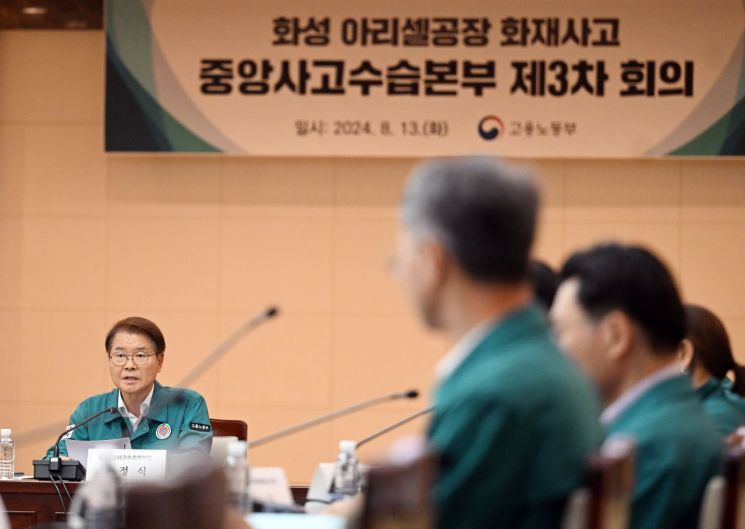 On the 13th, the 3rd meeting of the Central Accident Response Headquarters for the Hwaseong Arisel Factory Fire Accident was held at the Government Seoul Office Building, where Lee Jeong-sik, Minister of Employment and Labor and head of the Central Accident Response Headquarters, is seen speaking. / Photo by Ministry of Employment and Labor
Educational institutions such as the Korea Occupational Safety and Health Agency will provide on-site education by visiting regional industrial complexes directly. Experiential education using public (3 locations) and private (over 200 locations) training centers will also be expanded.
The Ministry of Economy and Finance explained, "In addition to the Employment Permit System, we will promptly promote the revision of the Industrial Safety and Health Act to institutionalize that all foreign workers must complete basic safety and health education at professional educational institutions before workplace placement."
To cultivate professional foreign language safety education instructors, a 'Safety and Health Interpreter' qualification system will be introduced. Additionally, long-term foreign workers will be designated as 'Foreign Safety Leaders' within companies or local communities to support them in passing on safety education and work know-how to other foreign workers.
Priority Inspection of 200 High-Risk Fire and Explosion Workplaces
When inspecting and supervising workplaces, the results of the industrial safety diagnosis will be checked, and vulnerable workplaces with a 'red' self-diagnosis result will be required to receive consulting from specialized institutions such as the Korea Occupational Safety and Health Agency within three months. At this time, interviews with business owners and management officials will be mandatory. After consulting, a follow-up management stage will be newly established to revisit within six months to check compliance.
Also, the 'Risk Assessment Support System (KRAS)' will be improved so that small-scale workplaces can easily conduct risk assessments and manage them online. Comprehensive monitoring of supported workplaces and evaluation of on-site inspection results will be reflected in the assessment, and the weight of the appropriateness evaluation of project execution will be increased from 40% to 60%. The plan also includes restricting participation of institutions with poor performance for two years.
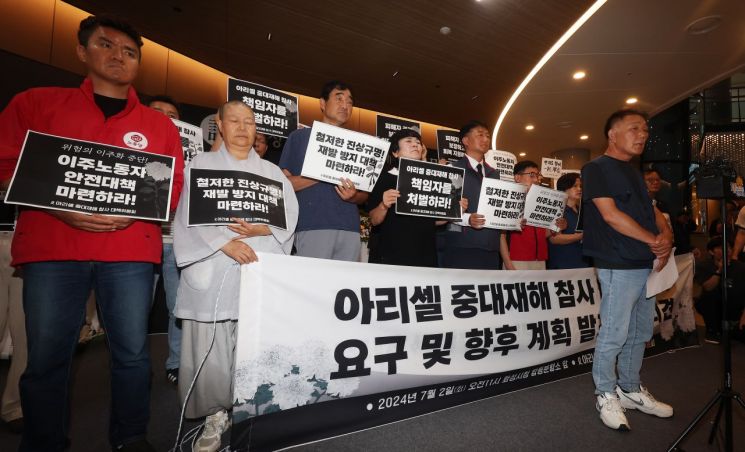 A press conference held by the Arisel Serious Accident Countermeasures Committee at the memorial incense altar for the Arisel factory fire accident last month at Hwaseong City Hall, Gyeonggi Province [Image source=Yonhap News]
In the case of the Hwaseong Arisel factory, there was an issue where it was excluded from inspection and supervision despite being a high-risk workplace. To improve this, the government will prioritize inspection of 200 high-risk fire and explosion workplaces that have not been inspected or supervised in the past three years. It plans to check the overall compliance with safety and health rules.
The government is also pursuing raising the recognition criteria for risk assessments and recovering industrial accident insurance premium reductions if a serious accident occurs within three years after recognition. Since companies participate in recognized risk assessment projects to receive industrial accident insurance premium reductions, this will prevent abuse while increasing participation in recognized projects.
Increase in Industrial Safety and Health Management Costs for Construction Safety
The measures also include support of up to 100 million KRW for installing firewalls and improving emergency exits for quick evacuation in case of fire. In the future, workplaces installing firewalls or hazardous material storage facilities can receive up to 100 million KRW. Workplaces improving visual ventilation to make emergency exits and evacuation routes easily recognizable will also receive up to 100 million KRW in support.
In the process of expanding safety investment in the construction industry, where many fatal accidents occur, industrial safety and health management costs will be increased by an average of 19% for the first time in 10 years. These costs are paid by the client and used for safety management. The current 60% self-payment rate will be abolished by 2026, and the government will bear the cost so that the increased industrial safety and health management costs can be used for purchasing or renting smart safety equipment.
Lee Jeong-sik, head of the Central Accident Response Headquarters (Minister of Employment and Labor), said, "This measure was prepared by incorporating the voices of various people on site to prevent tragic accidents like the Arisel Hwaseong factory fire from happening again. We will strive to raise the level of safety management on site in line with changing environments such as the increase of foreign workers and aging."
© The Asia Business Daily(www.asiae.co.kr). All rights reserved.


















