The Supreme Court has ruled that a waterworks cause-based charge can be imposed regardless of whether new water facilities have actually been newly established or expanded, if the cause for installing facilities that use a large amount of tap water, such as housing complexes or industrial facilities, has been provided.
According to the legal community on the 13th, the Supreme Court's First Division (Presiding Justice Kim Seon-su) overturned the lower court's ruling that had favored the plaintiff in the appeal case where Korea Land and Housing Corporation (LH) sued the mayor of Gangneung City to cancel the imposition of the waterworks cause-based charge, and remanded the case to the Seoul High Court.
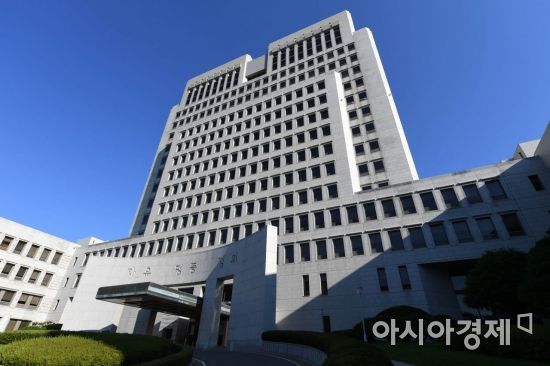
The court stated, "The lower court's judgment that the plaintiff could not be charged the cause-based charge stipulated in Article 4, Paragraph 1, Subparagraph 1 of the ordinance on the grounds that there was no new establishment or expansion of water facilities due to this project and that the facilities related to this project were within the defendant's existing water supply area misinterpreted the legal principles concerning Article 71, Paragraph 1 of the Waterworks Act and Article 4, Paragraph 1 of the ordinance," explaining the reason for overturning and remanding.
Article 71 (Cause-Based Charge), Paragraph 1 of the Waterworks Act stipulates that "A waterworks operator may require a person who causes the cost of waterworks construction (including those who install facilities that use a large amount of tap water, such as housing complexes and industrial facilities, thereby causing the establishment or expansion of water facilities) or a person who damages water facilities through business or acts to bear all or part of the necessary costs for the maintenance or prevention of damage of the waterworks and water facilities." This is the legal basis for imposing the cause-based charge.
Paragraph 2 of the same law states, "The standards for calculating and collecting the charge under Paragraph 1 and other necessary matters shall be prescribed by Presidential Decree," delegating the detailed matters to be stipulated in the enforcement decree.
Accordingly, Article 65 (Cause-Based Charge), Paragraph 1 of the Enforcement Decree of the Waterworks Act provides, "If a waterworks operator intends to require a person who causes the cost of waterworks construction under Article 71, Paragraph 1 of the Act to bear the cause-based charge, the operator must consult in advance with the person liable regarding the standards for calculating and payment methods of the charge under Article 71, Paragraph 2 of the Act. If no consultation is reached, the waterworks operator may determine the amount of the charge considering the cost of waterworks construction based on the amount of tap water used."
Paragraphs 3 and 5 of Article 65 of the enforcement decree regulate what costs are included in the cause-based charge. Paragraph 5 of the same article states, "The detailed standards necessary for calculating the costs under Paragraphs 3 and 5 shall be prescribed by the ordinance of the relevant local government," delegating the specific cost calculation to local ordinances.
LH began construction in May 2014 to build 624 national rental housing units in Hoesan-dong, Gangneung City, and completed the project in July 2016.
In August 2015, while the construction was ongoing, LH applied for water supply to Gangneung City, which imposed a cause-based charge of approximately 619 million KRW according to the "Ordinance on the Calculation and Collection of Waterworks Cause-Based Charges in Gangneung City." LH then filed a lawsuit requesting cancellation of the charge imposition, arguing that no new establishment or expansion of water facilities occurred due to the national rental housing construction project.
At that time, the relevant ordinance of Gangneung City classified the subjects of the cause-based charge into three categories in Article 4, Paragraph 1.
Gangneung City imposed the charge on LH under Subparagraph 1, which states, "A person who installs facilities that use a large amount of tap water, such as housing complexes and industrial facilities, causing water demand exceeding the water supply capacity of the waterworks operator, thereby causing the establishment or expansion of water facilities such as intake plants, water purification plants, reservoirs, booster stations, and transmission and distribution facilities, shall bear the corresponding construction costs."
Meanwhile, Subparagraph 3 of the same Article 4, Paragraph 1 stipulates that "When supplying tap water to buildings located within the water supply area, the construction costs of existing water facilities shall be borne by the users of the tap water (including cases where the facility capacity increases due to building extension or reconstruction, and in such cases, the charge shall be imposed only on the increased capacity)." This was also a target for charge imposition.
The issue in the trial was whether Gangneung City's imposition of the charge on LH under Article 4, Paragraph 1, Subparagraph 1 of the ordinance was lawful.
The first and second trials ruled in favor of LH, stating, "Since both parties do not dispute that no new or expanded water facilities were established due to the national rental housing construction project, the cause-based charge cannot be imposed based on this provision."
The court said, "There is no dispute between the parties that tap water is supplied through existing water facilities. Therefore, regardless of whether Subparagraph 3 can be applied to the plaintiff, the charge cannot be imposed based on Subparagraph 1," and added, "The defendant's imposition of the cause-based charge based on a misapplication of the relevant provision is illegal and must be canceled."
In other words, since LH's housing complex was formed within the existing water supply area and no new water facilities were constructed or expanded, there was room to impose the charge under Article 4, Paragraph 1, Subparagraph 3 of the ordinance, but imposing the charge based on Subparagraph 1 was deemed incorrect.
However, the Supreme Court's judgment was different.
The court first pointed out regarding the interpretation of Article 71, Paragraph 1 of the Waterworks Act, "Article 71, Paragraph 1 of the Waterworks Act stipulates that the cause-based charge can be imposed on those who cause the cost of waterworks construction, but it does not limit the imposition of the charge only to cases where immediate establishment or expansion of water facilities is necessary. Rather, it includes those who merely cause the establishment or expansion of water facilities by installing facilities that use a large amount of tap water, such as housing complexes and industrial facilities, thereby allowing the imposition of the cause-based charge even if immediate establishment or expansion of water facilities does not occur."
Furthermore, "According to Article 71, Paragraph 3 of the Waterworks Act, the waterworks cause-based charge is collected according to local government ordinances and incorporated into a special waterworks account, and can only be used for future construction costs such as establishment, expansion, relocation, reconstruction, and repair of water facilities," and "Article 4, Paragraph 1, Subparagraph 1 of the ordinance in this case can be seen as requiring the person who caused the establishment or expansion of water facilities to bear costs corresponding to future construction costs based on the 'corresponding construction costs.'"
Then, the court concluded, "Considering the wording and interpretation of Article 4 of the ordinance and Article 3 of the enforcement rules of the ordinance in this case in light of the above legal principles, even if immediate establishment or expansion of water facilities does not occur as in this case, if a facility that uses a large amount of tap water, such as a housing complex, is installed and only the cause of establishment or expansion of water facilities is provided, the cause-based charge under Article 4, Paragraph 1, Subparagraph 1 of the ordinance can still be imposed."
© The Asia Business Daily(www.asiae.co.kr). All rights reserved.

















