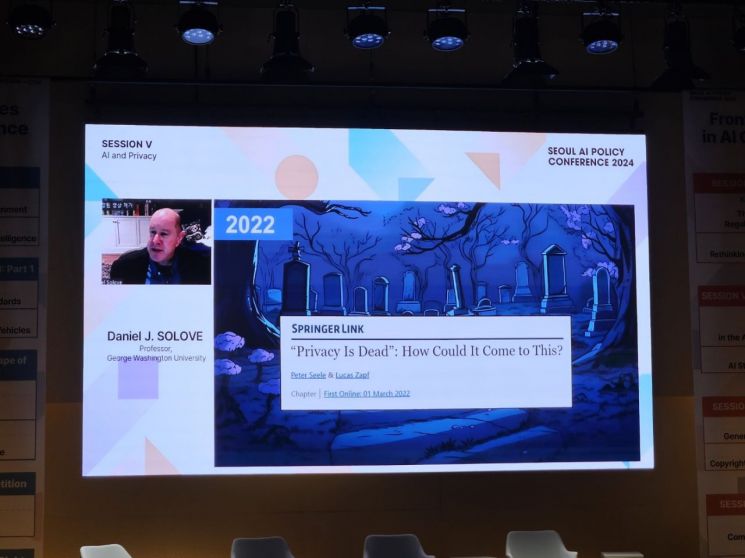
 Daniel Solove, a professor at George Washington University, is delivering the keynote speech at the 'Seoul AI Policy Conference 2024' on the 13th.
In a situation where technological evolution is occurring rapidly, such as with artificial intelligence (AI), there is a claim that the legal system regulating it needs to be flexible.
Professor Daniel Solove of George Washington University delivered a keynote speech on "Challenges of Regulating Privacy and AI" at the "Seoul AI Policy Conference 2024" hosted by Seoul National University on the 13th at Ferrum Tower in Jung-gu, Seoul. He explained, "While strict laws have the advantage of providing specificity in regulation, if they are too detailed, effective enforcement can become difficult."
He added, "It seems better to present broad principles such as prohibiting deceptive acts and unfair practices," and said, "I think the attitude that it is difficult to keep up because technology changes rapidly is not good. If based on principles such as fairness and social acceptance, the law can quickly catch up with technological development."
Professor Solove evaluated that it is desirable to start from minimum standards related to personal information protection and to establish standards through lawsuits and other means when problems arise in companies handling information.
He also expressed the opinion that while the introduction of laws to protect individual privacy in the AI era is necessary, it is important to avoid placing excessive burdens on individuals under the name of rights protection. He diagnosed, "It is problematic that individuals have to directly manage privacy-related rights and that this is specified in the law," adding, "Privacy notices related to personal information are becoming longer and are mostly too complex and extensive for people to understand."
He continued, "As AI spreads, related problems will inevitably increase exponentially, and it is almost impossible for individuals to properly assess and calculate risks," adding, "To meaningfully protect privacy rights, structural aspects must be considered, and people should not control their data themselves but have it managed by law."
The government also agreed with this perception. Yang Cheong-sam, Director of the Personal Information Policy Bureau at the Personal Information Protection Commission, said on the same day, "We believe it is possible to create a system that guarantees the rights of data subjects while allowing the development of new technologies," and added, "We have a two-step approach of creating guidelines based on a principle-based regulatory system and reflecting necessary changes in statutory law during the operation process."
© The Asia Business Daily(www.asiae.co.kr). All rights reserved.
![Clutching a Stolen Dior Bag, Saying "I Hate Being Poor but Real"... The Grotesque Con of a "Human Knockoff" [Slate]](https://cwcontent.asiae.co.kr/asiaresize/183/2026021902243444107_1771435474.jpg)
















