Yanghyeongwi, Recommends Increasing Sentencing Range for Fraud Crimes
The recommended sentencing range for fraud crimes will be increased to allow for a maximum sentence of life imprisonment when the gain from general fraud is 30 billion KRW or more, or when the gain from organized fraud is 5 billion KRW or more.
The mitigating factor of "when the victim sought high returns in a short period," which had previously reduced sentences, will be excluded from the sentencing factors, and the phrase "including deposit" will be removed from sentencing factors such as "substantial victim restitution" or "considerable victim restitution."
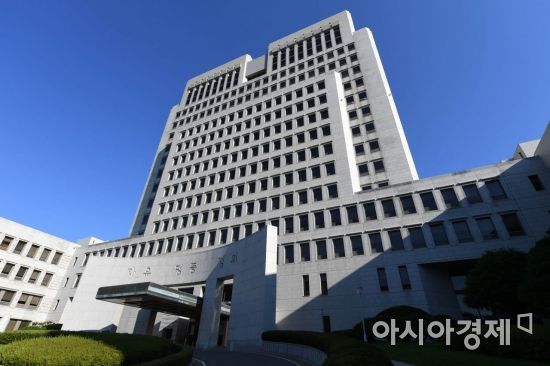
On the 13th, the Supreme Court Sentencing Commission (Chairman Lee Sang-won) announced that at the 133rd plenary meeting held the previous day, it reviewed and prepared a revised sentencing guideline for fraud crimes containing these changes.
The Sentencing Commission first raised the recommended sentencing range for fraud crimes to reflect changes in crime patterns and public perception due to social and economic changes. The Commission stated that it presented the recommended sentencing range after a comprehensive review of the existing sentencing guidelines, considering the inclusion of telecommunication financial fraud and insurance fraud crimes, changes in crime patterns, and public perception.
The Commission considered the statutory penalties under the Act on the Aggravated Punishment of Specific Economic Crimes, statistical data such as average sentences in sentencing practice, and the need for strict punishment for multi-victim fraud crimes and high-value fraud crimes that cause significant social harm, including jeonse fraud and telecommunication financial fraud. Accordingly, it raised the upper limits of the aggravated zones for general fraud and organized fraud with gains between 500 million KRW and less than 2 billion KRW, as well as the basic and aggravated zones for gains between 5 billion KRW and less than 30 billion KRW, and 30 billion KRW or more.
In particular, for crimes involving general fraud with gains of 30 billion KRW or more and organized fraud with gains between 5 billion KRW and less than 30 billion KRW, the upper limit of the aggravated zone was raised to 17 years, allowing for the possibility of life imprisonment through special adjustment in cases of severe offenses.
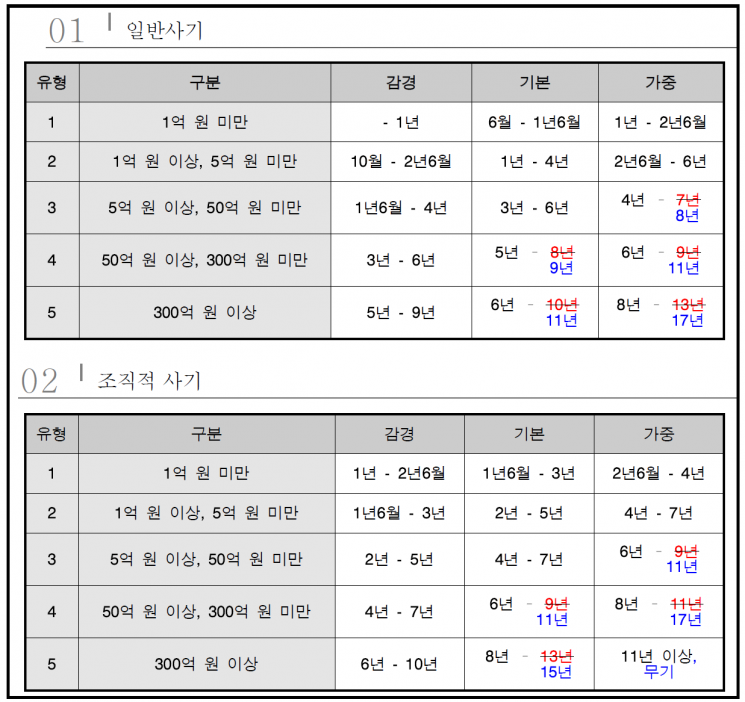
In addition to raising the recommended sentencing range for fraud crimes, the Sentencing Commission also prepared measures including ▲ narrowing the scope of special mitigating factors ▲ adding participation of professionals such as insurance workers as an aggravating factor ▲ revising sentencing factors related to deposits ▲ and strengthening probation criteria.
First, the definition of the special mitigating factor that reduces sentences for fraud crimes, "cases where the degree of deception is weak," was revised by deleting "cases of omission of disclosure obligations in insurance contracts."
The Supreme Court has stated, "The mere fact that an insurance contract was concluded in violation of the disclosure obligation does not necessarily mean there was intentional deception, and insurance fraud is established only when the essence of insurance is harmed, such as concluding a contract silently despite an insurance accident having already occurred."
Considering this Supreme Court precedent, the Sentencing Commission judged that even in cases of insurance fraud by omission through violation of disclosure obligations, it is difficult to uniformly consider the illegality lighter compared to active deception.
Additionally, the Commission excluded "cases where the victim sought high returns in a short period" from the definition of "cases where the victim also bears significant responsibility for the occurrence or expansion of the crime."
This is because, given the nature of fraud crimes that exploit human instinct to pursue higher profits, it is inappropriate to use the fact that the victim sought high returns in a short period as a reason for sentence reduction.
The Commission decided to add "cases where professionals such as insurance workers participated in the crime" as an aggravating factor. However, the specific method will be finalized after further research by the expert panel and additional review by the Commission.
Sentencing factors related to deposits were also revised. The Commission decided to remove the phrase "(including deposit)" from the mitigating factors "substantial victim restitution (including deposit)" and "considerable victim restitution (including deposit)."
Since deposits are merely a means of victim restitution, the phrase "(including deposit)" could be misunderstood as automatically qualifying for mitigation solely by deposit, which led to this decision.
Instead, a proviso was added to the definition of the mitigating factor "substantial victim restitution," stating, "However, in the case of deposits, it only applies when, after careful investigation and judgment of the victim's intention to receive the deposit and the defendant's intention to waive the right to claim the deposit, it corresponds to substantial victim restitution."
The existing definition states that "substantial victim restitution" means cases where the defendant has made sincere efforts to restore the damage to a degree equivalent to a settlement (in cases of purely property damage, about two-thirds or more of the damage amount) or where such restitution is assured.
The Commission explained the purpose as "clarifying that deposits are one of the means to restore damage, and requiring careful investigation and judgment of the victim's intention to receive the deposit and the defendant's intention to waive the right to claim the deposit when determining whether substantial victim restitution has been made."
Finally, the Commission strengthened the probation criteria for fraud crimes.
The Commission newly added "cases where the fraud crime was planned or directed by the offender" as a negative major mitigating factor for organized fraud types, and limited the positive major mitigating factor "cases where deception was committed with conditional intent" to apply only to general fraud types, which had previously applied to organized fraud types as well. This means that for leaders who planned or led organized fraud crimes, this will be considered an unfavorable sentencing factor, and deception committed with conditional intent will not be considered a favorable sentencing factor as it is for general fraud crimes.
The revised sentencing guidelines discussed this time will undergo public hearings and consultations with related agencies from January to February next year, and will be finally approved at the plenary meeting of the Sentencing Commission in March next year. The Commission noted that detailed sentencing guidelines may change until final approval.
At the 134th Sentencing Commission meeting scheduled for next month, the revised sentencing guidelines for crimes violating the Electronic Financial Transactions Act will be reviewed.
© The Asia Business Daily(www.asiae.co.kr). All rights reserved.


















