"Opposition Will Also Hesitate to Implement Next Year... Consensus Can Be Reached"
"Current Government's Tax Cut Policy Aims to Support Low-Income, Middle Class, and Investment Activation"
Choo Kyung-ho, floor leader of the People Power Party, argued that the financial investment income tax to be applied from next year should be abolished because it could bring uncertainty to the domestic securities market. He also said that he believes an agreement can be reached with the opposition party, which insists on pushing forward the financial investment income tax, to postpone its implementation next year.
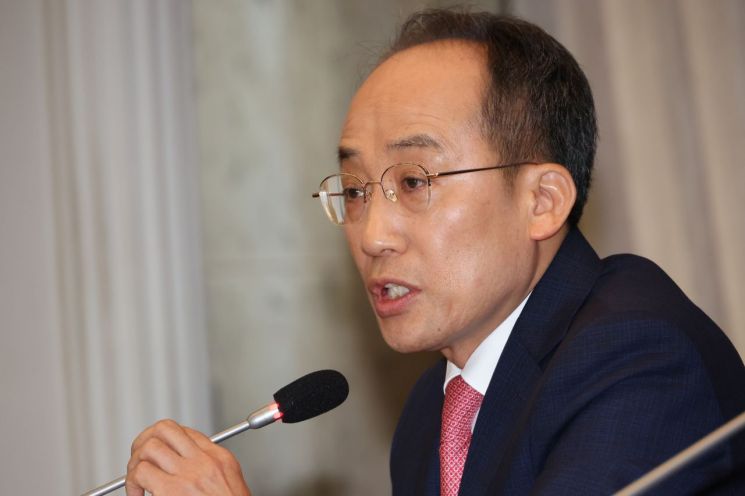
At a Kwanhun Club invitation debate on the 13th, Floor Leader Choo said, "I think it is right to abolish the financial investment income tax as promised in the presidential election pledge," adding, "The opposition party will probably hesitate to push forward the financial investment income tax next year." He continued, "The implementation next year is basically difficult, and I believe an agreement on this can be reached."
He emphasized, "The number of individual investors has exceeded 14 million, and the number of overseas stock investors has increased about tenfold over the past 6 to 7 years. If changes that affect investor behavior in the stock market occur, our already vulnerable stock market could face significantly increased volatility."
Regarding Park Chan-dae, floor leader of the Democratic Party, pointing out that the bill to establish the financial investment income tax was directly proposed by Floor Leader Choo, he responded, "I proposed it in 2019. At that time, since securities transaction tax and capital gains tax moved together, I proposed a method to impose tax where income exists. Even then, I thought the public still felt a heavy burden about imposing capital gains tax on stocks, and in the 21st National Assembly, considering structural changes in the market and difficulties, I did not propose it." He added, "The abolition of stock capital gains tax was also included in the presidential election pledge, and while serving as Deputy Prime Minister for Economy, I agreed with the abolition of the financial investment income tax, but a two-year grace period was agreed upon between the ruling and opposition parties."
When criticized for the Democratic Party's cash support law and questioned about pursuing tax cuts despite the national tax shortfall situation, he said, "The current administration has implemented so-called tax cut policies for the working class by applying low tax rates to the lower income brackets, investment tax credits to promote investment, and reforms to the comprehensive real estate tax. Parts like the comprehensive real estate tax are attacked as tax cuts for the wealthy, but the reform was also proposed by the Democratic Party. The Democratic Party said during local and presidential elections that the comprehensive real estate tax burden was excessive and should be lowered, but after the elections, they criticize it again as tax cuts for the wealthy."
Floor Leader Choo said, "The Democratic Party recently proposed large-scale tax credits for semiconductor investment through the Semiconductor Special Act," adding, "Tax cuts like these, which stabilize people’s livelihoods and expand future investments, are necessary." He continued, "Our country's corporate tax rate is significantly higher than the average of the Organization for Economic Cooperation and Development (OECD). The whole world is lowering corporate taxes to activate investment and attract foreign companies, and no international community calls corporate tax cuts tax cuts for the wealthy."
Floor Leader Choo explained, "Previous governments never raised corporate tax rates, and the only government that raised corporate tax was the Moon Jae-in administration," adding, "The current government's tax cut policies are mostly aimed at stabilizing livelihoods, supporting low-income groups, promoting future investment, and adjusting abnormal punitive taxation on the middle class."
© The Asia Business Daily(www.asiae.co.kr). All rights reserved.

![Clutching a Stolen Dior Bag, Saying "I Hate Being Poor but Real"... The Grotesque Con of a "Human Knockoff" [Slate]](https://cwcontent.asiae.co.kr/asiaresize/183/2026021902243444107_1771435474.jpg)















