Confirmed Cases Increase Ninefold in One Month in Summer 3-Mil Environments
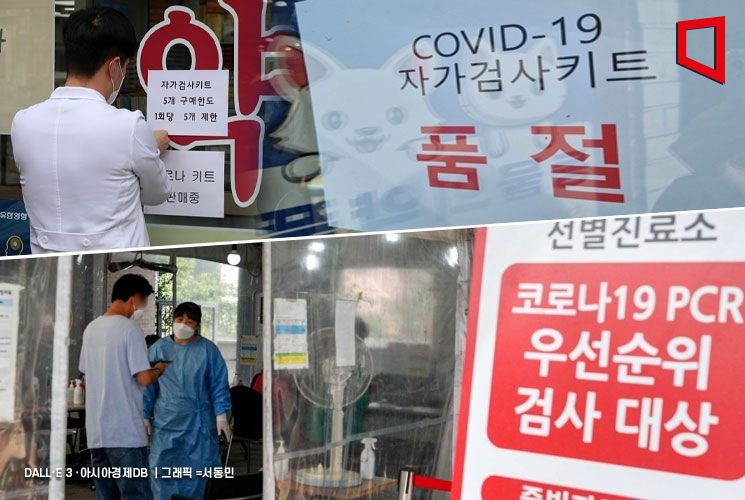
Shortages of Diagnostic Kits and Therapeutics Lead to Additional Purchases
Government Strengthens Task Force... Crisis Level Remains at 'Attention'
The number of patients hospitalized due to COVID-19 has increased nearly sixfold in a month, signaling a full-scale resurgence. This is the first time in 1 year and 3 months since the government declared COVID-19 'endemic' in May last year. Experts predict that confirmed cases will continue to rise in workplaces and schools from the end of this month, after summer vacations and students' school breaks, through early next month. However, health authorities plan not to issue additional guidelines such as quarantine mandates.
According to the Korea Disease Control and Prevention Agency (KDCA) on the 13th, the number of COVID-19 hospitalized patients in the first week of August was 861, the highest in six months since 875 in the first week of February. The number of hospitalized COVID-19 patients had been declining since early February but started increasing again from late June, recording 91 in the first week of July, 148 in the second week, 225 in the third week, and 465 in the fourth week, nearly doubling again within a week. Compared to the first week of July a month ago, this is a 9.5-fold increase. Notably, this figure is based on sample surveillance of 220 hospital-level medical institutions. Considering there are about 1,800 hospital-level medical institutions nationwide and mild cases that do not require hospitalization, the actual number of confirmed COVID-19 cases is much higher.
The medical community points to increased indoor activities due to summer heatwaves, decreased mask-wearing, and the use of air conditioning leading to poorly ventilated '3밀 (3M: crowded, close-contact, enclosed) environments' as causes of the COVID-19 resurgence. Additionally, a new variant KP.3, a successor to Omicron, has emerged in line with the 5-6 month COVID-19 epidemic cycle.
The Omicron variant is less severe than the Delta variant but has a higher transmission rate, causing rapid spread. Symptoms upon infection are similar to previous Omicron variants, including fever, cough, sore throat, and difficulty breathing. Compared to the existing JN1 variant, KP.3 has increased immune evasion capabilities, meaning previously infected individuals or vaccinated people can also be infected. This variant is currently spreading worldwide.
Experts believe that while the number of confirmed cases will continue to rise for the time being, this resurgence will not escalate into a pandemic. Health authorities also plan not to adjust the current infectious disease alert level, which is at the lowest 'interest' stage.
However, as COVID-19 resurges, diagnostic kits are rapidly depleting in the market, and some regions are even experiencing shortages of treatments like Paxlovid. Therefore, the government has initiated procedures to purchase additional treatments. Furthermore, the COVID-19 response system, which previously consisted of '1 division, 2 teams (total 18 people),' was significantly expanded yesterday to '1 division, 5 groups, 12 teams (total 71 people),' declaring an all-out response.
A KDCA official stated, "Apart from recommending isolation until 24 hours have passed after major symptoms such as cough and fever improve, no separate COVID-19 management guidelines will be issued. High-risk groups should maintain mask-wearing as a daily habit, and if general preventive measures are properly followed in daily life, there is no need to be excessively anxious."
© The Asia Business Daily(www.asiae.co.kr). All rights reserved.
![Clutching a Stolen Dior Bag, Saying "I Hate Being Poor but Real"... The Grotesque Con of a "Human Knockoff" [Slate]](https://cwcontent.asiae.co.kr/asiaresize/183/2026021902243444107_1771435474.jpg)
















