If Dominating the Disease Market, Sales Jump 5.5 Times
Sequential Treatment Followed by Chemotherapy Shows Greater Effectiveness
Lung Cancer Responds to J&J with ADC in 'Reclaza Combination'
Breast Cancer Challenges Roche's Dominance with 'Enhertu' Leading the Way
Global big pharma companies are engaged in a fierce battle for dominance in the anticancer drug market. Pharmaceutical companies are emerging with new drugs to challenge the current market leader, while the reigning company is introducing other new drugs to retain its throne. Korean pharmaceutical companies are also participating in this virtuous cycle of competition.
According to an analysis by DS Investment & Securities on the 13th, when a pharmaceutical company dominates the market for a particular disease treatment, related sales increase by 5.5 times, and the product development success rate rises by 70%. This effect occurs because follow-up investments are made to maintain the market share of the treatment, resulting in steady sales growth. This success formula is especially prominent in the anticancer drug market. When a treatment method is established where a pharmaceutical company sequentially administers various drugs it owns for a certain cancer?from first-line to second- and third-line treatments?a 'treatment fortress' is built around that cancer.
J&J Challenges with 'Rekaza'... AZ Responds with ADC Development
The company that has emerged as the winner in the anticancer drug market is AstraZeneca (AZ) in lung cancer. Its weapon is Tagrisso, which recorded sales of $5.8 billion (about 8 trillion KRW) last year. AZ has announced a goal to treat more than half of lung cancer patients worldwide with its anticancer drugs.
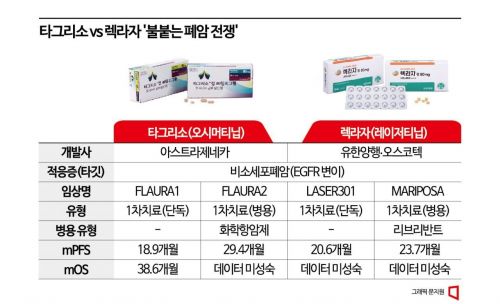
In response, Johnson & Johnson (J&J) threw down the gauntlet. J&J devised a strategy to secure stronger efficacy than Tagrisso by combining its own lung cancer drug, Rybrevant, with Yuhan Corporation’s lung cancer drug, Rekaza. The combination therapy succeeded in clinical trials by achieving a longer median progression-free survival (mPFS) than Tagrisso. Progression-free survival refers to the period during which patients receiving anticancer drugs survive without further cancer progression. J&J projected annual sales of over $5 billion (about 7 trillion KRW) for this combination therapy. The U.S. Food and Drug Administration (FDA) is expected to announce its approval decision for the combination therapy by the 22nd.
To block the challenge from the J&J-Yuhan alliance, AZ has embarked on developing new drugs. Last month, it acquired targeted protein degradation (TPD) candidate substances from Pine Tree Therapeutics. Pine Tree is a biotech company founded in the U.S. in 2019 by CEO Song Ho-jun, who participated in the development of Yuhan’s Rekaza.
AZ and J&J are recently exchanging blows in the development of new lung cancer drugs using antibody-drug conjugates (ADC), the new mainstream in global anticancer drugs. Here, our bio company LigandChem Bio has formed an alliance with J&J. First, AZ sounded the trumpet by developing an ADC drug targeting the Trop2 protein expressed in lung cancer cells. In response, J&J sounded the drum by acquiring an ADC targeting Trop2 from LigandChem Bio last December for up to $1.7 billion (about 2 trillion KRW).
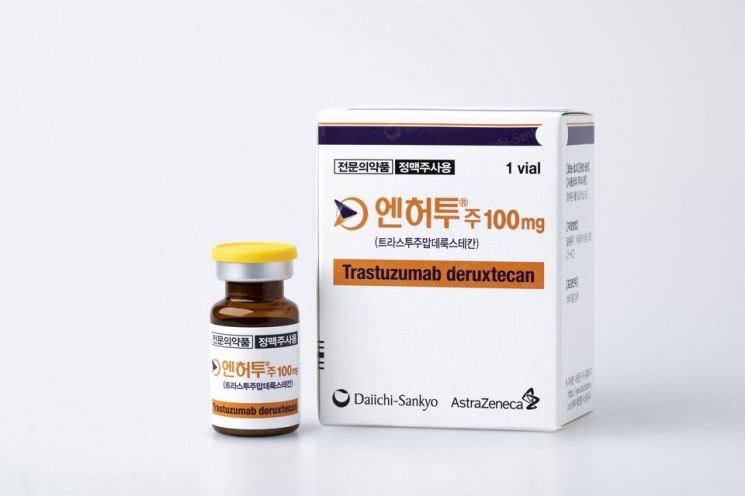 AstraZeneca-Daiichi Sankyo's antibody-drug conjugate (ADC) 'Enhertu' (generic name: trastuzumab deruxtecan)
 [Photo by Daiichi Sankyo Korea]
Meanwhile, AZ is in the challenger position in the breast cancer market. Its weapon is Enhertu, which is leading the ADC craze in the anticancer market. Developed jointly by AZ and Daiichi Sankyo, Enhertu shows excellent efficacy in HER2-mutant positive breast cancer, which occurs in 20% of breast cancer patients. It is expected to generate global sales exceeding $11 billion (about 15 trillion KRW) by 2030.
Originally, HER2-positive breast cancer treatments were dominated by Swiss pharmaceutical company Roche. Roche is a traditional powerhouse that developed drugs effective against this mutation, such as Herceptin and Perjeta. However, its ADC treatments are faltering due to side effect issues. Analysts suggest that AZ, with Enhertu, could seize the throne in this gap. However, other big pharma companies like Pfizer, BioNTech, and J&J have recently begun entering this field by directly acquiring ADC developers, signaling a competitive era akin to the Warring States period.
© The Asia Business Daily(www.asiae.co.kr). All rights reserved.



















