Professor Lim Dojin's Research Team Publishes Paper in 'Sensors and Actuators B: Chemical'
The research on a novel dispensing system conducted by the research team of Professor Lim Dojin (Department of Chemical Engineering) at Pukyong National University has been published in a top-tier international journal.
The paper, titled 'Syringe pump-embedded, on-demand sample supply and collection system for droplet 3D cell culture in digital microfluidics,' describes the development of a sample supply and collection device using a solenoid pump independently developed by Professor Lim Dojin's team. This study was recently published in an international academic journal (IF 8.0).
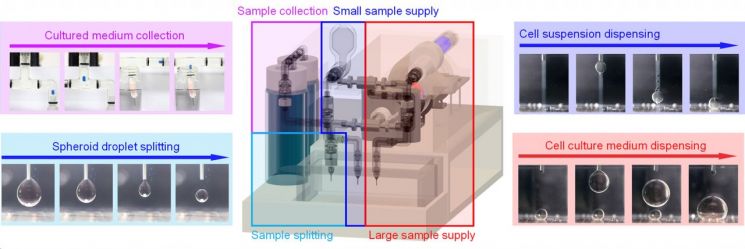 Demonstration images of the entire process of droplet-based 3D cell culture using the developed dispensing system.
This international journal is ranked first among 76 journals in the field of Instruments & Instrumentation.
The research team led by Professor Lim Dojin developed a dispensing system capable of performing various functions such as sample supply, splitting, and collection with a single device using a compact solenoid pump of their own design. Using this system, they demonstrated all processes of droplet (very small and round droplets) 3D cell culture.
Currently, various dispensing technologies are used to supply droplets to cell culture devices, but the use of a precise syringe pump is inevitable for supplying samples at a constant volume and speed. However, most syringe pumps are bulky, making miniaturization of the system difficult, and they lack a collection function, which requires the construction of a complex system for applications in the biological field.
Bae Seojun, the first author of this research paper and a doctoral student, applied a simple method of supplying samples by inserting a sample chamber instead of filling a syringe for sample supply, thereby solving the problem of dead volume that inevitably occurs when using syringes.
He said, "By combining the newly developed dispensing device with the excellent droplet manipulation technology of digital microfluidics, we expect this will help to utilize the characteristics of digital microfluidic technology more effectively in various studies requiring automation, such as organoid culture."
This research was carried out with the support of the Mid-career Researcher Program (NRF-2021R1A2C1011723) of the National Research Foundation of Korea.
© The Asia Business Daily(www.asiae.co.kr). All rights reserved.
![Clutching a Stolen Dior Bag, Saying "I Hate Being Poor but Real"... The Grotesque Con of a "Human Knockoff" [Slate]](https://cwcontent.asiae.co.kr/asiaresize/183/2026021902243444107_1771435474.jpg)











