Bank Household Loans Increase by Over 5 Trillion Won Following Previous Month
Significant Expansion of Mortgage Loans Due to Rise in Housing Transactions
Possibility of Continued Household Loan Growth in Near Term
As the trend of increasing housing transactions continues, household loans at commercial banks in July maintained an increase of over 5 trillion won, mainly driven by mortgage loans.
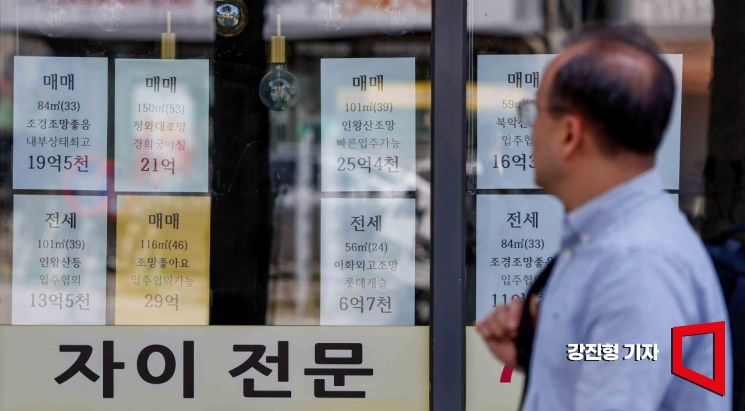 Apartment prices are fluctuating across Seoul. According to the weekly apartment price trends from the Korea Real Estate Board, Seoul housing prices have risen for 11 consecutive weeks from the fourth week of March until last week. Now, areas such as Nowon, Dobong, and Gangbuk, which had lagged behind Gangnam, have also turned to an upward trend. The 84㎡ exclusive area apartment in Gyeonghuigung Xi, considered the "flagship apartment" of northern Seoul, was traded for 2.15 billion KRW on the 30th of last month (based on actual transaction prices from the Ministry of Land, Infrastructure and Transport). This is an increase of 200 million KRW compared to January (1.95 billion KRW). The photo shows a price information board for apartment sales and jeonse near Gyeonghuigung Xi apartments in Jongno-gu, Seoul, on the 12th. Photo by Kang Jin-hyung aymsdream@
According to the 'Financial Market Trends in July 2024' report released by the Bank of Korea on the 12th, the outstanding balance of household loans at banks (including policy mortgage loans) stood at 1,120.8 trillion won at the end of last month, an increase of 5.5 trillion won compared to the previous month. This marked a continued increase in the 5 trillion won range following the previous month’s 5.9 trillion won. Bank household loans have been rising for four consecutive months since a temporary decline of 1.7 trillion won in March this year.
The expansion of bank household loans was led by mortgage loans. The outstanding balance of mortgage loans last month was 882.5 trillion won, up 5.6 trillion won from the previous month, continuing a significant increase following the previous month’s 6.2 trillion won rise. Mortgage loans have been increasing for 17 consecutive months since March last year.
Park Min-cheol, Deputy Head of the Market General Team at the Bank of Korea’s Financial Market Department, explained, "The continuation of the 5 trillion won increase in bank household loans in July, following the previous month, is due to the rise in housing transactions centered on apartments in Seoul since May, which with a time lag, led to the execution of mortgage loans."
The Bank of Korea forecasted that the increase in household loans could expand further. Deputy Head Park said, "Household loans have been managed at a stable level within the nominal Gross Domestic Product (GDP) growth rate so far," adding, "Considering the current trend, the volume of apartment transactions in Seoul is expected to increase further. Since housing transactions lead to mortgage loan executions with a two to three month time lag, there is a possibility that the increase in household loans will expand for the time being."
The outstanding balance of other loans, which include unsecured loans, commercial real estate mortgage loans, and stock-backed loans, was 237.3 trillion won, showing a slight decrease of 100 billion won following a 300 billion won decline in the previous month.
The outstanding balance of corporate loans at banks in July was 1,304.7 trillion won, an increase of 7.8 trillion won compared to the previous month. This increase was larger than the 5.3 trillion won rise in the previous month. Loans to large corporations increased by 4.4 trillion won compared to the previous month due to reissuance of temporary repayments at the end of the half-year, expanding the increase. Loans to small and medium-sized enterprises (SMEs) continued to rise due to some banks strengthening corporate loan operations and demand for value-added tax payments on the 25th of last month. However, the increase narrowed to 3.4 trillion won compared to the previous month as repayment of settlement funds was deferred to early July due to holidays at the end of June.
Deputy Head Park evaluated, "Given the significant external uncertainties in the second half of the year, companies are not expected to raise large-scale funds as they did in the first half. As companies have largely met their business targets in the first half, if their business approach becomes more cautious in the second half, corporate loans are expected to show a moderate trend like now."
Regarding the impact of the interest rate hikes on Didimdol Loans and Beotimok Loans, which will take effect from the 16th, he said, "Policy loans from the Korea Housing Finance Corporation have been steadily supplied at levels consistent with the trends in May and June. Since the interest rates remain more attractive than market rates, we do not expect a significant change in the trend."
On the impact of the postponement of the second phase implementation of the stress-based Debt Service Ratio (DSR), which was scheduled for July, he explained, "The basic purpose of the introduction is to restrain the increase in household loans, so it is expected to work accordingly. However, the effect may vary depending on whether the loan products are variable or fixed rate, and what types of products are launched."
© The Asia Business Daily(www.asiae.co.kr). All rights reserved.
!["The Woman Who Threw Herself into the Water Clutching a Stolen Dior Bag"...A Grotesque Success Story That Shakes the Korean Psyche [Slate]](https://cwcontent.asiae.co.kr/asiaresize/183/2026021902243444107_1771435474.jpg)
















