'Revised Innovation City Industry-Academia-Research Cluster Management Manual'
Uniform Regulation on Cluster Location Standards → Local Government Autonomy
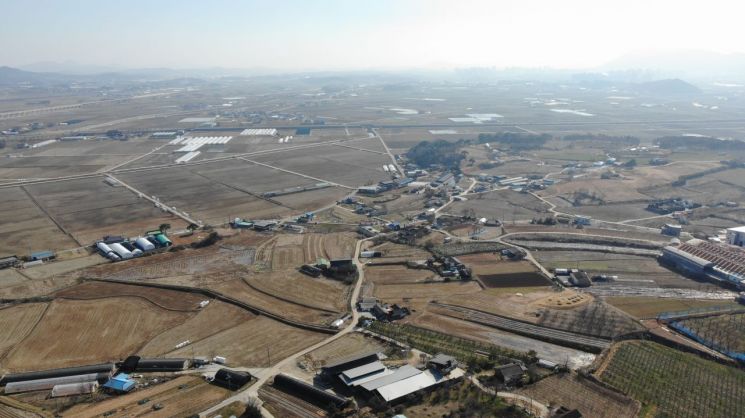 The planned site for the Naepo Bio-Agro Convergence Cluster project in Sapgyo-eup, Yesan-gun, Chungnam.
 [Photo by Yonhap News]
Employees of tenant companies at an industry-academia-research cluster site in an innovation city in Chungbuk send their children to a daycare center located far from the cluster every morning. Although there were requests to establish a daycare center within the site, current regulations classify daycare centers as child-related facilities, which are not allowed to be established there.
Going forward, local governments will be able to autonomously set location standards for industry-academia-research cluster facilities in innovation cities, allowing daycare centers to be established. These regulations will apply to 10 clusters nationwide.
The Ministry of Land, Infrastructure and Transport announced on the 10th that it revised the "Innovation City Industry-Academia-Research Cluster Management Manual" to include these changes, which have been in effect since the 9th.
The innovation city cluster sites were uniformly restricted in building usage according to the Ministry’s "Facility Location Standards Guidelines." The Ministry designated and operated 14 permitted building uses and 11 prohibited uses, and for facilities not specified, the Innovation City Development Committee decided on tenancy through review.
The Ministry plans to shift from uniform regulation of these location standards to a more autonomous approach to encourage building occupancy that fits the characteristics of each innovation city. Accordingly, the manual was revised to allow local governments to determine permitted building uses.
In particular, child-related facilities such as daycare centers linked to the welfare of tenant company employees have been relaxed to be permitted. However, construction of lodging and entertainment facilities that do not align with the purpose of the cluster remains prohibited as before.
The change in the cluster management manual comes as the cluster’s sales rate is 82%, but the occupancy rate is only about 53%. This low occupancy compared to sales led to calls for guidelines that can be flexibly applied according to each innovation city.
With this relaxation of location standards, support facilities such as education, culture, sports, and tourism rest facilities suitable for innovation cities can be established. Expansion of neighborhood living facilities will also be possible.
Jung Yang-gi, Director of the Innovation City Industry Division at the Ministry of Land, Infrastructure and Transport, said, "We will continue to improve regulations to revitalize corporate attraction so that the industry-academia-research clusters become growth hubs leading regional development in innovation cities."
© The Asia Business Daily(www.asiae.co.kr). All rights reserved.
![Clutching a Stolen Dior Bag, Saying "I Hate Being Poor but Real"... The Grotesque Con of a "Human Knockoff" [Slate]](https://cwcontent.asiae.co.kr/asiaresize/183/2026021902243444107_1771435474.jpg)
















