20th Anniversary Transformation Project
Next Week, Crosses US Continent to Scout Star Professors
Practical Staff Training with New Graduate School of Engineering... 'ABB Campus' Site Secured
Expanding Both Internally and Externally to Overcome Smallest Scale Among 4 Major Science Institutes
Lee Geon-woo, President of Daegu Gyeongbuk Institute of Science and Technology (DGIST), stated on the 9th, "We will attract star professors of Son Heung-min caliber to raise international recognition." This is a grand ambition to transform DGIST into a school on par with the Massachusetts Institute of Technology (MIT), transcending the regional limits of Daegu Gyeongbuk and Korea.
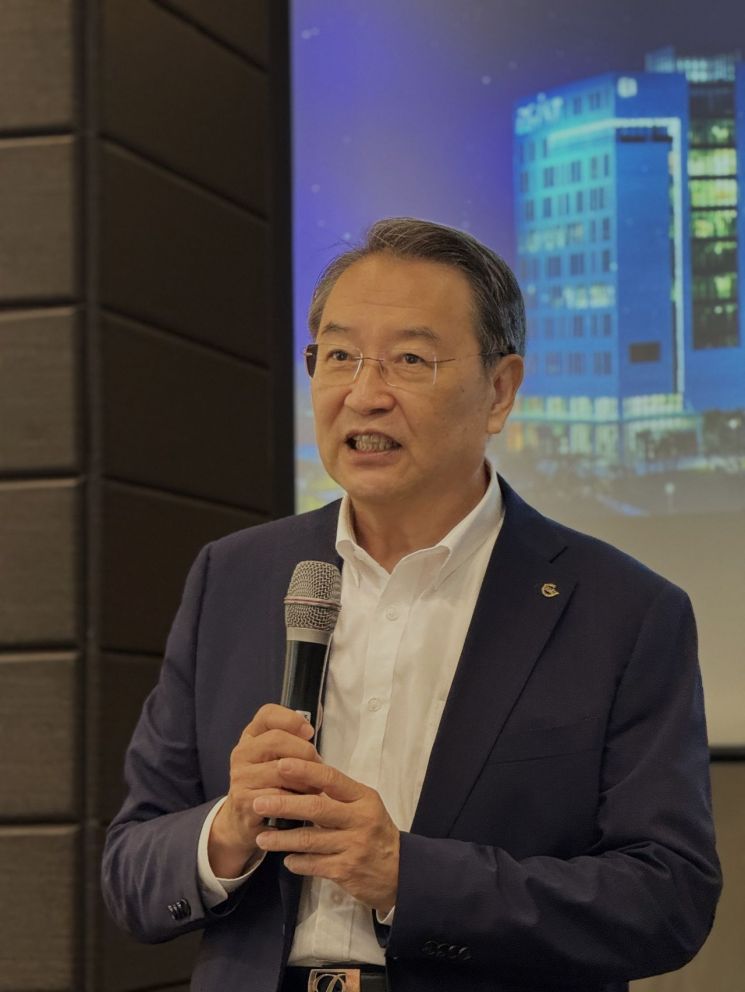
On the same day, President Lee held a press conference at a restaurant in Jongno-gu, Seoul, saying, "Starting next week, I plan to tour the United States to recruit world-class scholars." He mentioned that through a schedule spanning from the East Coast to the West Coast of the U.S., including MIT, Arizona State University, Stanford University, and California Institute of Technology, he will contact professors in pre-selected fields. When asked who the pre-selected professors are and what fields they specialize in, he requested understanding, saying, "It would not help negotiations," and declined to disclose further details.
President Lee, formerly a professor in the Department of Mechanical Engineering at Seoul National University, took office as the 5th president of DGIST on December 20 last year. Marking nine months since his inauguration, he is embarking on a full-fledged effort to bring change to DGIST. His judgment is that to transform DGIST, the smallest among the four science and technology institutes, the level of personnel composition must be changed first. His strategy is that star-level professors can elevate the school's standards.
He said, "Even abroad, top universities bring in star professors to significantly boost performance in lagging fields. Initially, we will target foreigners and plan to link recruitment with inviting campus directors of the Institute for Basic Science (IBS)."
President Lee announced plans to increase diversity by making one-third of the members foreigners and to operate with 390 full-time faculty and researchers, which is 100 more than the current number.
He said, "We requested an increase of 44 personnel next year, and if government funding is difficult, I asked to allow recruitment using our own budget."
Although the science and technology institute was deregulated from a public institution last year, President Lee pointed out that no significant measures have been taken since, leaving them bound by the total wage system. However, he added that additional costs incurred when inviting star-level professors can be excluded from the total wage system.
President Lee emphasized the importance of DGIST’s external expansion as it marks its 20th anniversary this year. He mentioned that at the current level, it is even difficult to find a contractor to operate the campus cafeteria. To address this, next year DGIST will open a Graduate School of Engineering in Gumi, Gyeongbuk, selecting local industry practitioners as professional master's students. He also revealed that land has been secured to build an 'ABB (AI, Big Data, Blockchain) Campus' in the National Digital Innovation Complex (Suseong Alpha City) currently being promoted in Suseong-gu, Daegu.
Additionally, to cultivate medical scientists, DGIST plans to open a Department of Biomedical Engineering that offers master's and doctoral programs for students who have graduated from undergraduate programs or are medical doctors. They also intend to establish a business school modeled after the Sloan School of Management at MIT. He explained that they are also pursuing the establishment of a gifted school to nurture scientific talent in the region, alongside KAIST and GIST.
President Lee said, "DGIST is the smallest in scale and faces many disadvantages in competition, so we have focused on this. For internal strengthening, we plan to create a Future Strategy Discovery Committee to set flagship research themes and propose leading projects from the bottom up."
© The Asia Business Daily(www.asiae.co.kr). All rights reserved.

















