2024 Q2 Earnings Results
Wireless Communication Market is Virtually Saturated
Corporate Infrastructure and Service Business Drive Performance
The performance announcements for the second quarter (April to June) of this year by the three major mobile carriers have concluded. As the wireless communication market has entered a stagnation phase, growth in the enterprise services sector, including data centers, influenced the second quarter results. While all three companies expressed their goal to transform into AI companies, SK Telecom was the only one to report an increase in operating profit compared to the previous year.
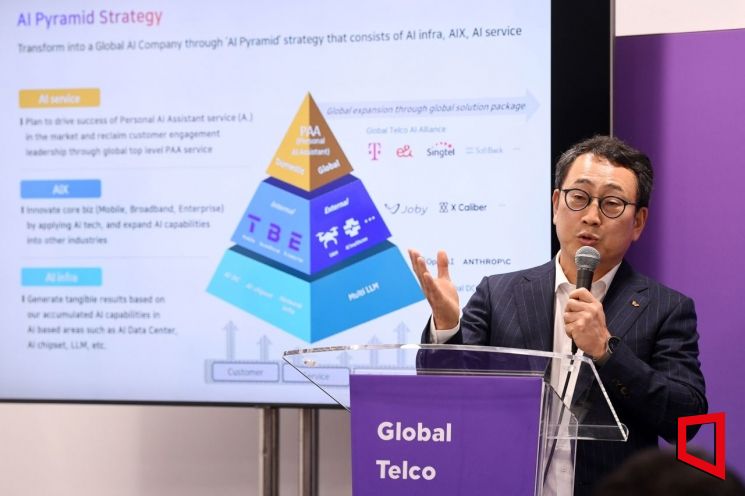 Yu Young-sang, CEO of SK Telecom, is speaking at a CEO press briefing held on the 26th (local time) at the Fira Gran Via exhibition center in Barcelona, Spain, where Mobile World Congress (MWC) 2024 is taking place. Photo by Joint Press Corps
SK Telecom announced on the 6th that it recorded sales of 4.4224 trillion KRW and an operating profit of 537.5 billion KRW in the second quarter of this year. Sales and operating profit increased by 2.7% and 16.0%, respectively, compared to the same period last year.
With the accelerated application of AI technology across all industries, data center utilization rates increased and cloud orders grew, resulting in enterprise business sales rising 11% year-on-year to 434.2 billion KRW. In particular, the data center business achieved a 20.5% sales growth compared to the same period last year due to continuous increases in utilization rates. Among the enterprise sectors, the Internet of Things (IoT) business recorded a 29% increase in sales year-on-year.
SK Telecom is laying the groundwork to leap forward as a global AI company by investing 10 million USD in Perplexity, a generative AI search specialist, and 200 million USD in SGH, a US-based AI data center integrated solutions company. In the second half of the year, the company plans to focus on building an AI value chain and securing competitiveness. It will target not only the domestic but also the overseas AI data center markets.
SK Telecom's 5G subscriber base reached 16.23 million, a 10.6% increase compared to the same period last year, but the total handset subscribers decreased by 1.5% year-on-year to 22.85 million, indicating that the wireless communication market has entered a stagnation phase.
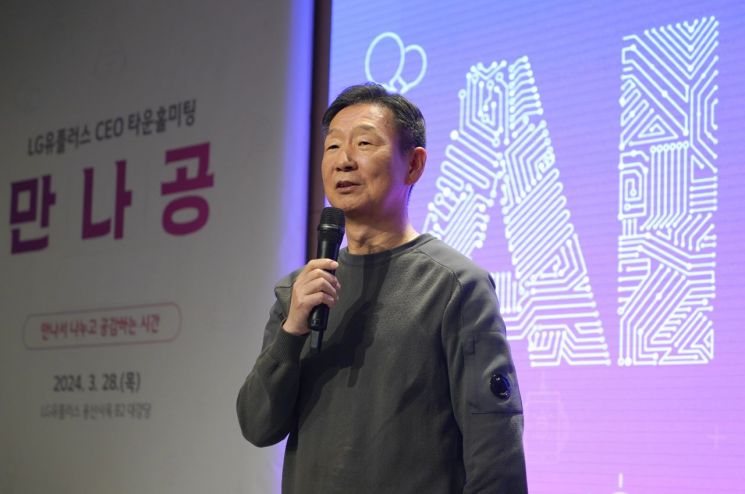 Hwang Hyun-sik, CEO of LG Uplus, is speaking at a town hall meeting held for employees. [Image source=Yonhap News]
LG Uplus announced on the 7th that its consolidated sales for the second quarter increased by 1.9% to 3.4937 trillion KRW. Service revenue, excluding device sales, rose 1.6% year-on-year to 2.9439 trillion KRW.
Operating profit, however, fell 11.8% year-on-year to 254 billion KRW. LG Uplus explained that this reflected amortization expenses related to the construction of a new integrated IT system. Amortization of intangible assets was 109.4 billion KRW, up 27.8% from the second quarter of last year. Labor costs, part of operating expenses, also increased by 12% to 493.9 billion KRW.
Wireless business sales increased by 1.0% year-on-year to 1.5926 trillion KRW, but handset subscribers decreased by 1.2% to 10.94 million.
Enterprise infrastructure segment sales, which include data centers, solutions, and corporate lines, rose 5.4% year-on-year to 431.5 billion KRW. The internet data center business posted the highest growth within the enterprise infrastructure segment, with sales increasing 15.0% year-on-year to 91.7 billion KRW in the second quarter.
Last month, LG Uplus announced a mid-to-long-term B2B growth strategy to accelerate revenue growth centered on AI transformation by advancing 'AI application services' through technological innovation in three key areas: infrastructure, platform (generative AI), and data.
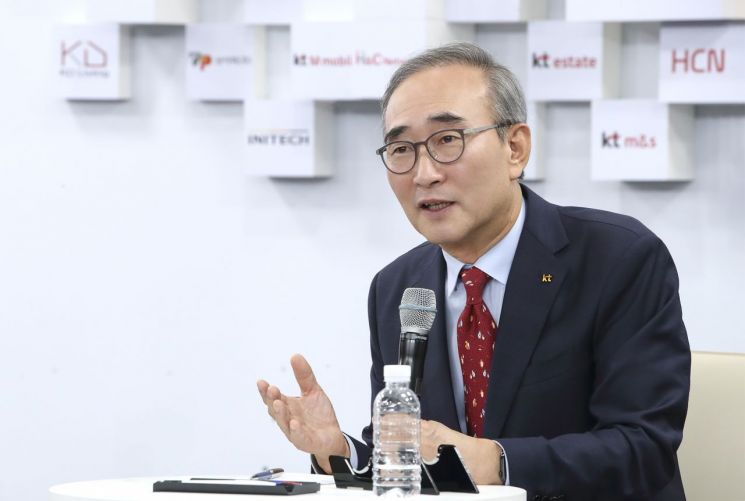
KT also posted a disappointing performance with a double-digit decline in operating profit. KT announced on the 9th that its consolidated operating profit for the second quarter was 494 billion KRW, down 14.3% year-on-year. Factors affecting this included increased labor costs, decreased revenue in the wired business, and poor performance of major KT group affiliates.
Regarding the decline in operating profit, KT explained that costs related to wage negotiations were reflected. Labor costs in operating expenses for the second quarter were 1.2132 trillion KRW, a 7.2% increase compared to the second quarter of last year. Excluding 64.4 billion KRW in costs related to the wage negotiation results, consolidated operating profit decreased by 3.1% year-on-year, while separate operating profit increased by 3.9%.
Wireless business sales increased by 2.5% year-on-year to 1.7651 trillion KRW, whereas wired businesses such as internet and media recorded a 0.3% decrease to 1.3166 trillion KRW. Home wired phone sales dropped 7.8%, and IPTV subscribers decreased to 9.423 million from 9.47 million in the second quarter of last year.
Among enterprise services, sales from five growth businesses?AI customer centers, Internet of Things (IoT), smart mobility, smart spaces, and energy?grew 10.3% year-on-year to 96 billion KRW.
To transform into an AICT company, KT signed a strategic partnership with Microsoft (MS) in June. KT plans to collaborate comprehensively with MS in AI, cloud, and IT fields.
© The Asia Business Daily(www.asiae.co.kr). All rights reserved.



















