18g Steel from the Eiffel Tower Embedded in Medal
Surface Corrosion on Front and Back of Paris Olympic Medal
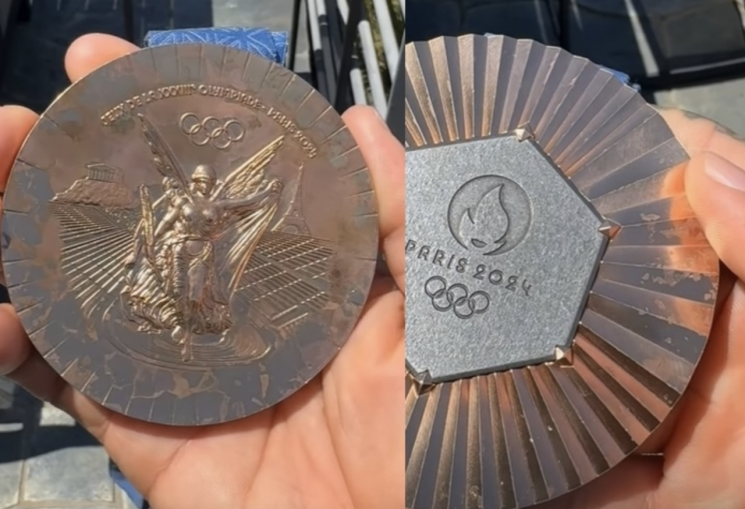 On the 8th (local time), the British Telegraph reported that Najah Houston (USA), the Olympic men's skateboarding street bronze medalist, posted a photo of his bronze medal with a damaged surface on his Instagram (SNS) that day.
 [Photo by Najah Houston]
On the 8th (local time), the British Daily Telegraph reported that Najia Houston (USA), the Olympic men's skateboarding street bronze medalist, posted a photo of the damaged bronze medal on her Instagram. In the video Houston posted on her Instagram story, the front surface of the bronze medal she received appeared corroded and peeled, with much of the bronze color gone and turned grayish.
The back showed scratches and peeling around the edges. The men's skateboarding street final was held on the 29th of last month. Houston said, "Olympic medals look great when they are new, but after briefly touching my sweaty skin and hanging it around my friends' necks, it ended up like this." She added, "The quality of the (Olympic) medal doesn't seem as high as expected. The medal looks like it came back from a war."
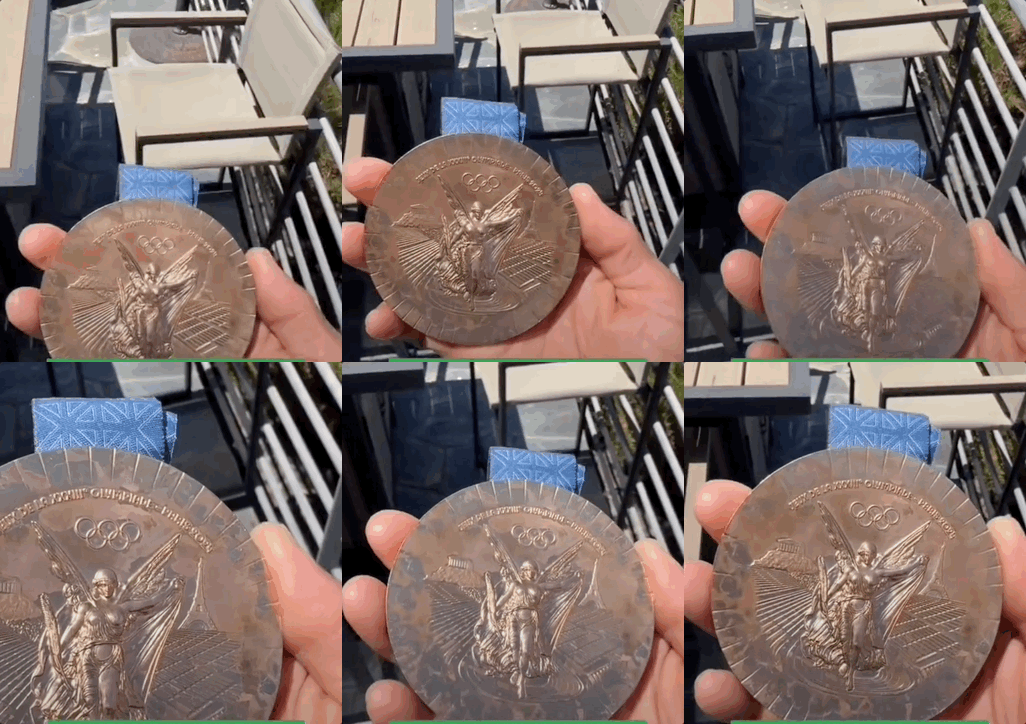 Naija Houston, the bronze medalist in men's skateboarding street at the 2024 Paris Olympics, revealed her damaged bronze medal on her social media (SNS) just ten days after receiving it. The front side appears corroded with some of the bronze color peeled off (left), and the back side has scratches and peeling on the edge surface.
 [Photo by Naija Houston on Instagram]
During the 2016 Rio de Janeiro Olympics, there were also refund requests due to corrosion problems with medals. At that time, Mario Andrade, an official from the Rio Olympic Organizing Committee, stated, "It appears that 6-7% of all medals have issues," and added, "We are exploring ways to exchange the corroded medals with the International Olympic Committee (IOC)." The corrosion problem occurred with bronze medals and was predominantly found in over 130 bronze medals used in the Rio Olympics and Paralympics, sparking controversy.
Meanwhile, the Paris Olympic medals, designed by the French luxury jewelry brand CHAUMET, feature a hexagonal steel piece on the back, sourced from French territory regardless of the medal color. This steel was cast from 18 grams of steel collected during the maintenance of the Eiffel Tower in Paris. The front side features the common design mandated by the International Olympic Committee (IOC), including the winged goddess of victory, Nike, flying from the Panathenaic Stadium in Greece, with the Eiffel Tower engraved in the upper right corner. The medal weights are 529g for gold (6g of gold), 525g for silver, and 455g for bronze. The diameter is 85 mm with a thickness of 9.2 mm.
© The Asia Business Daily(www.asiae.co.kr). All rights reserved.
![Clutching a Stolen Dior Bag, Saying "I Hate Being Poor but Real"... The Grotesque Con of a "Human Knockoff" [Slate]](https://cwcontent.asiae.co.kr/asiaresize/183/2026021902243444107_1771435474.jpg)

















