Food Exports Reach 6.22 Billion in H1, Up 5% YoY
Processed Foods Like Ramen Lead Exports
Traditional Foods Such as Kimchi and Gochujang Also Show Growth
Calls for New Items Like Frozen Gimbap

Despite recent challenging external conditions, the popularity of K-food based on K-content is spreading worldwide, with export value exceeding $6 billion in the first half of this year. While processed foods such as ramen showed remarkable growth, there are calls for discovering new export items through improvements to existing products to further expand exports in the future.
According to the agricultural and food export information from the Korea Agro-Fisheries & Food Trade Corporation on the 10th, the export value of agricultural, forestry, and fishery food products in the first half of this year was $6.2187 billion (approximately 8.521 trillion KRW), a 4.7% increase compared to the same period last year ($5.9416 billion). Exports of fresh foods ($697.1 million) and seafood products ($1.5151 billion) decreased by 3.4% and 0.3% respectively compared to the previous year, but processed foods led export growth with $4.066 billion (approximately 5.492 trillion KRW), an 8.3% increase.
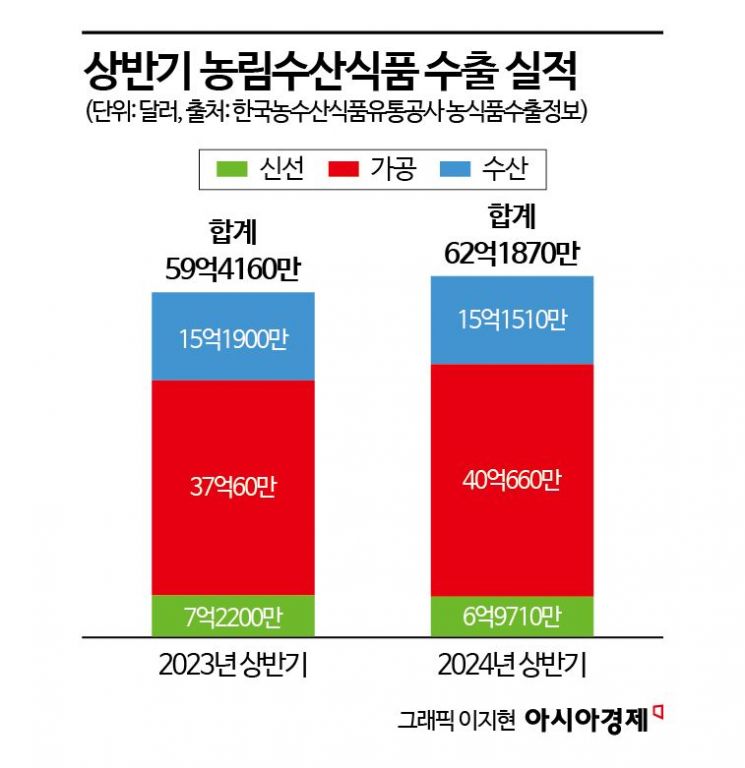
Among processed foods, noodle exports led the way with $719.6 million (approximately 990 billion KRW), a 21.6% increase from the previous year. Exports of sucrose, including sugar, rose 12.0% to $75 million (approximately 103 billion KRW), snacks increased 10.2% to $354 million (approximately 485 billion KRW), and other processed foods grew 2.8% to $1.4995 billion (approximately 2.052 trillion KRW).
The surge in noodle exports is attributed to the growing popularity of ramen, with spicy ramen gaining traction through social media (SNS) and various new products tailored to local consumers’ tastes accelerating exports. The increase in other processed foods appears to be due to a sharp rise in exports of rice-processed products, including frozen gimbap and Makgeolli.
In seafood products, seaweed including gim recorded $579.8 million (approximately 795 billion KRW), a 29.3% increase from the previous year, while other items saw a decline in export value. Although fish exports decreased by 10.0% to $619.6 million (approximately 850 billion KRW), tuna exports were $292.2 million (approximately 400 billion KRW), up 7.4% compared to the previous year.
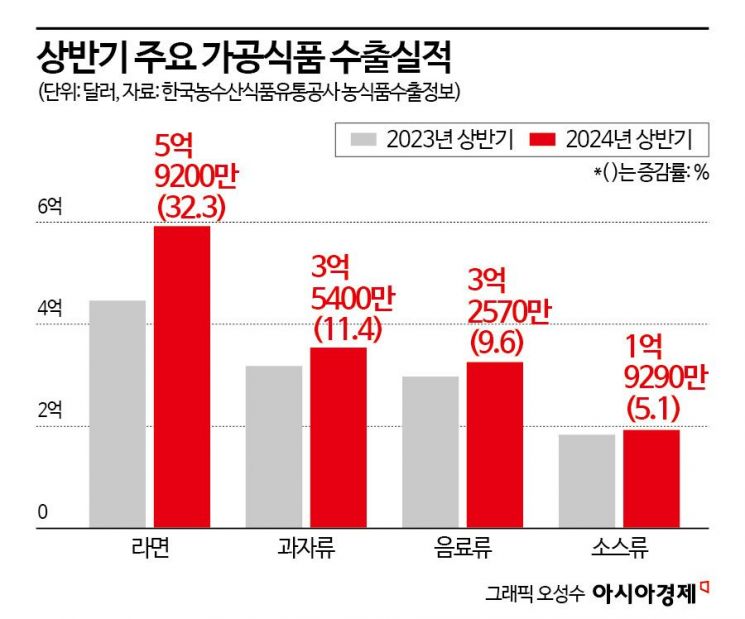
By item, ramen led processed foods with exports of $590.2 million (approximately 807 billion KRW), showing the highest growth of 36.3% compared to the same period last year. This was followed by snacks at $354 million (approximately 485 billion KRW), up 11.4%, beverages at $325.7 million (approximately 445 billion KRW), up 9.6%, and sauces at $192.9 million (approximately 263 billion KRW), up 5.1%.
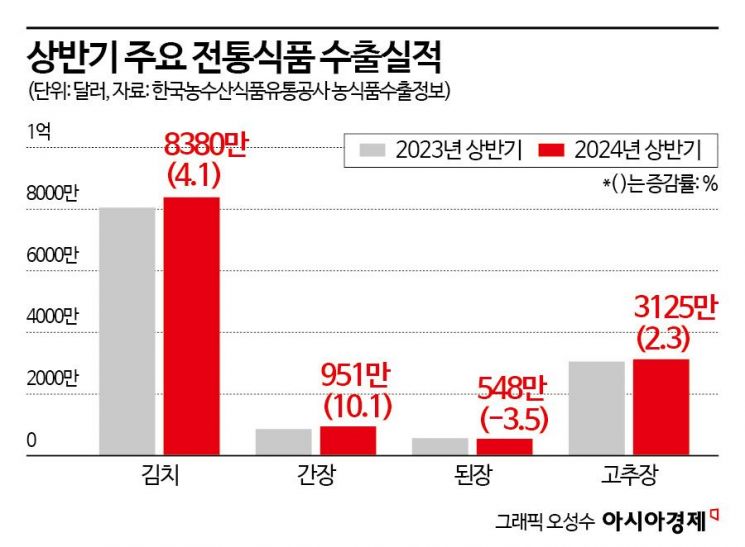
Among traditional foods, kimchi, a representative K-food, recorded export value of $83.8 million (approximately 115 billion KRW) in the first half, a 4.1% increase from the previous year, mainly exported to Japan and the United States. Soy sauce exports increased by 10.1% year-on-year in the first half, centered on the U.S., Russia, and Canada. Doenjang exports increased to Canada and the Association of Southeast Asian Nations (ASEAN) region but decreased to the U.S. and China, resulting in a 3.5% decline in export value compared to the previous year. Gochujang exports rose 2.3% year-on-year, driven by significant increases to Europe, including the Netherlands and the United Kingdom.
Although export performance in the first half is on track, there are recommendations that continuous growth requires the development and application of technology to existing products to discover additional export items. Mi-sung Park, a research fellow at the Korea Rural Economic Institute, said, “As in the case of developing frozen gimbap products using rapid freezing and moisture control technologies to solve the issues of sogginess and short shelf life of gim, it is necessary to develop and apply food tech technologies to complement the shortcomings of existing products.” She added, “It is also necessary to select export items considering food market trends in target countries, such as the increasing demand for convenience foods that are easy to prepare and health-oriented, and reviewing food types and items mentioned by influencers is another option.”
© The Asia Business Daily(www.asiae.co.kr). All rights reserved.
![Clutching a Stolen Dior Bag, Saying "I Hate Being Poor but Real"... The Grotesque Con of a "Human Knockoff" [Slate]](https://cwcontent.asiae.co.kr/asiaresize/183/2026021902243444107_1771435474.jpg)


















