Joining Government Request... Target Areas to Be Announced in November
Focus on Low Preservation Value Zones... Measures to Curb Speculation Also Implemented
The Seoul Metropolitan Government has expressed its willingness to join the government's request to lift the Greenbelt (GB, Development Restriction Zone) and supply housing, announcing plans to build homes for newlyweds.
On the 9th, the city announced detailed plans at the city level regarding the government's announcement to expand housing supply, including the lifting of the Greenbelt.
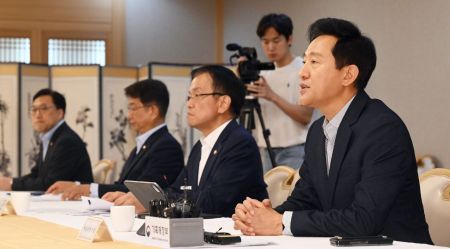 Oh Se-hoon (right), Mayor of Seoul, is giving an opening remark at the Real Estate Ministers' Meeting held at the Government Seoul Office on the 8th. The meeting, attended by Deputy Prime Minister and Minister of Economy and Finance Choi Sang-mok, Minister of Land, Infrastructure and Transport Park Sang-woo, Chairman of the Financial Services Commission Kim Byung-hwan, Governor of the Financial Supervisory Service Lee Bok-hyun, and Mayor Oh, discussed measures to expand housing supply for national housing stability. Photo by Heo Young-han younghan@
Until now, Seoul has been extremely cautious about lifting the Greenbelt to preserve the natural environment. However, as housing prices have surged sharply and supply shortages have increased the need for land development within Seoul, the city has changed its stance.
Seoul plans to lift the Greenbelt in areas where preservation value is relatively low due to poor management and damage. Most of the housing supplied in the lifted areas will be for newlyweds, including long-term rental housing II, which is part of the city's 'Newlywed 20-Year Jeonse Head of Household Housing' initiative.
Measures to prevent speculative demand following the Greenbelt lifting will also be implemented. On the 7th, Seoul held the 11th Urban Planning Committee meeting and temporarily designated the Seoul Greenbelt as a land transaction permission zone until the end of this year. Out of the total 149.09㎢, 125.16㎢ are included, and when combined with the already designated areas in Gangnam and Seocho districts and the Songpa district designated by the Ministry of Land, Infrastructure and Transport, the entire Seoul Greenbelt is now under land transaction permission control.
A Seoul city official said, "This is a preemptive response to prevent speculative demand focused on expecting development profits while the specific project scale or boundaries have not been finalized," adding, "Once the specific housing supply sites are confirmed, measures such as lifting will be implemented." The city also plans to monitor the usage status of existing land transaction permission zones to watch for potential speculation.
This is the first time in about 12 years that the city has announced a policy to lift the Greenbelt. During the Lee Myung-bak administration from 2009 to 2012, 34㎢ were lifted in areas including Jagok-dong and Segok-dong in Gangnam-gu, Umyeon-dong and Naegok-dong in Seocho-gu, and Godeok-dong, Gangil-dong, and Sangil-dong in Gangdong-gu to supply housing.
Although the target sites will be disclosed in November, considering that most of the northern areas are mountainous and unsuitable for land development, there is speculation that the Greenbelt in the Gangnam area will be selected as the target site. Areas around the Suseo vehicle depot in Gangnam-gu and Gimpo Airport in Gangseo-gu are being mentioned.
Seoul Mayor Oh Se-hoon said, "In a situation facing the crisis of population extinction due to low birth rates, lifting part of the Greenbelt to supply housing for future generations is a necessary measure," adding, "Stabilizing real estate prices downward is Seoul's unwavering goal, and we will do our best to provide sufficient and stable housing supply in cooperation with the central government."
In addition to lifting the Greenbelt, Seoul has decided to proceed with parts of the housing supply measures announced the previous day that can be implemented quickly at the city level.
First, the city will designate 10 districts in the second half of this year to pilot online general meetings and voting for redevelopment project associations, allowing electronic decision-making. The integrated review for redevelopment projects will also be expanded to include fire and disaster impact assessments, aiming to shorten the project approval period by an additional three months.
Conflict management, currently focused on construction cost increases, will be expanded by project stages. The city plans to analyze and categorize the causes and contents of various conflicts occurring after the establishment of associations and deploy related experts early to prevent issues such as vacancies in the association executive body. Through this, the city expects to reduce the time required from project approval to completion from the current seven years to a maximum of four years.
Furthermore, in line with the government's plan to supply unlimited new purchase rentals until the non-apartment market such as villas, officetels, and urban-type residential housing normalizes, Seoul Housing and Communities Corporation (SH) will expand new purchase acquisitions. This year, Seoul's plan for existing housing purchases totals 3,951 units, of which 712 units are new purchases.
For non-apartment buildings that were built previously and currently exceed the floor area ratio standards, Seoul will provide incentives such as temporarily relaxing the existing floor area ratio by revising the city planning ordinance.
Meanwhile, Seoul also announced plans to proceed normally with the redevelopment and reconstruction support measures announced in March this year, aiming to start construction on 130,000 housing units over six years. Currently, there are 415 ongoing redevelopment projects in Seoul (370,000 units), with 129 projects (106,000 units) having received project approval or management disposition approval and expected to start construction within five years. The city believes that including projects that will quickly proceed after association establishment and collective housing, starting construction on 130,000 units within six years is achievable.
© The Asia Business Daily(www.asiae.co.kr). All rights reserved.

















