Promotion of Establishing 6 Schools in Incheon, Chungnam, Gyeongbuk, Jeonnam and the Military Medical Corps
Reappearance of Regional Medical Service Public Medical School Proposal
Medical Community Strongly Opposes Mandatory Service and Additional Quotas
As the medical service gap caused by the increase in medical school admissions prolongs, demands for the establishment of new medical schools are flooding in from political circles and local governments. With the push for new medical schools following the existing increase of 2,000 medical students, concerns are rising that conflicts between the medical community and the government will worsen.
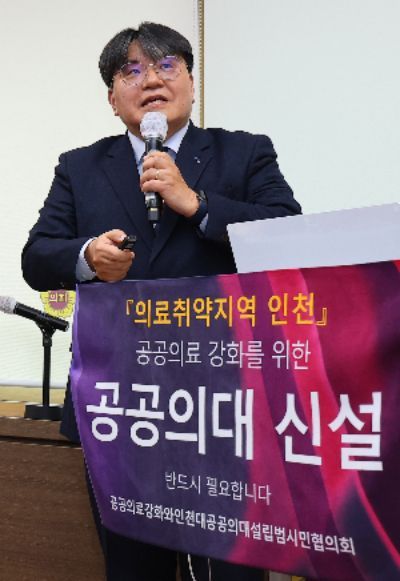 Senior Researcher Lee Yong-gap of the Incheon Institute is presenting the research results at the presentation and discussion session on the "Establishment Plan for the National Incheon University Public Medical School," held on the afternoon of February 15 at the main building of the Incheon City Council in Namdong-gu, Incheon.
 [Image source=Yonhap News]
The 22nd National Assembly has seen a flood of bills proposing new medical schools since its opening at the end of May. Currently, bills to establish new medical schools have been introduced for six local governments including Incheon, Gongju in Chungnam, Andong and Pohang in Gyeongbuk, Mokpo and Suncheon in Jeonnam, as well as the Armed Forces Medical Academy, totaling seven proposals.
In the Democratic Party of Korea, lawmakers Kim Won-i, Kim Moon-soo, and Kim Gyo-heung have each proposed bills to establish medical schools at Mokpo University, Suncheon University, and Incheon University, respectively. The People Power Party lawmakers Kim Hyung-dong, Kim Jeong-jae, and Kang Seung-gyu have submitted bills to establish medical schools at Andong University, POSTECH (Pohang), and Gongju University. People Power Party lawmaker Sung Il-jong proposed a bill to establish the Armed Forces Medical Academy, which requires mandatory military service after graduation.
Among these, the political circles see Jeonnam as the region with the highest possibility of new medical school establishment. On May 31, Park Min-su, the 2nd Vice Minister of Health and Welfare, responded to Democratic Party lawmaker Seo Mi-hwa’s request for quota allocation for the establishment of a national medical school in Jeonnam by 2026, stating, "We will definitely allocate quotas in some way," and added, "The Ministry of Health and Welfare fully agrees with the establishment of a national medical school in Jeonnam."
Gyeongbuk and Incheon are pushing for new medical schools not only at the National Assembly level but also at the local government level. On June 6, at a public discussion hosted by President Yoon Seok-yeol in Gyeongsan, Gyeongbuk Province, Governor Lee Cheol-woo said, "Andong University must have a public medical school, and POSTECH must have a research-oriented medical school." Incheon Mayor Yoo Jeong-bok visited Health and Welfare Minister Cho Kyu-hong last month to request cooperation for the establishment of a public medical school under Incheon University.
The reason why political circles and metropolitan local governments have simultaneously pushed for new medical schools since this spring appears to be the expansion of regional and public healthcare. Reviewing the 'reasons for proposal' in each bill, they specify issues such as "low number of active doctors due to concentration of specialized medical personnel in the metropolitan area," "establishment of a public healthcare foundation including emergency medical services and essential medical services," and "strengthening regional healthcare."
Accordingly, many of the new medical school bills stipulate that graduates of the newly established medical schools must serve mandatory duty in the respective regions. The bills to establish medical schools at Mokpo University, Gongju University, and Andong University require that a certain percentage of freshmen be selected through special tracks such as the 'regional public healthcare course,' with tuition supported by the national government, in exchange for mandatory service in the metropolitan area where the medical school is located after obtaining a medical license. Graduates of Incheon University, Mokpo University, and Gongju University medical schools are required to serve for 10 years in Incheon, Gyeongbuk, and Jeonnam, respectively. The Andong University medical school bill stipulates mandatory service in Gyeongbuk for a 'certain period.' Graduates of the Armed Forces Medical Academy must serve as military doctors for 15 years.
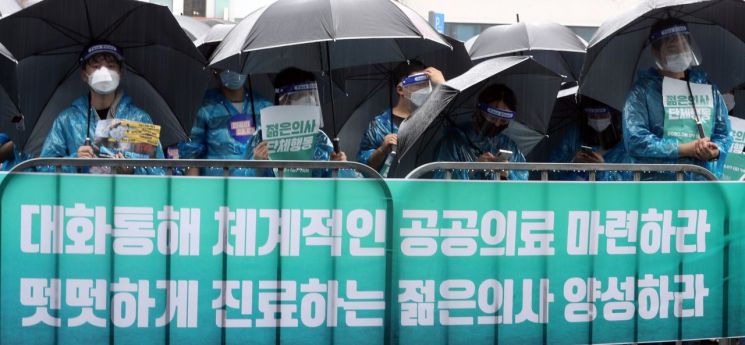 During the legislative conflict in 2020, a resolution rally of medical residents was held at Daejeon Station. The Korean Intern Resident Association collectively took a day off in protest against the government's plan to increase medical school quotas and establish a public medical school. [Image source=Yonhap News]
The medical community opposes these plans to establish new medical schools. Chae Dong-young, Public Relations Director of the Korean Medical Association, said, "The push to establish regional and public medical schools will deepen the rift in medical-government relations." The medical community also argues that the public healthcare track, which is based on mandatory service, is unrealistic. During the 2020 medical-government conflict, the medical community strongly opposed the government's plan to introduce public medical schools based on a 'civil society recommendation track,' and the government eventually scrapped this plan. A current physician who was an executive of the Korean Intern Resident Association during the 2020 medical strike said, "Mandatory regional service for graduates of public medical schools infringes on the freedom of residence and occupational choice and is unconstitutional," adding, "If discussions on establishing regional and public medical schools resume this year, conflicts between the medical community and the government will become even more severe."
The medical community also raises issues regarding the essential increase in the total quota of domestic medical schools or the redistribution of existing medical school quotas when new medical schools are established. Among the seven bills for new medical schools introduced this year, excluding the Incheon University bill and the Armed Forces Medical Academy bill which do not specify quotas, the other five bills specify quotas of around 50 to 100 students per medical school. Combined, this would increase the quota by about 450 students across five schools. Chae Dong-young of the Korean Medical Association said, "Lawmakers are pushing bills individually without considering the appropriate total quota for all domestic medical schools," and added, "If new medical schools are established, it inevitably ties into the quota issue. The Korean Medical Association will respond in conjunction with the government's plan to increase the quota by 2,000 students."
© The Asia Business Daily(www.asiae.co.kr). All rights reserved.


















