From AR Driver Obstacle Detection to Foldable Device Hinge Patents
Maintaining No.1 in the US... "Protecting New Businesses"
#Samsung Electronics has filed its first augmented reality (AR) driver obstacle identification patent in collaboration with Hyundai Motor Company. This feature helps drivers recognize obstacles faster than checking through in-vehicle black box video playback or smartphone applications.
#Samsung Electronics recently filed a patent related to hinges (folding parts) applied broadly to 'foldable electronic devices' beyond foldable phones. The patent concerns technology connecting hinge assemblies and flexible circuit boards. Since unveiling the Galaxy Z Flip in 2020, hinge patents have become Samsung Electronics' exclusive domain, reflecting ongoing research and development (R&D) in foldable electronic products.
Samsung Electronics is advancing its patent portfolio not only in quantity but also by specializing in cutting-edge industries such as artificial intelligence (AI) and semiconductors. This strategy is based on the judgment that securing patents domestically and internationally, especially in the U.S. market, is essential to reduce patent disputes and establish new businesses. Notably, despite a 15 trillion KRW annual loss last year, the semiconductor (DS) division maintained its top position in U.S. patent acquisitions.
 On the 27th of last month (local time), Osanguk, who won the men's sabre final at the 2024 Paris Olympics fencing event held at the Grand Palais in Paris, France, by defeating Pares Ferjani (Tunisia), is taking a commemorative photo with a Samsung Z Flip6 on the podium.
 [Photo by Yonhap News]
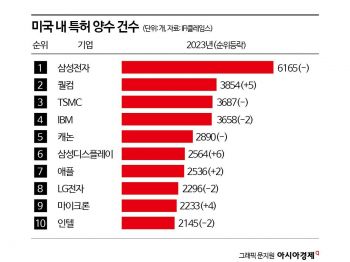
According to IFI Claims, a U.S. patent analysis firm, Samsung Electronics acquired 6,165 patents in the U.S. last year, maintaining first place. Although this is a decrease of 83 patents (1.33%) from 6,248 in 2022, Samsung still holds about twice as many patents as the second-ranked company. It surpasses Qualcomm (3,854 patents) and Taiwan's TSMC (3,687 patents).
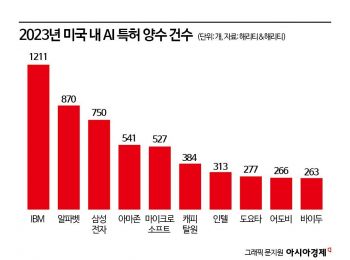
Samsung Electronics also ranks high in the 'AI' patent field. According to patent specialist firm Harrity & Harrity, Samsung acquired 750 AI patents in the U.S. last year, ranking third after IBM (1,211 patents) and Alphabet (Google's parent company, 870 patents). Amazon (541 patents) and Microsoft (527 patents) ranked fourth and fifth, respectively.
Domestically, Samsung Electronics is overwhelmingly first. According to data released yesterday by CEO Score, a corporate data research institute, Samsung Electronics (387 patents) holds more patents than LG Electronics (154 patents), Naver (90 patents), and SK Telecom (78 patents).
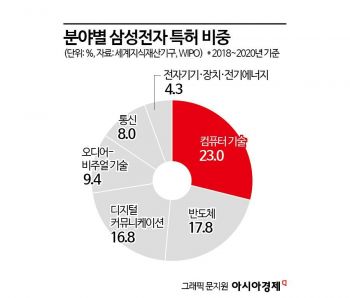
Along with the number of patents, the fields of patent acquisition and sales performance are also important. The reason Samsung Electronics maintained first place despite last year's recession is that it kept its patent portfolio focused on high value-added semiconductor and digital technologies. According to data from the World Intellectual Property Organization (WIPO) from 2018 to 2020, Samsung's patent portfolio is concentrated in advanced industries such as computer technology (23%), semiconductors (17.8%), and digital communication (16.8%).
In the past month, Samsung Electronics has been actively filing patents related to semiconductors and mobile devices. In addition to AR driver obstacle identification patents and foldable device hinge patents, it continues to file semiconductor-related patents. According to the patent information search service KIPRIS, last month Samsung filed patents for ▲ three-dimensional stacked memory including reconfigurable computing logic ▲ memory devices and their operating methods.
Samsung Electronics is focusing on acquiring patents in the U.S. As of the end of the first quarter, out of the 250,691 patents Samsung holds, 37.9% or 94,903 are U.S. patents. Samsung disclosed that it registered 2,505 patents in the U.S. during the first quarter through 7.8 trillion KRW of R&D investment. This is explained as having the largest number of patents in the U.S. to effectively respond to disputes within the country.
A company official said, "The secured intellectual property rights will serve to check competitors and protect business when entering new businesses related to future technologies," adding, "We have signed patent licenses with Google, Ericsson, Qualcomm, Huawei, Nokia, and others to establish a broad patent protection network in core and new business areas such as mobile and semiconductors."
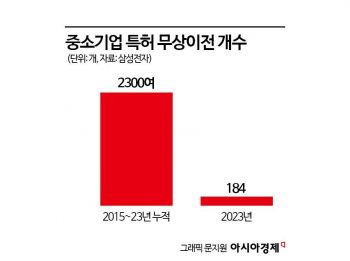
As Samsung Electronics' patent filings increase, it also positively impacts the advancement of the national industrial supply chain. This is the driving force behind Samsung's nearly decade-long policy of transferring patents free of charge to small and medium-sized enterprises. According to Samsung Electronics, the number of free patent transfers last year was 184, totaling about 2,300 patents transferred free of charge over nine years since 2015.
The reason Samsung Electronics transfers patents free of charge to partners is the rapid pace of AI transformation, which requires supply chain advancement to enable flexible business. Han Jong-hee, Vice Chairman and Head of Samsung Electronics' DX Division, recently urged the top executives of 202 member companies of the first-tier partner meeting 'Hyupsunghoe' to "join forces with Samsung to actively respond to the AI era."
© The Asia Business Daily(www.asiae.co.kr). All rights reserved.



















