Peterson Institute for International Economics (PIIE) Report
"Foreign Workers' Share Should Increase to 15%"
A U.S. think tank has warned that if South Korea, which is facing a low birthrate and aging population crisis, does not open its immigration gates, its per capita national income could plummet by more than 20% in about 50 years. There is also a recommendation to expand the proportion of foreign workers to 15% of the total workforce over the next 40 years to prevent a decline in economic growth caused by a shrinking working-age population.
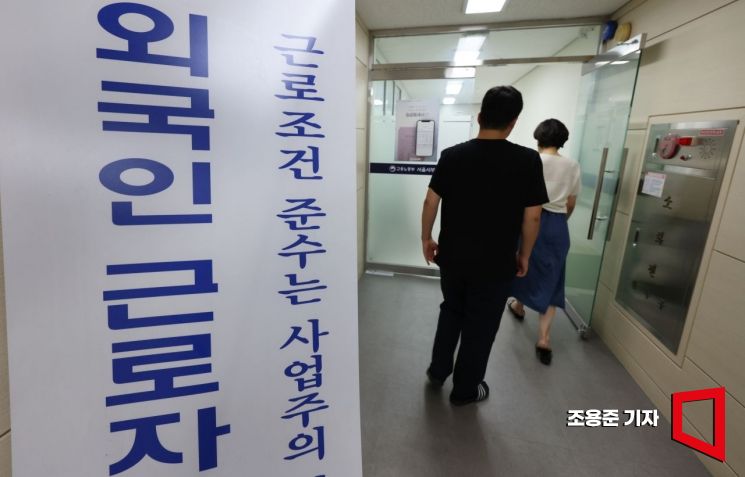
On the 8th (local time), the Peterson Institute for International Economics (PIIE), a think tank based in Washington D.C., U.S., made this claim in a report titled "Immigration or Stagnation: Korea's Aging and Economic Growth Today, the Future of the World."
Michael A. Clemens, a non-resident senior fellow at PIIE and a professor in the Department of Economics at George Mason University, stated in the report, "South Korea is facing a socio-economic crisis due to rapid aging," adding, "If the number of migrant workers does not increase, Korea will experience significant losses in income and economic growth due to demographic challenges."
Currently, the number of foreign workers in South Korea is 1 million, accounting for about 3% of the total workforce. The report analyzed the economic impact assuming South Korea implements a "zero immigration" policy that blocks additional foreign worker inflows after 2024. Under this scenario, South Korea's per capita income is estimated to decrease by 10% in 2042, 18 years later, and by 20% in 2064, 40 years later.
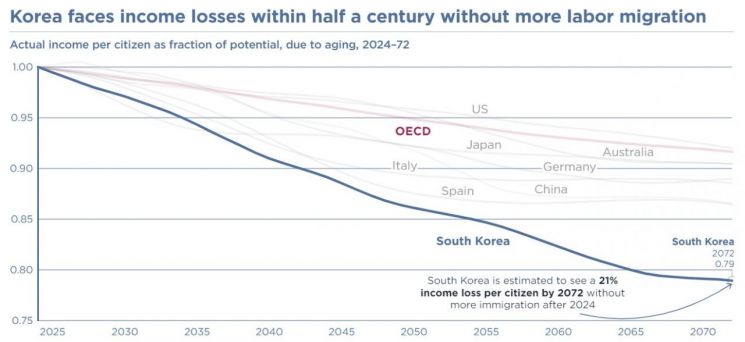 The Peterson Institute for International Economics (PIIE) in the United States projected that if South Korea blocks the influx of foreign workers, the per capita income will decrease by 10% in 2042 and by 20% in 2064.
The impact of the zero immigration policy is analyzed to be the most severe among major countries in South Korea. It is projected that South Korea's per capita income will decrease by 21% by 2072, the largest decline. The 32 member countries of the Organisation for Economic Co-operation and Development (OECD) are expected to see an average income decline of 8%, making South Korea's decrease nearly three times greater. Next, Spain is expected to see a 14% decrease, China 13%, Italy and Germany 11% each, Japan and Australia 10% each, and the U.S. 8%. Given that South Korea's total fertility rate was 0.72 in 2023, the lowest in the world, the economic impact from the sharp decline in the working-age population is expected to be the greatest.
The report argues that South Korea must implement proactive immigration policies to avoid a decline in growth rates caused by low birthrates and aging. It particularly points to the cases of Malaysia and Australia as references for significantly increasing the proportion of foreign workers. In Malaysia, the share of foreign workers expanded from 3% in 1982 to the current level of 13-14%. Australia also exceeds 15%.
Senior fellow Clemens stated, "South Korea should gradually increase the proportion of foreign workers to 15% of the total workforce over the next 40 years," adding, "This level can offset most of the decline in economic growth caused by aging."
He emphasized, "South Korea needs to invest more in immigration policies to respond to aging," and said, "Many developing and developed countries should refer to South Korea's experience," adding, "Policy makers worldwide will pay attention to South Korea's choice as it navigates this sea of low birthrates and aging."
© The Asia Business Daily(www.asiae.co.kr). All rights reserved.
![An "Human Knockoff" Clutching a Stolen Dior Bag... A Bizarre Con That Shakes Your Sanity [Slate]](https://cwcontent.asiae.co.kr/asiaresize/183/2026021902243444107_1771435474.jpg)

















