Practical Negotiations on Formation of Ye·Ya·Jeong Consultative Body
Breakthrough Through Consecutive Meetings of Floor Leaders and Policy Committee Chairs
Chaesangbyeong Special Prosecutor Law and 'Political Truce' Remain Unlikely
On the 8th, the People Power Party and the Democratic Party of Korea will discuss the formation of a 'Ruling-Opposition-Government Consultative Body' for livelihood legislation. Following meetings between the floor leaders and policy committee chairs of both parties, the chief deputy floor leaders, who oversee practical affairs, will hold a meeting. If the consultative body is established, it is expected that the two parties will begin full-scale cooperation. However, since the opposition party is preparing special investigation bills for Chae Sang-byeong and First Lady Kim Geon-hee, and there remain differences in positions on some economic bills, partial cooperation is also possible.
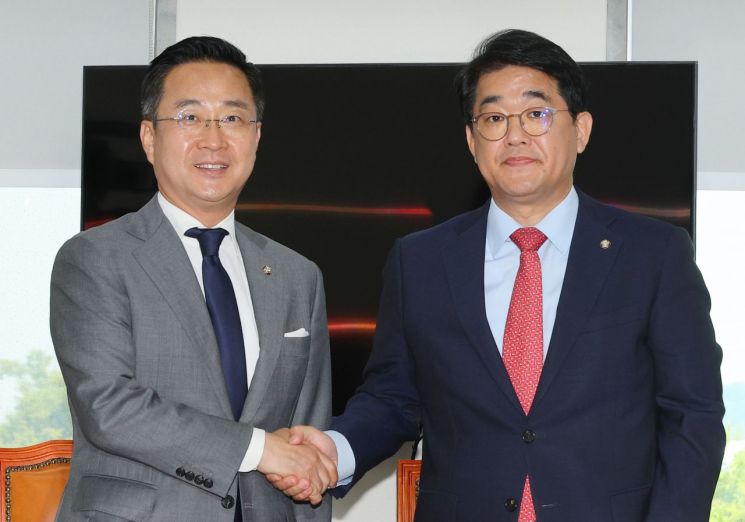
On the morning of the same day, Bae Jun-young, chief deputy floor leader of the People Power Party, and Park Sung-jun, chief deputy floor leader of the Democratic Party, are scheduled to meet privately at the National Assembly to conduct practical negotiations regarding the formation of the Ruling-Opposition-Government Consultative Body. When asked by Asia Economy whether there would be discussions beyond the consultative body, Chief Deputy Bae explained, "We plan to focus on the formation of the Ruling-Opposition-Government Consultative Body (in discussions with Chief Deputy Park)." This meeting between the chief deputy floor leaders follows the proposal by Park Chan-dae, acting leader and floor leader of the Democratic Party, the previous day to establish a permanent policy consultation body between the government and the National Assembly, to which Floor Leader Chu Kyung-ho responded by proposing the formation of a Ruling-Opposition-Government livelihood consultative body.
Over the past 70 days, the political standoff has repeated with the opposition party forcibly passing bills, the ruling party conducting unlimited debate (filibuster), and President Yoon Seok-yeol exercising his veto power, leading to criticism both inside and outside the political sphere that the National Assembly has neglected livelihood bills. In particular, as the floor leadership of both parties has been meeting steadily this week, there is a consensus to "accept bills that can be mutually agreed upon," and it is expected that discussions on livelihood bills will gain momentum.
Earlier, Floor Leader Chu and Floor Leader Park agreed on the 5th during a luncheon at a restaurant in Yeouido hosted by National Assembly Speaker Woo Won-shik to "engage in dialogue to resolve livelihood issues." The day before, Kim Sang-hoon, chair of the People Power Party’s policy committee, and Jin Sung-jun, chair of the Democratic Party’s policy committee, met at the National Assembly and shared a commitment to the swift processing of common legislative bills.
If the Ruling-Opposition-Government Consultative Body is established, the two parties are expected to first agree on bills with fewer disagreements, such as the amendment to the Nursing Act, which institutionalizes the scope of work for physician assistants (PA) nurses; the amendment to the Civil Act (Gu Ha-ra Act); the K-Chips Act (amendment to the Restriction of Special Taxation Act); and other bills jointly proposed and discarded during the 21st National Assembly, as well as the establishment of the Population Strategy Planning Department and the Special Act on Jeonse Fraud. Since the differences in the content of bills proposed by lawmakers from both parties are not significant, only detailed adjustments are needed for immediate processing. If results begin to emerge from the consultative body, there is also a possibility that summit talks will resume. Floor Leader Park proposed summit talks at the emergency economic inspection meeting the previous day to resolve the economic crisis, and Han Dong-hoon, leader of the People Power Party, responded positively, saying, "It is not a matter to be constrained by form or timing."
However, in the political sphere, it is considered difficult for the two parties to reach a truce agreement through the processing of livelihood bills. Differences continue to surface regarding the Special Act on Livelihood Recovery Support Fund (25,000 won support law) and the abolition of the Financial Investment Income Tax (Capital Gains Tax) law, and if the Democratic Party files the third special investigation bill for Chae Sang-byeong, confrontation between the ruling and opposition parties may be highlighted again. On the morning of the same day, Jang Dong-hyuk, a Supreme Council member of the People Power Party, criticized at the Supreme Council meeting held at the central party office in Yeouido, Seoul, saying, "It is hard to understand why the Democratic Party is so obsessed with this special investigation bill," and added, "They talk as if they will come to a truce negotiation upfront, but behind the scenes, they are scheming to stab us in the back with a two-faced strategy."
© The Asia Business Daily(www.asiae.co.kr). All rights reserved.
![User Who Sold Erroneously Deposited Bitcoins to Repay Debt and Fund Entertainment... What Did the Supreme Court Decide in 2021? [Legal Issue Check]](https://cwcontent.asiae.co.kr/asiaresize/183/2026020910431234020_1770601391.png)
















