Impersonating Soldier and Demanding Item Payment
Disappears After Payment Refusal
A man impersonating a military officer placed a large order for lunchboxes and then disappeared, prompting a police investigation.
On the 7th, Yonhap News reported that "Lunchbox vendor Mr. A filed a complaint with the Gwangju Bukbu Police Station stating that he was asked by another company to make a payment on their behalf under the pretext of a large order."
According to the complaint, the man who introduced himself as a second lieutenant of the Army's 31st Division ordered lunchboxes worth about 7 million won for around 80 soldiers on the 25th of last month. On the first delivery day, about 1.4 million won worth of lunchboxes were prepared, but the man claimed "there is no bank nearby" and asked another supplier to pay the amount on his behalf.
Feeling suspicious, Mr. A refused to make the payment, after which the man cut off contact. Mr. A claimed damages amounting to 1.4 million won for the lunchboxes already prepared.
The police, who launched an investigation, confirmed that the man impersonated a soldier and are tracking his whereabouts based on the account number used for the requested payment.
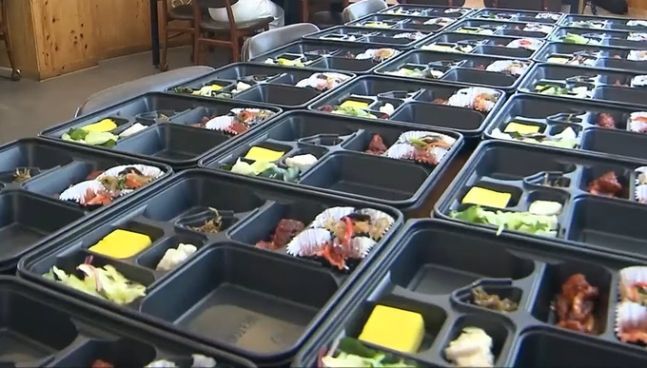 A restaurant in Cheongju, Chungbuk, that suffered damage from a scam impersonating a soldier. [Image source=KBS news footage]
Previously, a no-show incident involving a man impersonating a soldier also occurred at a restaurant in Cheongju, Chungbuk. In June, a man who introduced himself as a colonel from the Ministry of National Defense ordered 480 lunchboxes and then requested, "Please send 9.8 million won to the combat ration supplier on my behalf." Suspecting fraud, the restaurant owner refused to transfer the money, after which the man disappeared. As a result, the owner suffered losses amounting to several million won, including the cost of the prepared lunchboxes and ingredients. It is estimated that about 60 restaurants have suffered similar damages in this manner.
Although cases of no-shows are increasing, there is controversy due to the lack of clear regulations to punish such acts. While charges such as fraud or obstruction of business can be applied, it is difficult to prove intent. Consequently, self-employed business owners are sharing know-how to prevent no-shows.
Shared no-show prevention measures include ▲receiving deposits ▲keeping records of order details and cancellation deadlines via text messages ▲documenting order forms ▲installing CCTV. Additionally, following the military no-show incidents, information such as the aliases and phone numbers of soldiers making false orders, KakaoTalk profile images and chat contents, and copies of contracts have also been shared.
© The Asia Business Daily(www.asiae.co.kr). All rights reserved.


















