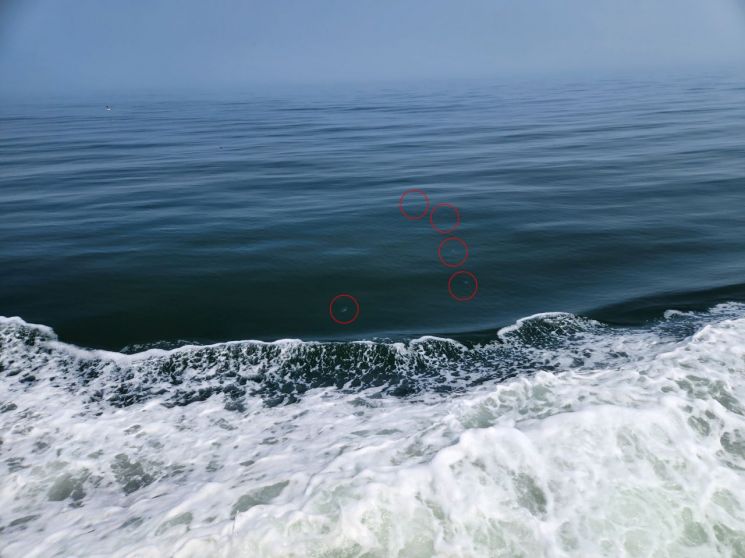
Gyeonggi Province has issued a 'Jellyfish Warning' due to high water temperatures in the Gyeonggi Sea.
On the 8th, Gyeonggi Province announced that the water temperature in the Gyeonggi Sea reached the level of a 'High Water Temperature Preliminary Warning' earlier this month, and the number of mildly toxic moon jellyfish has increased, urging local fishermen and related organizations to be cautious.
According to the Gyeonggi Marine Fisheries Resources Research Institute, the average surface water temperature at 10 locations in the Gyeonggi Sea was 26.1℃ on the 6th. In particular, temperatures as high as 27.4℃ were recorded at the Sihwa Embankment and Jebudo Island. The average temperature has been steadily rising, with 22.1℃ on the 8th of last month and 23.7℃ on the 24th.
According to the standards of the National Institute of Fisheries Science, a preliminary high water temperature warning (25~27℃) requires measures such as preemptive prevention of fish diseases and inspection of shading facilities when issued.
Gyeonggi Province predicts that during some daytime hours with strong solar radiation, the water temperature may reach the level of a high water temperature warning (28℃ reached).
The province also confirmed that the occurrence frequency of mildly toxic moon jellyfish is increasing along with the rise in water temperature.
At the beginning of last month, there was only one individual per 100㎡, but by the end of last month, it increased to a maximum of 10 individuals, and this month it has risen to a maximum of 20 individuals. The proportion of smaller individuals has increased over time.
Based on the locations and quantities of moon jellyfish found, the Marine Fisheries Resources Research Institute estimates that the inflow of moon jellyfish from outside the bay is higher than the occurrence inside the Gyeonggi Bay. Moon jellyfish attach to fishing gear and cause damage to fisheries.
Kim Seong-gon, director of the Marine Fisheries Resources Research Institute, stated, "Although moon jellyfish are mildly toxic, an increase in their numbers can cause damage to fisheries," adding, "We will promptly disseminate information on abnormal marine phenomena caused by high water temperatures to help prevent fishery damage."
© The Asia Business Daily(www.asiae.co.kr). All rights reserved.
![From Hostess to Organ Seller to High Society... The Grotesque Scam of a "Human Counterfeit" Shaking the Korean Psyche [Slate]](https://cwcontent.asiae.co.kr/asiaresize/183/2026021902243444107_1771435474.jpg)
















