Controversy Over Attire Led to 2012 Dress Code Changes
Many Athletes Still Prefer Wearing Bikinis
As with previous Olympics, the bikini outfits of female beach volleyball players are a hot topic at the 2024 Paris Olympics. Female beach volleyball players generally compete wearing bikinis that are highly revealing and tightly fitted. In contrast to the loose uniforms of male players, these outfits have sparked both attention and controversy at every Olympics.
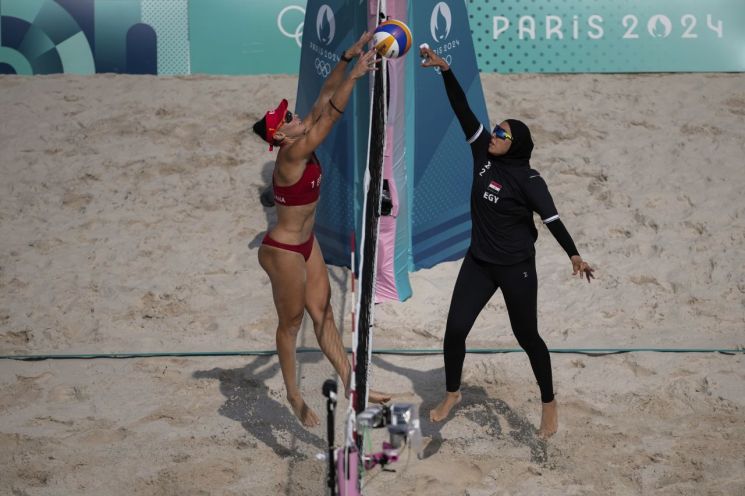 Doaa Elghobashy, an Egyptian beach volleyball player who also competed in the 2024 Paris Olympics. She wears a hijab while playing beach volleyball.
 [Photo by AP·Yonhap News]
On the 6th (local time), the French daily newspaper Le Monde pointed out that even at the 2024 Paris Olympics, which for the first time achieved gender balance among participating athletes, many sports still apply different standards to female athletes' uniforms. It also reported that female athletes face restrictions in uniform choices due to the influence of international federations (IFs) for each sport and national sponsors.
Sports that apply completely different standards for male and female athletes' uniforms include artistic gymnastics and beach handball. In particular, beach volleyball has faced ongoing uniform controversies since it was first introduced as a demonstration sport at the 1992 Barcelona Summer Olympics and became an official sport at the 1996 Atlanta Olympics. At that time, the International Olympic Committee (IOC) established official regulations requiring female beach volleyball players to wear bikini-style bottoms with a maximum width of 7 cm, under the premise of lowering athletes' perceived temperature and enhancing mobility.
Due to this regulation, the bikini uniforms that clearly reveal female athletes' body lines attracted more attention compared to men's competitions, which directly translated into ticket sales. However, some critics argued that the Olympic Committee was using female athletes in bikinis as a marketing tool to generate revenue.
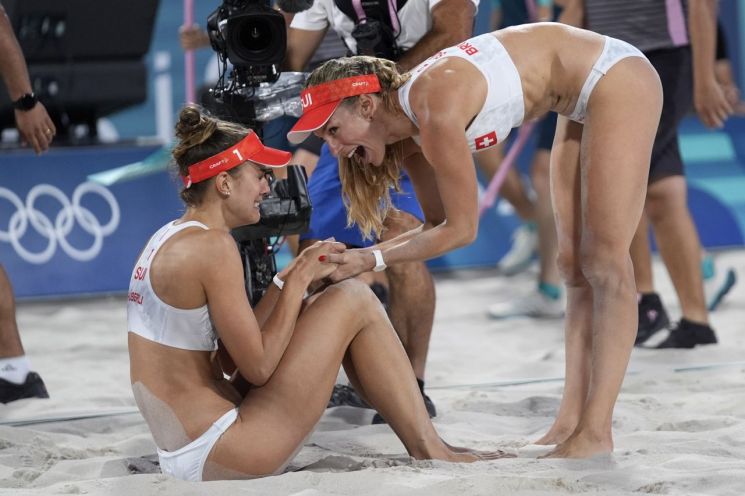 Beach volleyball was first introduced as a demonstration sport at the 1992 Barcelona Summer Olympics and became an official event at the 1996 Atlanta Olympics. Since then, controversies over the athletes' attire have persisted. At that time, the International Olympic Committee (IOC) established official regulations requiring female beach volleyball players to wear bikini-style bottoms with a maximum width of 7 cm, citing reasons to reduce the athletes' perceived temperature and enhance mobility.
 [Photo by AP·Yonhap News]
The International Women's Rights Federation also stated in an interview with Forbes, "The sports world sexually exploits women's bodies, and everything is connected to money," adding, "(Forcing bikini wear) makes women appear as objects, which is clear gender discrimination." In response to the criticism, the International Volleyball Federation (FIVA) changed the rules at the 2012 London Olympics beach volleyball competition to allow uniform choice. They permitted shorts and long-sleeve or sleeveless tops out of respect for participating countries' religious beliefs and cultural customs.
Although a new rule allowing long-sleeve tops was introduced in 2012, many players still prefer to wear bikinis. The reason is that most female players who insist on bikini uniforms do so to prevent sand from entering and getting trapped inside the uniform when diving into the sand to catch the ball. American beach volleyball player Kerri Walsh Jennings emphasized, "Beach volleyball matches are generally held in hot places where temperatures exceed 100 degrees Fahrenheit (about 37.8 degrees Celsius)," adding, "It's purely for performance, with no intention of sex appeal."
At the 2016 Rio de Janeiro Olympics, female beach volleyball uniforms were again at the center of attention. During a beach volleyball match held at Copacabana Beach, Egypt's beach volleyball player Doaa Elghobashy wore a hijab and a full-body covering uniform, competing against opponents in bikinis, which was a striking sight.
Elghobashy also competed in the Paris Olympics wearing a hijab uniform. In an interview with a Swedish media outlet, she said, "Just as I cannot force others to wear a hijab, others cannot force me to wear a bikini," adding, "In a free country, what you wear is a personal freedom."
© The Asia Business Daily(www.asiae.co.kr). All rights reserved.
![Clutching a Stolen Dior Bag, Saying "I Hate Being Poor but Real"... The Grotesque Con of a "Human Knockoff" [Slate]](https://cwcontent.asiae.co.kr/asiaresize/183/2026021902243444107_1771435474.jpg)

















