In June, the current account recorded a surplus of $12.26 billion, marking the highest level in 6 years and 9 months. The current account surplus for the first half of the year reached $37.73 billion, far exceeding the initial forecast of $27.9 billion.
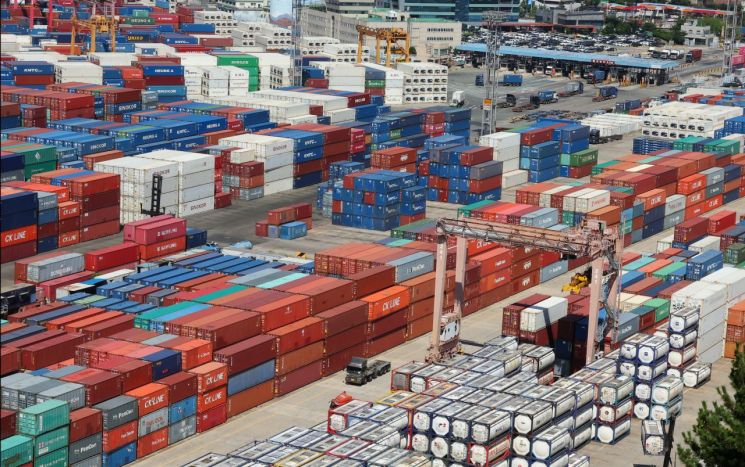
According to the "June Balance of Payments (provisional)" released by the Bank of Korea on the 7th, the current account surplus in June was $12.26 billion. This is the highest since September 2017 ($12.34 billion), marking the largest surplus in 6 years and 9 months.
South Korea's current account recorded a surplus for 11 consecutive months from May last year, temporarily turning to a deficit in April due to large-scale dividend payments to foreigners, but has maintained a surplus for two consecutive months since May.
On a half-year basis, the current account surplus reached $37.73 billion, significantly surpassing the Bank of Korea's first-half forecast of $27.9 billion.
The goods balance in June recorded a surplus of $11.47 billion, the largest since September 2020 ($12.02 billion). Exports increased by 8.7% year-on-year to $58.82 billion, while imports decreased by 5.7% to $47.35 billion.
Exports increased for the ninth consecutive month, centered on semiconductors and information and communication devices. Based on customs clearance, semiconductors (50.4%) and information and communication devices (26%) increased significantly compared to the same month last year, along with petroleum products (8.5%) and passenger cars (0.5%). Machinery and precision instruments (-1.4%), chemical products (-7.5%), and steel products (-18%) decreased.
Imports of raw materials (-6.6%), capital goods (-4.6%), and consumer goods (-15.6%) all declined. Specifically, petroleum products (17.5%), crude oil (8.2%), and information and communication devices (12.1%) increased year-on-year, while steel materials (-18.9%), chemical products (-20.6%), semiconductor manufacturing equipment (-24.1%), and passenger cars (-44.1%) decreased.
The services balance recorded a deficit of $1.62 billion, widening from the previous month's deficit of $1.29 billion. The transportation balance turned to a surplus of $500 million as transportation income expanded due to rising container freight rates. However, the travel balance recorded a deficit of $900 million, slightly larger than May's deficit of $860 million, as travel income decreased more than travel payments.
The primary income balance recorded a surplus of $2.69 billion, expanding from $1.76 billion in the previous month. The dividend income balance increased to $2.34 billion, up from $1.13 billion in April, as the impact of quarterly dividend payments in the previous month disappeared. Interest income recorded a surplus of $480 million.
The financial account net assets, indicating capital inflows and outflows, increased by $12.24 billion, the largest increase since October 2020 ($18.75 billion). Direct investment saw an increase of $4.89 billion in domestic investors' overseas investments, while foreign investment in the domestic market decreased by $370 million.
Securities investment showed an increase of $6.63 billion in domestic investors' overseas investments, mainly in stocks, while foreign investment in domestic bonds decreased by $2.39 billion.
© The Asia Business Daily(www.asiae.co.kr). All rights reserved.

![Clutching a Stolen Dior Bag, Saying "I Hate Being Poor but Real"... The Grotesque Con of a "Human Knockoff" [Slate]](https://cwcontent.asiae.co.kr/asiaresize/183/2026021902243444107_1771435474.jpg)















