Research Team Predicts Korean Heat Waves... Interpreting Complex Interactions Between Weather Phenomena
Mongolian Desert and Tianshan Mountain Snow Depth Play Key Role in Predicting Korean Heat Waves
As record-breaking heatwaves have become more frequent in South Korea, a research team at UNIST has developed a technology that uses artificial intelligence (AI) to predict heatwaves.
This technology is also expected to help respond to various types of climate change.
The research team led by Professor Lim Jungho from the Department of Urban and Environmental Engineering at UNIST (President Park Jongrae) developed an AI-based heatwave prediction model by analyzing global climate factors such as sea surface temperature, soil moisture, snow depth, and sea ice concentration. In particular, they found that the snow depth in the Mongolian desert and the Tianshan Mountains in China are key factors in predicting the number of heatwave days in South Korea.

The phenomenon in which the variability of the land and sea surface interacts with the atmosphere to affect the weather in distant regions is called "teleconnection." By identifying specific regions that influence heatwaves through teleconnection, the team was able to apply these factors to their prediction model.
The research team proved that an increase in snow depth in the Tianshan Mountains during winter and a decrease in snow depth in the Gobi Desert during spring are important variables for predicting summer heatwaves. They confirmed that when there is high variability in snow depth in the Mongolian desert and the Tianshan Mountains, summer temperatures in South Korea tend to rise.
It is noteworthy that snow depth in the Tianshan Mountains played a major role in predicting heatwaves in 2023. In 2024, the influence of various climate factors, such as soil moisture and sea surface temperature, is becoming even more complex.
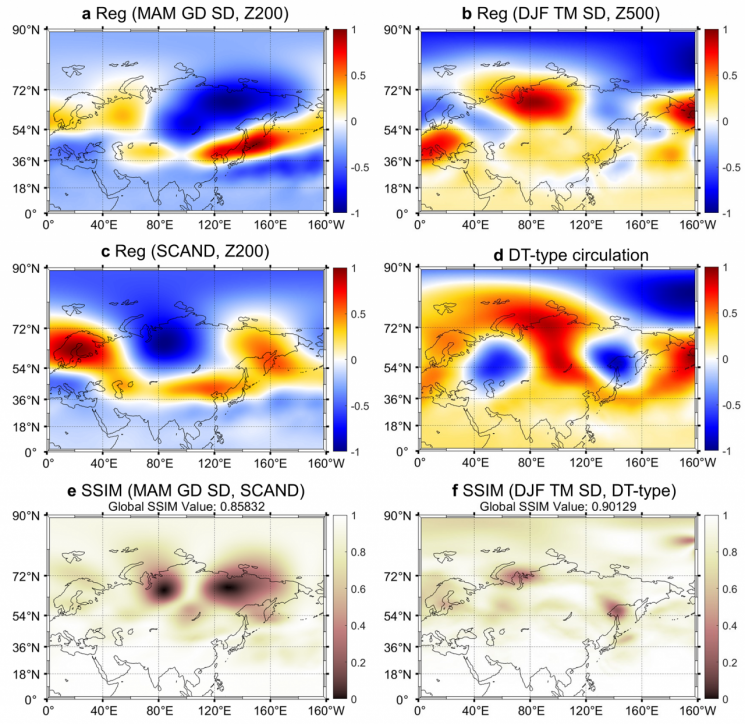 Spatial congruence (e, f) between atmospheric patterns (a, b) induced by variability in snow depth and previously known large-scale atmospheric circulation patterns (c, d) related to heatwaves in Korea.
Researcher Lee Yeonsu explained, "We have identified the link between snow depth in the Mongolian desert and the Tianshan Mountains and heatwaves in South Korea," adding, "This structure is similar to conventional large-scale teleconnection patterns and is expected to play an important role in heatwave prediction."
Professor Lim Jungho emphasized, "By monitoring the relationship between teleconnection factors not reflected in conventional weather forecasting models and heatwaves, we can improve prediction accuracy," adding, "This research will greatly help in understanding and responding to heatwaves in South Korea."
The research was supported by the Korea Meteorological Administration, the National Research Foundation of Korea, and the Ministry of Oceans and Fisheries. The results were published in the international journal npj Climate and Atmosphere Science on August 3.
© The Asia Business Daily(www.asiae.co.kr). All rights reserved.
!["The Woman Who Threw Herself into the Water Clutching a Stolen Dior Bag"...A Grotesque Success Story That Shakes the Korean Psyche [Slate]](https://cwcontent.asiae.co.kr/asiaresize/183/2026021902243444107_1771435474.jpg)

















