At the beginning of last week, the won-dollar exchange rate, which had been hovering around 1,380 won, fell to the 1,350 won level, marking its lowest point in about three months. This increased volatility in the exchange rate was due to consecutive interest rate decisions by major countries such as Japan, the United States, and the United Kingdom, as well as weaker-than-expected U.S. economic indicators. Analysts suggest that the won-dollar exchange rate could drop to the low to mid-1,300 won range in the future.
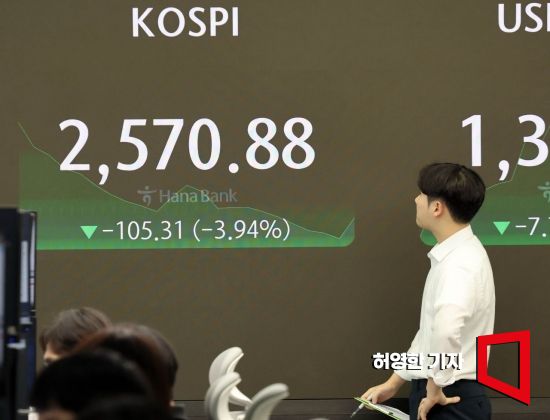 Following the fear of a recession in the United States, the US stock market plummeted, and the domestic stock market also crashed after the 'Black Friday.' On Monday the 5th, the domestic stock market plunged from the opening, falling more than 100 points at one point. Various indices are displayed on the electronic board as employees work in the dealing room of Hana Bank in Euljiro, Seoul. Photo by Heo Younghan younghan@
On the 5th, the won-dollar exchange rate opened at 1,359 won, up 3 won from the previous trading day’s closing price (based on 2 a.m. closing). This is the lowest level since May 20 (1,354 won) in about three months. The won-dollar exchange rate closed at 1,356 won at 2 a.m. on the 3rd, down 15.2 won from the 3:30 p.m. closing price (1,371.20 won) the previous day.
While the exchange rate remained around 1,380 won at the beginning of last week, volatility significantly increased following consecutive interest rate policy announcements by major countries starting from the 31st of last month. On the 30th of last month, the won-dollar exchange rate rose to 1,386.2 won during the day but dropped to 1,356 won by 2 a.m. on the 3rd, fluctuating more than 30 won over three trading days.
The won-yen recalculated exchange rate rose as the yen strengthened immediately after the Bank of Japan (BOJ) raised interest rates, reaching 900.88 won per 100 yen on the 31st of last month (based on the 3:30 p.m. closing price), up 6.65 won from the previous trading day. It then increased to 910.71 won on the 1st and 919.93 won on the 2nd, rising about 20 won over three trading days.
The Bank of Japan decided to raise its benchmark interest rate on the 31st of last month, causing the yen-dollar exchange rate, which had been hovering in the mid-to-high 150 yen range, to fall to the high 140 yen range. As the yen strengthened, the won followed suit. The Bank of England (BOE) also cut its benchmark interest rate on the 1st (local time) for the first time in over four years since the pandemic.
On the 31st of last month (local time), the U.S. Federal Reserve (Fed) hinted at a rate cut in September during the Federal Open Market Committee (FOMC) regular meeting, accelerating the dollar’s weakness. Just one day later, on the 1st (local time), the U.S. manufacturing index fell short of market expectations, and the employment data released the following day was also weaker than expected, increasing expectations that the Fed’s rate cut in September could be expanded to 0.5 percentage points.
Accordingly, the market analysis suggests that the won-dollar exchange rate could fall to the low to mid-1,300 won range. Jo Yong-gu, a researcher at Shin Young Securities, said, "The possibility of the Fed making a big cut of up to 0.5 percentage points has increased, and there is room for the yen-dollar exchange rate to decline. The probability of the exchange rate falling to the low 1,300 won range by the end of the year has become higher."
Kwon Ah-min, a researcher at NH Investment & Securities, said, "Considering that South Korea is also considering interest rate cuts in the second half of the year, which could further widen the interest rate gap between Korea and the U.S., the likelihood that Korea’s export growth rate will peak in the third quarter and then slow down, and the uncertainty surrounding the U.S. presidential election in November, there are many obstacles for the won to strengthen. Currently, the won-dollar exchange rate is somewhat linked to the weak dollar trend, so it is difficult for it to strengthen significantly and will likely remain in the low to mid-1,300 won range."
© The Asia Business Daily(www.asiae.co.kr). All rights reserved.

















