NYT: "Must Be Interpreted as an Extension of the Tangping Trend"
Tangping Trend Reveals the Powerlessness of China's Young Generation
A trend of taking photos or videos imitating birds is spreading mainly among Chinese university students. Some interpret this as an extension of the 'Tangping' (?平) trend that emerged as the growth of the Chinese economy slowed and the future uncertainty for the youth increased. On the 2nd (local time), the New York Times (NYT) introduced this trend of 'bird imitation' spreading among university students in China.
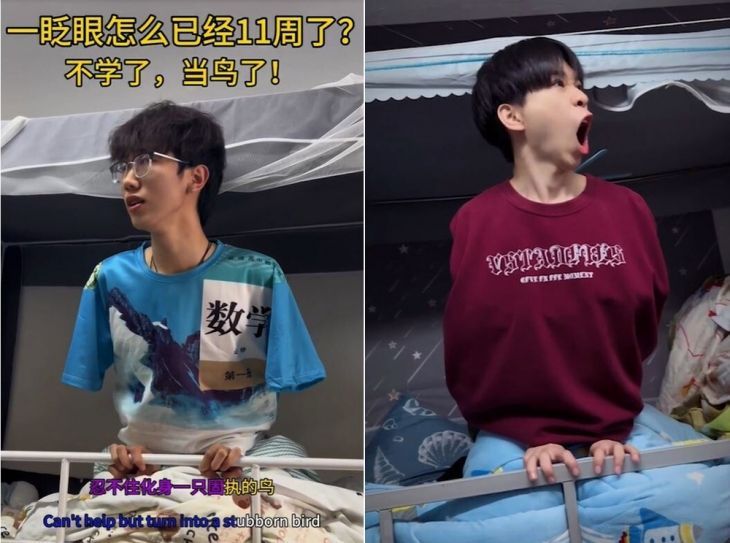 Wang Weihan, a student at a university in Shanghai, posted a video on a Chinese social networking service (SNS) mimicking a bird in his dorm room. In the video, Wang is wearing a large short-sleeved T-shirt with his legs hidden.
 [Photo by Douyin]
Wang Weihang, a student at a university in Shanghai, posted a video imitating a bird in his dorm room on Chinese social networking services (SNS). In the video, Wang is wearing an oversized short-sleeved T-shirt with his legs hidden. Both arms are not put inside the sleeves but pulled down below the T-shirt to hold the bed rail, making them look like bird claws. He said he wanted to convey the stress students feel about upcoming exams. He added, "Birds are free and can fly aimlessly in the sky," explaining, "This social media trend expresses everyone's innate desire for freedom."
Zhao Weixiang, a biology major student from Shanxi Province in northern China, also posted a composite photo on Douyin showing himself perched on a utility pole in the shape of a bird, with the caption "Don't study more, become a bird." Through the video, he revealed the pressure he feels about exams that will determine whether he can enter the biology graduate program he desires and build a career in a highly competitive field.
Sociologists analyze this phenomenon as an extension of the 'Tangping' trend among Chinese youth. Especially, they explain it as a small struggle to momentarily escape the stress of work, study, and job hunting amid the slowing Chinese economy and uncertain future. The neologism 'Tangping,' which appeared around 2021 as the Chinese economy's growth slowed and the wealth gap widened, means lying down quietly and doing nothing. This Tangping trend starkly reveals the sense of deprivation and helplessness felt by the younger generation in China.
Xiang Bao, director of the Max Planck Institute for Social Anthropology in Germany, diagnosed the phenomenon, saying, "Chinese youth were a generation with high expectations for themselves, China, and the world, but after graduating from university and becoming adults, they became victims of the economic slowdown," adding, "They have started asking themselves, 'Why did I study so hard?'"
© The Asia Business Daily(www.asiae.co.kr). All rights reserved.
![Clutching a Stolen Dior Bag, Saying "I Hate Being Poor but Real"... The Grotesque Con of a "Human Knockoff" [Slate]](https://cwcontent.asiae.co.kr/asiaresize/183/2026021902243444107_1771435474.jpg)
















