Macro and Financial Experts Hold First Financial Risk Review Meeting After Appointment
Household Debt, PF Debt, Self-Employed Debt, and Second-Tier Financial Sector Soundness
Review of Four Major Risk Factors Status
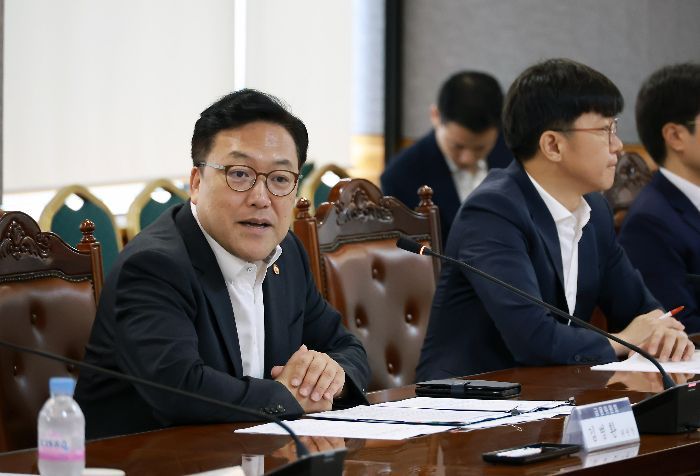
Kim Byung-hwan, Chairman of the Financial Services Commission, stated that he will strive for a soft landing through long-term, consistent policies with a high level of vigilance regarding the four major risk factors: household debt, real estate project financing (PF) debt, small business and self-employed debt, and the soundness of the secondary financial sector. He also emphasized closely monitoring stock market volatility amid the global major stock markets' turbulence and strengthening resilience to withstand adverse conditions.
On the 5th, Chairman Kim held a financial risk review meeting with macroeconomic and financial experts at the Korea Federation of Banks in Jung-gu, Seoul, to discuss countermeasures for the four major risk factors. Officials from related organizations such as the Financial Supervisory Service and Korea Asset Management Corporation (KAMCO), as well as private experts, attended the meeting.
The attendees emphasized that although the risk factors are unlikely to immediately escalate into a crisis, it is necessary to manage the situation with continued high vigilance. Chairman Kim also stressed that since domestic and international economic conditions, including recent major countries' monetary policies, the U.S. economic outlook, and the domestic real estate market, are at a turning point showing significant changes from the trends of recent years, enhanced inspection and response to market risks are required.
He said, "While swiftly stabilizing the four major risks accumulated over the past, we must also proactively manage newly emerging risks according to changing conditions. Given the current situation where major global stock markets are shaking due to concerns such as the recent U.S. economic slowdown, it is necessary to closely monitor stock market volatility."
Regarding specific issues, attendees pointed out that the household debt problem, which has sharply increased since April, could expand further depending on interest rate and real estate market conditions. Therefore, it is important to consistently maintain a policy stance on controlling the pace of household debt growth and managing its soundness. In particular, the implementation of the second phase of the stress total debt service ratio (DSR) scheduled for September 1, as well as the gradual and phased expansion of DSR application, could serve as important indicators of the government's commitment to managing household debt, highlighting the need for proactive and timely policy measures.
Regarding real estate PF, attendees agreed that the ongoing project evaluations and subsequent measures will be a critical turning point for the soft landing of PF debt. They also concurred that careful management is necessary to prevent increased burdens on the financial sector and the construction industry during the soft landing process. Concerning small business debt, it was suggested that various supports such as financial assistance including maturity extensions, management burden relief, and sales support should be provided to gradually reduce accumulated debts within repayment capacity. There was also a proposal to support the practical recovery of small business owners through more active debt restructuring, such as the New Start Fund, in cases where repayment is difficult.
Furthermore, regarding the soundness of the secondary financial sector, it was forecasted that it will take some time for the currently rising delinquency rates to stabilize, as issues in the secondary financial sector are linked with other risk factors such as PF and small business debt. However, attendees noted that unlike past crises, financial companies are proactively and preemptively managing non-performing loans and making efforts to enhance loss absorption capacity through provisions, so it is expected that soundness indicators will gradually stabilize under the current interest rate stabilization trend.
In response, Chairman Kim pointed out that the fundamental reason why the Korean financial system is vulnerable to external shocks is its higher debt ratio and debt dependency compared to major countries. He emphasized the importance of improving the debt-centered structure for sustainable economic growth, restoring dynamism, and financial stability. He stated, "We will consistently pursue ongoing debt response policies such as the second and third phases of stress DSR implementation and project-by-project PF evaluations," adding, "We will accelerate the implementation of immediate policy tasks to transition the financial structure from debt-centered to capital-centered."
He continued, "The task of debt response does not mean reducing the absolute scale of debt but stabilizing debt at an appropriate level in connection with the real economy," and added, "To alleviate difficulties arising during the debt response process, the government and financial sector will cooperate to adjust debt burdens, support recovery, and continuously expand support for low-income financial services."
Meanwhile, Chairman Kim stated, "The government is focusing on strengthening resilience to withstand external adverse factors through mid- to long-term structural improvements of our stock market and creating an investment environment that investors can trust," explaining, "To this end, we will steadily implement value-up programs and improvements to the short-selling system, and continue efforts to expand the domestic stock market investment base through tax support and other measures."
© The Asia Business Daily(www.asiae.co.kr). All rights reserved.

















