Korea Institute for Health and Social Affairs Survey Results Released
"58.2% Say Different Political Views Prevent Dating and Marriage"
74.1% Distrust National Assembly... Also Distrust Religion and Prosecution
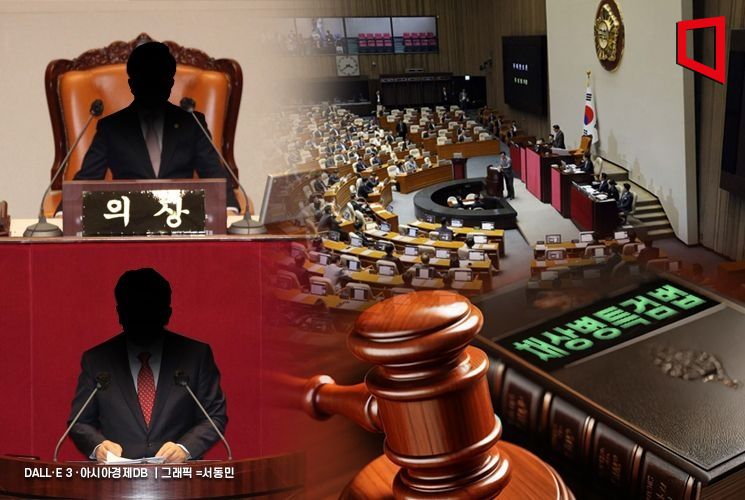
More than half of the population responded that they would not date or marry someone with different political views, according to a survey. The analysis suggests that social conflicts have generally intensified in various areas.
On the 4th, the Korea Institute for Health and Social Affairs (KIHASA) analyzed this in its report titled "Diagnosis of Social Integration Status and Response Measures (Ⅹ) - Perceptions of Fairness and Conflict."
In the "2023 Survey on Social Conflict and Social Integration Status" conducted by KIHASA from June to August last year among 3,950 men and women aged 19 to 75, respondents rated social integration at an average of 4.2 points out of 10. Since the survey began in 2014, the score rose to 4.59 points in 2021, right after the COVID-19 pandemic (social epidemic), but has declined since then. The report explained, "During the fight against the common enemy of the infectious disease, society became more cohesive, but after the peak of the outbreak passed, the integration level dropped again."
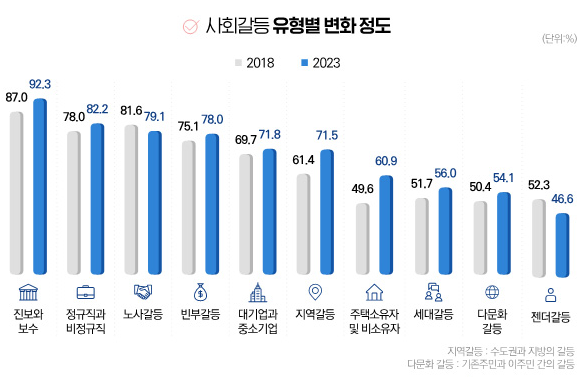
Social conflict levels have also increased. The social conflict score rose from 2.88 points (out of 4) in 2018 to 2.93 points last year. The top conflict issue identified by respondents was the conflict between progressives and conservatives. 92.3% said the progressive-conservative conflict is serious, up 5.3 percentage points from 87.0% in 2018.
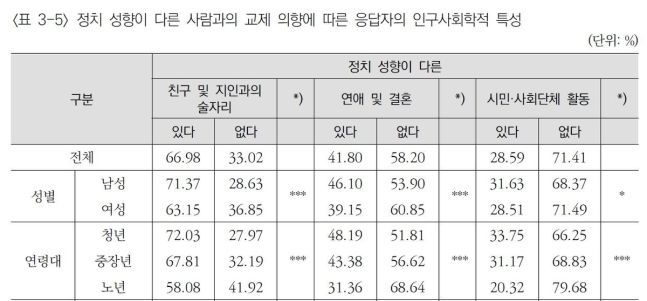
The conflict between progressives and conservatives also affected perceptions of forming personal relationships. More than half of respondents, 58.2%, said they could not date or marry someone with different political views. In particular, women (60.9%) were more likely than men (53.9%) to agree, and middle-aged (56.6%) and elderly (68.6%) groups more than young adults (51.8%).
33.0% said they could not share drinks with friends or acquaintances who have different political views. 71.4% said they would not participate in civic or social group activities with people holding different political views.
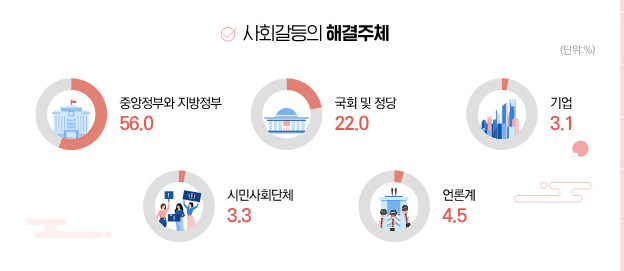
The report stated, "If dialogue and communication are cut off, conflicts will not be resolved but will inevitably deepen," and suggested, "To resolve conflicts, confrontations, tensions, and antagonisms among social members, it is necessary to activate public forums both online and offline where people with different thoughts and positions can meet and talk."
Additionally, respondents viewed conflicts between regular and irregular workers (82.2%), labor-management conflicts (79.1%), wealth disparity conflicts (78.0%), conflicts between large corporations and small and medium enterprises (71.8%), and regional conflicts (71.5%) as serious.
Meanwhile, among institutions and organizations, the public showed high trust in the medical sector (81.9%), financial institutions (74.5%), large corporations (69.9%), and the education sector (67.7%). Conversely, the religious sector (44.8%), prosecution and police (44.8%), civic movement organizations (42.2%), the executive branch (39.4%), courts (38.8%), media (35.4%), and labor unions (33.1%) were relatively distrusted. Notably, trust in the National Assembly was only 21.1%, with 74.1% expressing distrust.
However, individual life satisfaction and happiness increased after COVID-19, and feelings of depression decreased. Happiness, measured on a 10-point scale, averaged 6.76 points last year, up from 6.33 points in 2021. Life satisfaction also rose from 5.9 points to 6.46 points during the same period. Depression scores fell from 2.92 to 2.57.
© The Asia Business Daily(www.asiae.co.kr). All rights reserved.



















