"61.4% Say 'ESG Management Needed for Food Companies'
ESG Management Influences Future Product Purchases"
Nine out of ten consumers said they would not purchase products from food companies involved in power abuse issues. It has been revealed that whether a company practices ESG (Environmental, Social, and Governance) management is becoming increasingly important in consumers' food purchasing decisions.
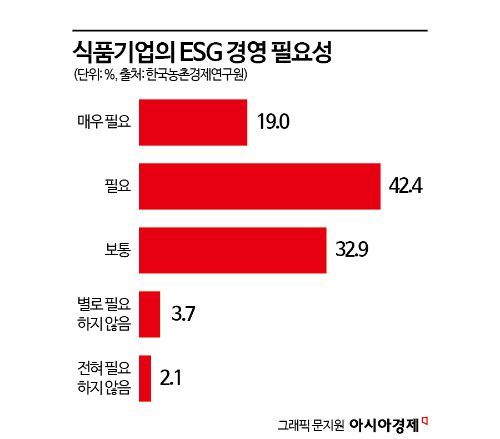
According to a survey titled “Consumer Opinions and Reactions on the Social Responsibility of Food Companies” conducted by the Korea Rural Economic Institute on June 3, targeting consumers nationwide aged between 19 and 74, 61.4% of respondents as of last year believed ESG management is necessary. This figure has increased by 6.6 percentage points over two years compared to 54.8% in 2021.
By age group, those in their 60s rated the necessity of ESG management the highest at 67.8%, showing a significant difference compared to those in their 30s (54.4%). Additionally, respondents with higher education levels and those in higher household income brackets tended to evaluate ESG management more positively. Conversely, only 5.8% thought ESG management was unnecessary.
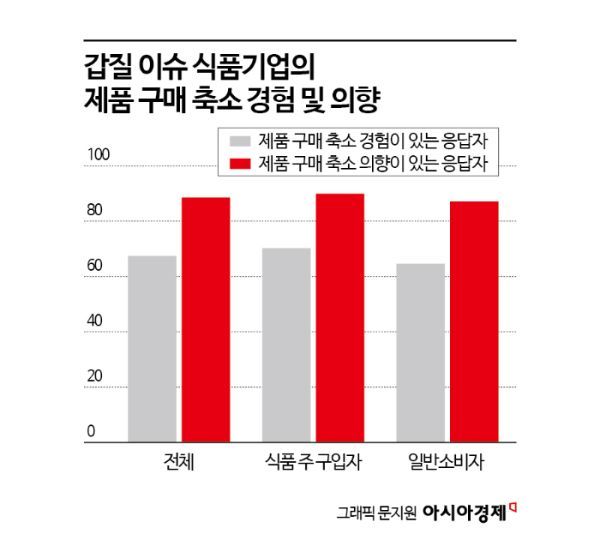
In fact, respondents showed a strong correlation between the necessity of ESG management and corporate image. After incidents of power abuse issues such as pushing large volumes of products to distributors, refusal of returns, and unilateral termination of transactions with partner companies by processed food manufacturing companies, 63.8% of respondents said the image of the company worsened. Furthermore, 67.4% reported having reduced their purchases of processed foods from companies involved in power abuse issues, and 88.5% expressed an intention to reduce purchases from such companies in the future.
Since the intention to reduce purchases is higher than the actual experience of reducing purchases, it is interpreted that power abuse issues could become an even more critical factor in the future sales of food manufacturing companies' products. Researcher Lim Ji-eun explained, “There is a relatively strong correlation between the experience and intention to reduce purchases of products from companies involved in power abuse issues. Consumers interested in specific social responsibility issues may also change their consumption regarding other related issues, and this behavior and intention may have persistence.”
Meanwhile, regarding packaging materials for processed foods, concerns about excessive packaging were the greatest. Among the reasons for dissatisfaction with processed food packaging, 66.2% of respondents cited “concerns about environmental pollution caused by excessive packaging,” showing a high level of awareness. This was followed by difficulties in separation and recycling (16.7%), concerns about environmental hormones (12.0%), concerns about quality degradation due to insufficient packaging (4.9%), and concerns about price increases due to excessive packaging (0.2%).
Since 2019, the government has implemented a “double packaging ban” to promote resource saving and recycling, prohibiting unnecessary additional packaging of already packaged products solely for promotional purposes. However, awareness of the double packaging ban was mixed: 47.0% had “heard of it but did not know the details,” 25.0% “knew it well,” and 28.0% “did not know it at all.” Meanwhile, 70.9% responded that the double packaging ban system is necessary, indicating that raising awareness of the related system is an important issue.
Additionally, regarding carbon neutrality, 85.5% of respondents thought it was necessary, showing a higher level of concern compared to other social responsibility issues. Also, 88.4% expressed willingness to increase purchases of processed food products from companies engaged in carbon neutrality activities, indicating that consumers recognize corporate carbon neutrality as an important social responsibility.
© The Asia Business Daily(www.asiae.co.kr). All rights reserved.
!["I'd Rather Live as a Glamorous Fake Than as a Poor Real Me"...A Grotesque Success Story Shaking the Korean Psyche [Slate]](https://cwcontent.asiae.co.kr/asiaresize/183/2026021902243444107_1771435474.jpg)

















