Tmon Engages in Both PG and Escrow Businesses
Potential Misuse of Payment Funds for Consumer Safety
CEO Koo Young-bae: "Part of Sales Proceeds Used for Acquisition Funds"
6 Platforms Operating Both Businesses
12 Companies Including Affiliates
Escrow Business Subject to Registration, Not Licensing, and Lacks Supervisory Regulations
Regarding the delay in settlement of sales proceeds by TMON and WEMAKEPRICE, there is speculation that TMON, which operates an escrow business, and the Qoo10 Group may have used funds meant for consumer transaction safety as acquisition funds. Many distribution platforms and open market companies also operate escrow services alongside electronic payment gateway (PG) services, raising concerns that incidents similar to TMON’s could recur.
According to the financial sector on the 7th, TMON registered not only as a PG operator but also as an escrow operator with the Financial Services Commission in 2016. Escrow is a system designed to protect consumers when they pay cash for goods in transactions between sellers (small businesses on the platform) and consumers. When consumers use escrow services, the escrow operator requests consumers to deposit the payment into their account. Once the deposit is confirmed, the escrow operator notifies the seller to ship the product to the consumer. After confirming product delivery, the escrow operator requests purchase approval from the consumer. The escrow operator then remits the remaining amount to the seller after deducting the escrow fee from the consumer’s payment. If the consumer requests a return due to product defects, the escrow operator refunds the full amount held to the consumer.
Platforms are intermediaries, not sellers, under the Electronic Commerce Act. Therefore, platforms are not subject to escrow obligations (such as the duty to notify the existence of escrow services) required of sellers under the Act. Nevertheless, TMON’s registration as an escrow operator may have been intended to repurpose the deposited payment funds at the group level for consumer transaction safety. TMON received escrow service outsourcing from Interpark Commerce, a Qoo10 Group affiliate. When consumers pay cash for goods on Interpark Commerce using escrow services, TMON manages those payment funds. From Qoo10 Group’s perspective, they can earn escrow fees while holding cash during the period from product shipment to purchase approval. Another Qoo10 affiliate, Wishplus, also introduced escrow services; if TMON had been entrusted with Wishplus’s escrow operations, consumer cash payments using escrow services at Wishplus would also flow to TMON. On the 29th of last month, Interpark Commerce changed its escrow outsourcing from TMON to other companies (such as KG Inicis).
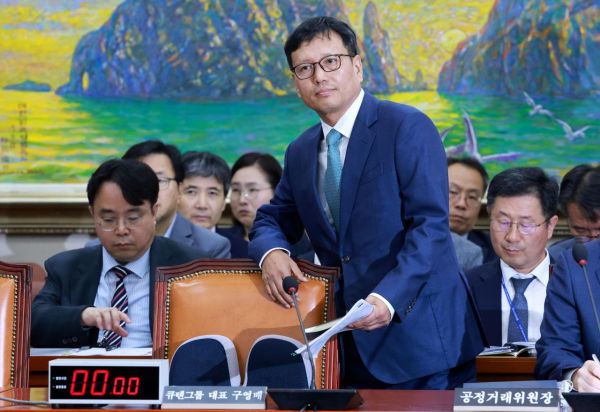 Koo Young-bae, CEO of Qoo10 Group, is attending an emergency inquiry related to the 'Timon and Wemakeprice settlement and refund delay incident' held at the National Assembly's Political Affairs Committee on the 30th. Photo by Hyunmin Kim kimhyun81@
TMON and WEMAKEPRICE also acted as secondary PG operators. When consumers make payments to purchase goods, the funds pass through the primary PG operator to the secondary PG operator before finally reaching the sellers. Since TMON and WEMAKEPRICE had longer settlement cycles for sellers compared to other platforms, they could hold the settlement funds owed to sellers for extended periods.
The usage of these funds has not yet been disclosed. However, Qoo10 may have used these funds to finance group activities such as the acquisition of Wish or to settle the blocked sales proceeds of TMON and WEMAKEPRICE. On the 30th, during an emergency inquiry at the National Assembly’s Political Affairs Committee, Qoo10 CEO Koo Young-bae acknowledged that part of the sales proceeds was included in the 40 billion KRW acquisition amount for Wish.
Under the current legal framework, many other distribution platforms and open market companies have registered as escrow operators in addition to PG operators, similar to TMON. According to the registration and cancellation status of electronic financial businesses, 42 companies have registered as escrow operators from 2007 to the 1st of this month. Among them, 12 companies (including TMON) operating open markets and registered as both PG and escrow operators (including cases where affiliates operate open markets) are Gmarket, Kakao, Lotte Members, TMON, Coupang Pay, Kakao Pay, 11st, Naver Financial, Lotte Shopping, Interpark Triple, Coupang, and Danggeun Pay. Having an escrow operator license does not necessarily mean these companies have outsourced escrow services to themselves or their affiliates. However, cases like TMON’s, where escrow services are self-outsourced rather than entrusted to a third party, can occur.
Escrow operation is a registration system, not a licensing system like PG operation. If a company meets the requirements under commercial law?including capital requirements, personnel requirements (securing at least five IT specialists), and physical requirements (provision of IT equipment)?the Financial Supervisory Service reviews the application and notifies the Financial Services Commission of the results. Disqualifications include company bankruptcy, failure to repay debts, or penalties for violating financial laws. The capital requirement is 1 billion KRW, but companies with quarterly electronic financial transaction amounts below 3 billion KRW can operate escrow services with only 300 million KRW in capital. The supervisory authorities have no regulations to oversee matters other than financial soundness, and even that oversight is only advisory in nature.
© The Asia Business Daily(www.asiae.co.kr). All rights reserved.
![Clutching a Stolen Dior Bag, Saying "I Hate Being Poor but Real"... The Grotesque Con of a "Human Knockoff" [Slate]](https://cwcontent.asiae.co.kr/asiaresize/183/2026021902243444107_1771435474.jpg)
















