UNIST Professor Kim Dongseok's Team Achieves High Efficiency Resistant to Prolonged Heat and UV
Solves Unstable Oxidation Issues... Enhanced Stability Through Tin Precursor Treatment
The commercialization of perovskite solar cells is expected to accelerate with the use of low-cost tin chloride.
A joint research team led by Professor Kim Dongseok from the Graduate School of Carbon Neutrality at UNIST (President Park Jongrae) and Dr. Cho Imhyeon from the Korea Institute of Energy Research has improved the stability of perovskite solar cells. By reacting inexpensive tin(IV) chloride on top of tin oxide, the team enhanced the stability of the solar cells.
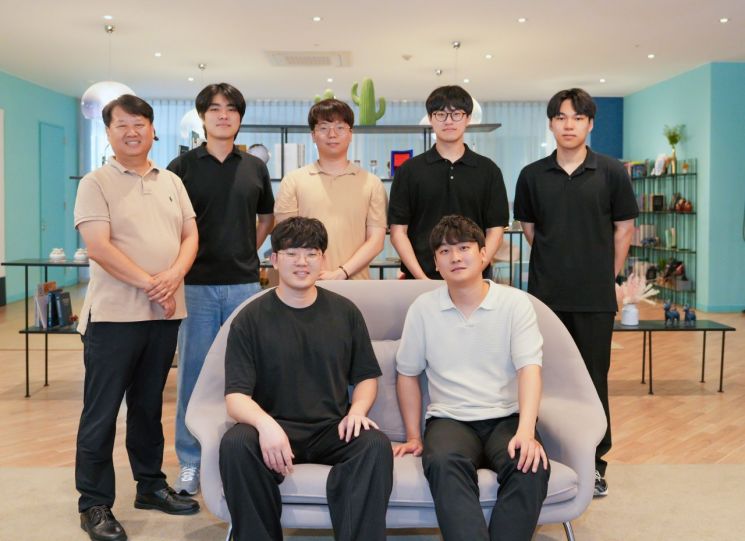 Research team (from left counterclockwise: Professor Kim Dongseok, Researcher Song Jiwon, Dr. Shin Yunseop)
For high efficiency in perovskite solar cells, it is important to control surface defects in the electron transport layer, a thin film that facilitates electron flow. These defects significantly affect not only the efficiency but also the stability of the solar cells.
The research team dissolved tin chloride in water and applied it to the oxide layer. During the treatment process, the formation of tin hydroxide completely oxidized the upper part of the tin oxide, and the acid induced recrystallization, which improved electron mobility.
The chemical solution deposition method is a technique for forming tin oxide layers, but it naturally creates surface defects because the tin is not fully oxidized. Post-treatment to reduce these defects after forming the thin film is a key technology to achieve both high efficiency and long-term stability.
To commercialize perovskite solar cells, passing various certification tests is essential. The research team improved the electron transport layer to enhance device efficiency and demonstrated performance that withstands prolonged heat and ultraviolet exposure.
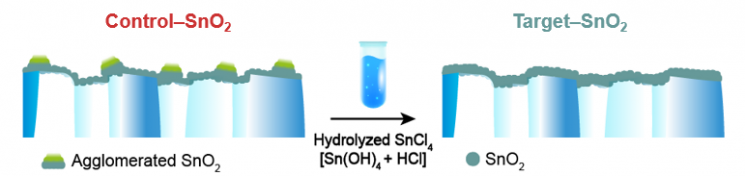
Professor Kim Dongseok explained, "Through this research, we succeeded in suppressing the aggregation of tin oxide and enhancing its crystallinity. This technology will play an important role in improving the stability of solar cells."
Researcher Song Jiweon and Dr. Shin Yunseop said, "By using inexpensive tin chloride, we expect to achieve high efficiency, high durability, and low cost simultaneously, bringing positive changes to the energy industry."
The research results were published online in Advanced Energy Materials on July 3.
© The Asia Business Daily(www.asiae.co.kr). All rights reserved.


















