Unveiled Jinju Daecheop Square: 1,300 Years of Jinju's History and Spirit Coexist
Created as 'The Square of History Remembered by the Land'
Landscaped with Zelkova Trees and More Inside Jinju Fortress
Serving as 'An Urban Oasis'
The city of Jinju in South Gyeongsang Province announced on the 1st that it had invited city reporters to the site of the Jinju Battle Square development project, located in front of Chokseokmun in Bonseong-dong, which has remained shrouded in mystery for 17 years but is finally beginning to take shape, to provide a comprehensive briefing on the project.
During the press briefing, the city shared updates on the progress of Jinju Battle Square, which is scheduled for completion at the end of August, stories from the development process, and future plans.
The Jinju Battle Square project is being carried out with a total budget of 94 billion KRW, covering a land area of 19,870 square meters and a total floor area of 7,081 square meters. The facility consists of an underground level with 149 parking spaces, and a ground level with minimal park support facilities and a historical park. Final construction is underway, aiming for completion by the end of August.
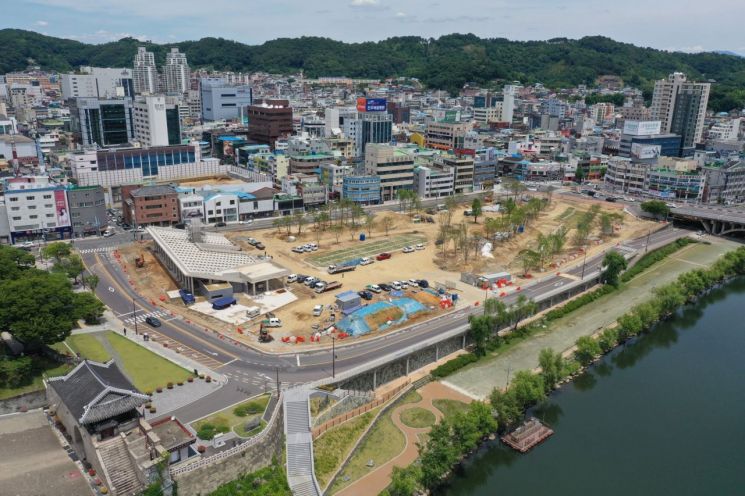
Jinju Battle Square broke ground in February 2022, 15 years after the initial master plan was established in 2007, following over a decade of large-scale compensation and demolition work and more than three years of cultural heritage excavation.
However, during the more than 15 years that passed, factors such as the construction of a cultural center, youth training center, youth hub house, and Jinju N Creative Culture Center near the square led to an expected increase in visitors. This created a need for management of the square, which can accommodate up to 20,000 square meters of visitors, as well as rest areas for guests. In response, the city allocated 5% of the total park area to install park support facilities, including an exhibition and promotion hall, a cafe, and offices for park management and operations.
Throughout this process, Jinju City received advice from many architects and historians. In particular, the city accepted a proposal from renowned modern architect Seung Hyo-sang, who suggested, "Let us create a square that embraces stories, awakens the history remembered by the land, and connects Jinju's past, present, and future." As a result, the park support facilities were changed to the current PC slab stepped roof design.
The park support facilities can accommodate 400 to 600 spectators during events and offer various configurations depending on the user's perspective, making it a perfect space for cultural activities.
For landscaping within the historical park, Professor Kang Hocheol, a landscaping expert, advised the city to plant representative tree species from Jinju Fortress, such as zelkova, hackberry, pine, and ginkgo trees. In the future, shrubs and ground cover plants will also be planted with native species to blend naturally with Jinju Fortress.
In particular, by applying traditional Korean planting styles in clusters, the park will provide shaded rest areas from the strong sunlight in spring and summer, and serve as an urban natural retreat where visitors can enjoy diverse scenery throughout the four seasons.
Meanwhile, drainage channels from the Unified Silla period, earthen fortifications from the Goryeo period, and stone fortifications from the Joseon period discovered during the cultural heritage excavation will be preserved and maintained in accordance with the Cultural Heritage Administration's "on-site preservation" requirements. The drainage channels and earthen fortifications will be covered and reconstructed, with informational installations added.
For the outer fortress wall of Jinju Fortress, the exposure height will be determined based on the results of a stability review by a specialized institution and deliberation by the Cultural Heritage Administration, followed by preservation of the original shape. The northern slope will be covered with soil and grass will be planted, creating a historical exploration path for visitors to view the excavated relics.
The city plans to enhance the historical significance of Jinju Battle Square, which will be developed as a space that inherits past cultural heritage and coexists with the present while preparing for future generations. The square, commemorating the Jinju Battle?one of the three great battles of the Imjin War?will be shaped to embody the spirit of Jinju, with each viewing path reflecting the characteristics of its era.
To achieve this, the city will analyze the meaning of each path and traces of relationships through fingerprint analysis using period maps, visualize patterns, and use different paving materials so that visitors feel as if they are walking through a scene from history.
Additionally, Jinju City will commemorate the historic completion of Jinju Battle Square, a project that has been challenging and long in the making, by harmoniously arranging 1,592 commemorative floor inscriptions along the park's main road as a completion ceremony performance.
An official from the city stated, "Once Jinju Battle Square is completed, it will become a hot spot for the upcoming October festival. We hope that this historic site of overcoming national crisis will be transformed into a tourism resource and revitalize the stagnant old downtown. We are paying meticulous attention to planting every single tree and flower so that it can become a new landmark of our city."
© The Asia Business Daily(www.asiae.co.kr). All rights reserved.

















