Oil Prices Rise 4%... Largest Increase Since October Last Year
Impact of Hamas Leader Haniye's Assassination
Continued Rise Expected Amid Escalating Middle East Military Tensions
Factors Limiting Further Oil Price Increases Also Exist
Possible Production Cut Lift Due to China's Demand Slowdown Concerns
As military tensions in the Middle East reached a peak following the assassination of Hamas leader, New York crude oil prices surged more than 4%.
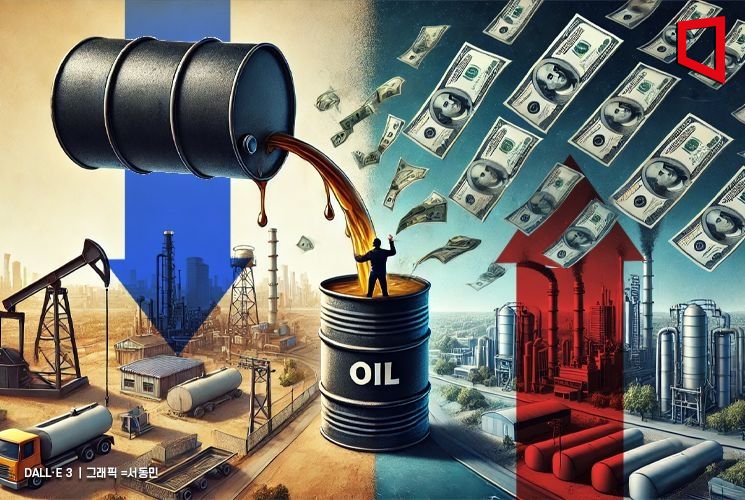
On the 31st of last month (local time), the September delivery West Texas Intermediate (WTI) crude oil contract, the near-month contract, closed at $77.91 per barrel on the New York Mercantile Exchange, up 4.26% from the previous trading day. This marked the largest single-day increase since October 2023. The global benchmark Brent crude for September delivery closed at $80.72 per barrel, up 2.66% from the previous session.
Oil prices had been declining for three consecutive days until the previous day, but buying surged after Hamas's top political leader, Haniyeh, was assassinated in Tehran, the capital of Iran, on the same day. Haniyeh had been visiting Iran to attend the inauguration ceremony of Iranian President Masoud Pezeshkian held the day before. Iran and Hamas pointed to Israel as behind Haniyeh's assassination and hinted at strong retaliation.
There are also views that the ceasefire in the Gaza war between Israel and Hamas is now out of reach due to this assassination. Priyanka Sachdev, senior market analyst at Phillip Nova Securities in Singapore, analyzed that "it seems certain that hopes for a ceasefire have disappeared" following this attack. Earlier, Israel confirmed the death of Fuad Shukr, a senior commander of Hezbollah, the pro-Iranian Islamic militant group in Lebanon, in an airstrike on Beirut, Lebanon. This was a retaliatory attack by Israel after Hezbollah bombed a soccer stadium in the Israeli-occupied Golan Heights on the 27th, killing 12 children.
As military tensions in the Middle East escalate, oil prices are expected to continue rising for the time being. Clay Siegel, Global Oil Services Director at Rapidan Energy Group, said, "Oil traders have so far mispriced Middle East risks," adding, "Now the Middle East has entered a worsening phase, which will attract the attention of oil traders and add a significant risk premium to Brent crude prices."
On the other hand, there is also analysis that Haniyeh's assassination will not provide sustained upward momentum for oil prices. Tamas Varga, oil analyst at PVM Associates, said, "Because the assassination occurred on Iranian territory, the risk of actual oil supply disruption increased and oil prices rallied," but added, "The shock will not last unless the military conflict expansion clearly threatens the physical oil production in the region."
The larger-than-expected decline in U.S. crude oil inventories also put upward pressure on oil prices. According to the U.S. Energy Information Administration (EIA), U.S. crude oil inventories for the week ending on the 26th decreased by 3.43 million barrels compared to the previous week. This figure is more than three times the expert forecast of a 1.1 million barrel decrease.
Predictions that demand from China, the world's largest crude oil importer, may continue to weaken, and the possibility that production cuts by OPEC countries and non-OPEC oil producers including Russia, collectively known as OPEC Plus (OPEC+), may be partially lifted starting in October, are factors limiting further oil price increases.
© The Asia Business Daily(www.asiae.co.kr). All rights reserved.

















