Fed Holds Interest Rates Steady for 8th Consecutive Time... "Caution on Both Employment and Inflation"
Powell: "Carefully Watching for Deterioration in Job Market"
"Growing Confidence in Inflation Sustaining Slowdown to 2%"
"While the risk of inflation rebound has decreased due to the cooling labor market, the risk of employment slowdown can now be considered substantial. Interest rate cuts may be discussed at the upcoming September meeting."
Jerome Powell, Chairman of the U.S. Federal Reserve (Fed), has recently expressed caution regarding the risk of a slowdown in the labor market, which is showing signs of cooling. He also stated that confidence has grown regarding the possibility of achieving the long-emphasized '2% inflation slowdown.' With the Fed holding the benchmark interest rate steady for the eighth consecutive time at the Federal Open Market Committee (FOMC) meeting, this is interpreted as effectively opening the door to a rate cut in September. Powell’s announcement of a significant shift in monetary policy led to a sharp rise in the New York stock market.
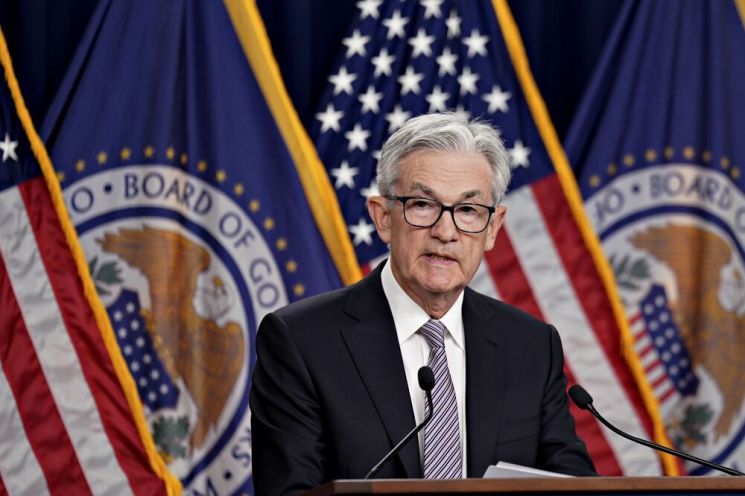
At a press conference following the July FOMC regular meeting held on the 31st (local time), Chairman Powell said, "A policy rate cut could be discussed at the next meeting in September," adding, "It is not yet the appropriate time to lower the policy rate, but we are getting closer."
Powell’s mention of a possible rate cut in September stems from concerns about labor market cooling. By repeatedly warning about the risk of labor market weakening that day, he suggested that the Fed’s concerns have shifted from inflation risks to employment slowdown risks.
He explained, "We are watching very carefully for a rapid deterioration in the job market," and "We are prepared to respond if the labor market unexpectedly weakens or if inflation falls faster than expected."
Regarding the inflation risks that the Fed had been concerned about, he diagnosed, "The Q2 price indicators have strengthened our confidence that inflation is steadily slowing to 2%," and "With progress on inflation, there is no longer a need to focus 100% on prices."
At this FOMC, the Fed kept the federal funds rate unchanged at 5.25?5.5%. This marks the eighth consecutive hold following decisions in September, November, and December of last year, and January, March, May, and June of this year. As a result, the interest rate gap with South Korea remains at 2 percentage points at the upper bound.
The Fed added language signaling a shift in monetary policy in the policy statement issued that day. New phrases included noting that the unemployment rate has risen and that attention will be paid not only to inflation risks but also to employment risks. The assessment of the inflation situation was also improved.
According to the policy statement that day, the Fed described inflation as "somewhat elevated." Previously, it was diagnosed as "elevated," but the word "somewhat" was added. Also, regarding progress toward the 2% inflation target, the previously used phrase "modest progress" was replaced with "some progress." These changes indicate an improved evaluation of the inflation situation compared to the previous FOMC.
Additionally, the Fed stated, "Job gains have moderated and the unemployment rate has risen but remains low," with the phrase "has moved up" added to describe the unemployment rate.
Furthermore, the Fed emphasized, "We continue to judge that the risks to achieving employment and inflation goals are becoming better balanced," and "The economic outlook is uncertain, and the Committee is paying attention to risks on both sides of its dual mandate." By removing the previously included phrase about "inflation risks" and adding the phrase about "risks to both (employment and inflation) mandates," this is interpreted as signaling a significant shift in the Fed’s monetary policy direction. Recent signals of labor market slowdown suggest that a rate cut could come soon.
Chairman Powell also revealed at the press conference that discussions about rate cuts took place among Fed officials. He explained that the vast majority supported holding the benchmark rate steady, but some officials advocated for a rate cut in July. At the next September meeting, as Powell forecasted, discussions about rate cuts are expected to be seriously considered.
The market welcomed Powell’s remarks and the FOMC meeting results. The Dow Jones Industrial Average, composed of blue-chip stocks, closed up 0.24% from the previous session. The S&P 500 and Nasdaq indices rose 1.58% and 2.64%, respectively. The Nasdaq extended its gains after the FOMC.
Government bond yields have fallen sharply on expectations of rate cuts. The U.S. 2-year Treasury yield, sensitive to monetary policy, is currently down 6 basis points (1bp = 0.01 percentage points) from the previous trading day to 4.29%, while the U.S. 10-year Treasury yield, a global bond yield benchmark, is trading around 4.06%, down 8 basis points from the previous day.
Jeffrey Roach, Chief Economist at LPL, analyzed, "The Fed’s statement has prepared the market for an upcoming rate cut," adding, "With improving inflation and rising unemployment, the Fed can cut rates while keeping nominal rates above the inflation rate." He further noted, "As the Fed fine-tunes its tone, the market is likely to respond favorably."
© The Asia Business Daily(www.asiae.co.kr). All rights reserved.

















