Ismail Haniyeh, the top political leader of the Palestinian armed faction Hamas, was assassinated in Tehran immediately after the inauguration ceremony of the Iranian president, signaling a major upheaval in the Middle East situation. While Israel is being pointed to as the mastermind behind the attack, Hamas has promptly promised retaliation, and Iran, which failed to protect its allies on its own soil, also convened an emergency session of the Supreme National Security Council (SNSC). If Iran takes a hardline response, the possibility of a full-scale war is being raised.
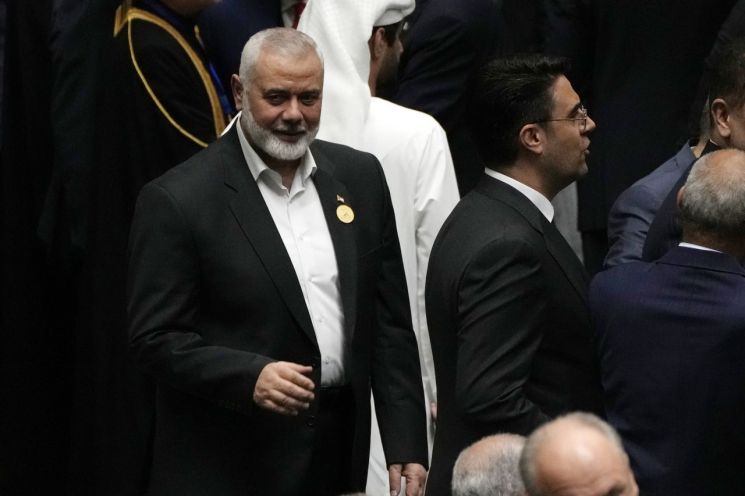
On the morning of the 31st (local time), Hamas issued a statement saying, "Martyr Haniyeh died due to a deceptive attack by Zionists (Israel) targeting his residence in Tehran after attending the inauguration ceremony of the new Iranian president." The Islamic Revolutionary Guard Corps (IRGC) also confirmed in a statement, "Hamas Political Bureau Chief Haniyeh was attacked at his residence in Tehran this morning and was martyred along with one of his bodyguards."
Currently, Hamas and Iran are attributing the assassination to Israel. If it is confirmed that Israel was behind the attack, it would be the first direct Israeli strike on Iranian mainland since April 19. Haniyeh had been visiting Iran to attend the inauguration ceremony of President Masoud Pezeshkian, along with officials from the so-called 'Axis of Resistance' including Hamas, Lebanon's Hezbollah, and Yemen's Houthi rebels, and was staying in the capital, Tehran.
With the Gaza Strip war between Israel and Hamas entering its tenth month, the death of Hamas's top leader is expected to disrupt the ceasefire and hostage negotiations in which Haniyeh played a key role, and plunge the Middle East situation into turmoil. Notably, this assassination in the Iranian capital occurred just hours after Israel retaliated for a Golan Heights bombing by airstriking Beirut, Lebanon’s capital, eliminating Hezbollah’s top commander Fouad Shukr, raising concerns about the conflict spreading throughout the entire Middle East region.
The New York Times (NYT) analyzed, "The focus now is on how Hamas and Hezbollah will respond to the attacks on their leaders, and how Iran will react to the attack on its territory," adding, "The key question is which of these will lead to a broader regional war." CNN also predicted, "This incident will further destabilize the Middle East and jeopardize negotiations between Israel and Hamas."
Hamas has immediately promised retaliation. The Palestinian Liberation Front (PFLP), a hardline faction affiliated with the Palestine Liberation Organization (PLO), also declared that Israel has crossed a 'red line' and stated, "The Axis of Resistance is fully prepared to confront the enemy." Nasser Kanaani, spokesperson for the Iranian Ministry of Foreign Affairs, said, "Haniyeh’s blood will not be in vain," adding, "Haniyeh’s martyrdom in Tehran will strengthen the deep and inseparable bond between Iran, Palestine, and the resistance forces."
On the morning of the same day, Iran convened an emergency session of the Supreme National Security Council (SNSC) at the residence of Ayatollah Khamenei, attended by the elite Quds Force commander of the Revolutionary Guard, to discuss countermeasures, according to major foreign media. These outlets noted the significance of Haniyeh’s death during his visit to Tehran and suggested it could be interpreted as a 'declaration of war against Iran.' Iranian state TV reported that the IRGC plans to announce the investigation results later that day.
Russia and T?rkiye also condemned the attack as a "cowardly murder" and "political assassination." The Turkish Ministry of Foreign Affairs warned that the attack could expand the Gaza Strip war to the entire Middle East region and urged the international community to stop Israel.
Israel has not yet issued an official response regarding Haniyeh’s death. The Israeli military stated, "There is currently no change in the directives of the military front command," adding, "The Israeli military is assessing the situation and will announce any changes if they occur."
The United States, which has been focused on finding a solution to the Gaza Strip war, is cautiously monitoring the situation, wary of escalation. The White House acknowledged receiving news of Haniyeh’s death but refrained from further comment. U.S. Secretary of Defense Lloyd Austin, who is visiting the Philippines, responded to questions about Haniyeh’s assassination by saying, "War is not inevitable," and "There is always space and opportunity for diplomacy." He added, "We will do our best to prevent the situation in the region from escalating into a broader conflict."
© The Asia Business Daily(www.asiae.co.kr). All rights reserved.
![Clutching a Stolen Dior Bag, Saying "I Hate Being Poor but Real"... The Grotesque Con of a "Human Knockoff" [Slate]](https://cwcontent.asiae.co.kr/asiaresize/183/2026021902243444107_1771435474.jpg)
















