North Korea Declares Two-State Theory... Rather Boosting Unification Sentiment
Despite North Korea's continuous provocations keeping inter-Korean relations in a cooling period, it has been found that 8 out of 10 South Koreans believe unification is necessary. North Korea designated the South as an enemy from the end of last year, but rather, since that time, public opinion in favor of unification has been rising.
According to the Democratic Peaceful Unification Advisory Council (hereinafter referred to as the Democratic Peace Council) on the 31st, in the second quarter 'National Unification Opinion Survey,' 78.0% of respondents answered that 'unification is necessary (strongly agree 39.9% · somewhat agree 38.1%).' The opinion that unification is necessary has risen for two consecutive quarters, reaching the highest level since the third quarter of 2018 (78.3%). The response that 'unification is not necessary (not really 13.9% · not at all 7.0%)' remained at 20.9%.
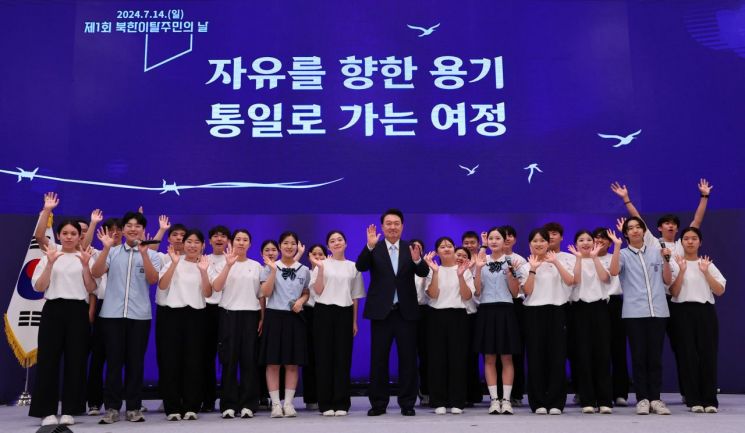 President Yoon Suk-yeol is taking a commemorative photo with South Korean youth and North Korean defector youth choirs at the '1st North Korean Defectors Day Ceremony' held at the Blue House State Guesthouse on the 14th. [Image source=Yonhap News]
As for the values to be pursued in unification, peace (59.2%) was chosen as the top priority. Next were freedom (52.2%), human rights (33.9%), democracy (21.3%), and prosperity (20.2%). In the same context, the most selected reason for unification was the resolution of the threat of war (34.9%). This was followed by economic development (23.3%), realization of freedom and human rights (17.0%), and restoration of ethnic homogeneity (15.0%). Unlike in the past when unification was perceived mainly from the perspective of 'Korean ethnic homogeneity,' there appears to be a shift toward viewing unification from security and economic perspectives.
Regarding the question about the future vision of unification we aim for, the largest number of respondents answered the realization of liberal democratic values such as freedom and human rights (47.4%). This aligns with the liberal democratic values pursued by the Yoon Suk-yeol administration and the new unification discourse being established based on these values. Strengthening national growth engines and economic prosperity (44.9%), resolving security threats such as nuclear weapons and war (42.3%), and contributing to peace and prosperity in the international community (22.7%) followed.
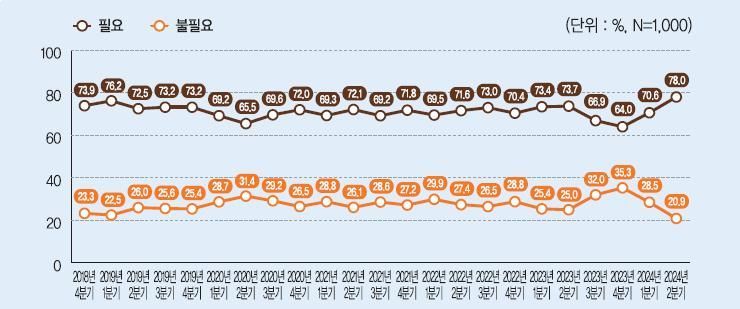
This survey was conducted from the 7th to the 9th of last month, targeting 1,000 adult men and women aged 19 and over nationwide. At a 95% confidence level, the maximum allowable sampling error is ±3.1 percentage points. The Democratic Peace Council conducts unification opinion surveys quarterly and compares and analyzes the results with those of experts and Democratic Peace Council advisory members.
© The Asia Business Daily(www.asiae.co.kr). All rights reserved.
![Clutching a Stolen Dior Bag, Saying "I Hate Being Poor but Real"... The Grotesque Con of a "Human Knockoff" [Slate]](https://cwcontent.asiae.co.kr/asiaresize/183/2026021902243444107_1771435474.jpg)

















