Yoon Byung-tae, Mayor of Naju City in Jeollanam-do, introduced the achievements and vision of the 8th local government of Naju City, which is being promoted with the goal of strengthening local competitiveness, at the Korea-Japan Joint Seminar.
According to the city on the 31st, the 15th Korea-Japan Joint Seminar was held the previous day at the Korea Chamber of Commerce and Industry in Seoul, hosted by the Korea Institute of Local Administration and the Japan Local Government Internationalization Association.
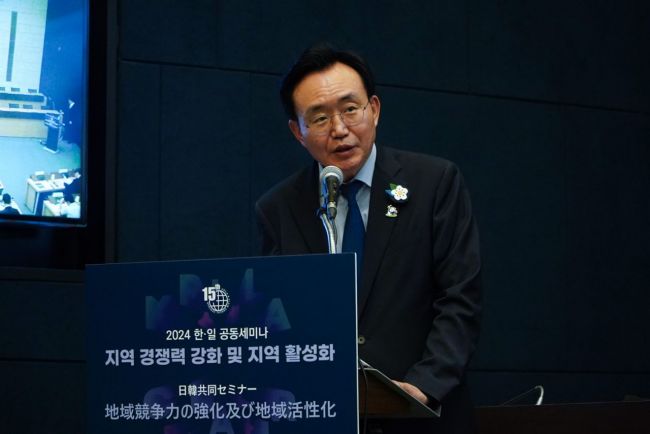 On the 30th, Yoon Byung-tae, Mayor of Naju, delivered a keynote speech at the 15th Korea-Japan Joint Seminar, introducing the achievements and vision of Naju during the 8th local government term, as well as Naju's leading policies to overcome the issue of population decline.
 [Photo by Naju City]
Mayor Yoon Byung-tae delivered a keynote speech representing both countries alongside Hirota Kazuyasu, Mayor of Kurayoshi City, Tottori Prefecture, Japan, which is an international sister city.
This seminar is an academic seminar where experts from Korea and Japan jointly research and seek practical alternatives on issues facing both countries, and it has been held annually since 2009.
This year, under the theme “The Role and Efforts of Local Governments for Strengthening Regional Competitiveness and Revitalizing Local Areas,” experts and local government heads from both countries attended to deliver keynote speeches, thematic presentations, and panel discussions.
Mayor Yoon delivered a keynote speech titled “The Dawn of a New Yeongsan River Era, Designing the Future with History in Naju.”
Mayor Yoon reexamined the historical status and scale of Naju-mok during the Goryeo and Joseon dynasties, the center of the ancient cultural zone of the Yeongsan River basin.
He then explained the current Naju, which is advancing as a successful model of national balanced development through the establishment of the Gwangju-Jeonnam Joint Innovation City, where 16 relocated public institutions have moved, and the founding of the Korea Energy Technology University (KENTECH).
He also mentioned the top 10 achievements of the first half of the 8th local government, including the designation of the Direct Current Industry Global Innovation Regulatory Free Zone and Education Free Zone as leading areas, selection for the Food Tech Research Support Center construction contest, supply of free rental housing for employed youth, the nation’s first integrated odor control center in Jeonnam, and the provision of standing tables and chairs to all village senior centers.
Mayor Yoon announced three major pillar projects that Naju City is promoting to leap forward as a hub for national balanced development: “Agricultural Life,” “New Energy Industry,” and “Tourism Revitalization,” as well as leading policies addressing population decline issues such as “Revitalization of Returning to Rural Areas,” “Improvement of Educational Environment,” and “Support for Childbirth and Childcare.”
In particular, he explained Naju’s vision as a city centered on the new energy industry, including attracting 369 companies to the Energy Valley, early establishment of the Energy National Industrial Complex, an energy cluster linked with KENTECH, and efforts to attract an artificial sun research facility by securing superconducting conductor testing equipment.
He also introduced a blueprint for the 5 million Naju tourism era through projects such as the national garden designation of the 570,000-pyeong Yeongsan River reservoir, the 300-ri Yeongsan River bicycle path, panoramic tourism spots along the Yeongsan River, restoration of Naju-mok cultural assets, the 2024 Naju Festival and the nationwide Naju Marathon, and cultural regeneration of the old Naju Theater and Hwanam Industrial Site.
Regarding solutions to the population decline problem, he emphasized “improving residential environments to revitalize returning to rural areas, making Naju a premium educational city attracting people for education, and supporting childbirth policies without any conditions or restrictions.”
He cited exemplary policy cases such as revitalizing rural centers in eup and myeon areas, rural spatial maintenance, creation of leading villages for returning farmers and residents, establishment of a future education support center, operation of joint educational programs linked with relocated public institutions under the designation of an education development special zone, removal of conditions for infertility couple facility expenses, childbirth incentives, and housekeeping care services, and the establishment of a 365-day childcare room free from parenting worries.
Mayor Yoon said, “The biggest issue facing our country is population decline, and to solve it, we must create a sustainable balanced development ecosystem, a country where local areas prosper, and a country where people flock to local areas.”
He added, “The center of Korea’s economic development has always been along rivers, and Naju City seeks to find the national balanced development hub in the Yeongsan River. Following the Han River centered on the metropolitan area, the Nakdong River centered on heavy chemical industry, and the Geum River where Daedeok Special Zone and Sejong City are located, the last puzzle piece is the Yeongsan River.”
He emphasized, “Naju City will propose a successful national balanced development model centered on the Yeongsan River and achieve the miracle of the Yeongsan River through a bold future vision supported by the nation.”
Naju = Asia Economy Honam Reporting Headquarters Reporter Kim Yuk-bong baekok@asiae.co.kr
© The Asia Business Daily(www.asiae.co.kr). All rights reserved.

![A Woman with 50 Million Won Debt Clutches a Stolen Dior Bag and Jumps... A Monster Is Born [Slate]](https://cwcontent.asiae.co.kr/asiaresize/183/2026021902243444107_1771435474.jpg)















