Using T-Mef Funds to Acquire US Shopping Mall Wish
Repayment of Acquisition Funds Using Wish Capital... Appears as a No-Capital M&A

The true identity of Koo Young-bae, CEO of Qoo10, was revealed to be a ‘capital-free multinational corporate raider.’
CEO Koo established or acquired corporations in several countries including Singapore (Qoo10, Qxpress), South Korea (Timon), and the United States (Wish), and attempted to list the Singaporean corporation Qxpress on the U.S. Nasdaq by linking their shares and businesses.
His management behavior of Qoo10 and Timon, revealed through the National Assembly’s Political Affairs Committee inquiry on Timon and Wemakeprice (Timon), showed a typical case of capital-free mergers and acquisitions (M&A), where he bought e-commerce companies left as mere shells with company funds and covered the acquisition funds using the acquired companies’ own money.
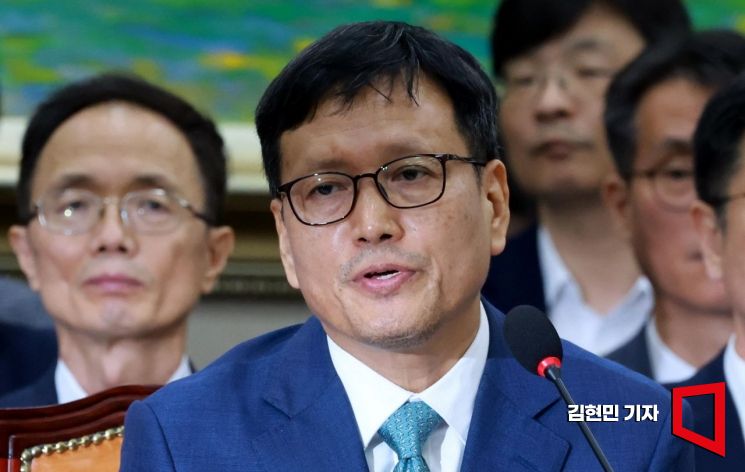 Koo Young-bae, CEO of Qoo10 Group, is speaking at the urgent inquiry on the 'Timon and Wemakeprice settlement and refund delay incident' held on the 30th at the National Assembly's Political Affairs Committee. Photo by Hyunmin Kim kimhyun81@
In February, Qoo10 acquired the U.S. online shopping platform Wish for $173 million (approximately 230 billion KRW). During this process, it borrowed 40 billion KRW from Timon’s funds to supplement the acquisition funds and repaid it a month later. CEO Koo stated at the Political Affairs Committee, “The loan repayment was made using Wish’s retained earnings.” This is a form of capital-free M&A where a company is acquired without equity capital and the acquisition funds are covered by the acquired company’s funds.
Attorney Cho Dong-hyun of Barun Law Firm said, “If the Timon funds used for the Wish acquisition were settlement payments, there is a possibility of embezzlement.” He explained, “Although the Electronic Commerce Act does not specify a deadline for settlement payments, Timon and Wemakeprice would have predicted the scale and timing of these payments. If that money was sent outside the company and used for acquiring another company, it is problematic.”
He added, “CEO Koo’s M&A method is close to a leveraged buyout (LBO), which could be subject to charges of breach of trust. This will be confirmed in future prosecution investigations.”
If there were any illegal or irregular practices in the process of Wish lending its retained earnings to Qoo10, the Wish management could face breach of trust charges under U.S. law. Additionally, since Wish is also operating at a large deficit, there is speculation that the retained earnings mentioned by CEO Koo might have been settlement payments to sellers on the Wish platform.
It is also questionable how Qoo10, which was struggling financially, raised 190 billion KRW in addition to the 40 billion KRW borrowed from Timon. When questioned on the source of the Wish acquisition funds on the 30th, CEO Koo gave evasive answers. Financial Supervisory Service Governor Lee Bok-hyun stated at the Political Affairs Committee, “Strong traces of illegal activity were found during the tracking of Timon’s funds,” raising calls for verification of any illegality related to the Wish acquisition.
Meanwhile, CEO Koo stated that the whereabouts of 1 trillion KRW in customer sales proceeds were “used for promotions.” Considering that Timon was originally a shopping mall that frequently held special discount events, it is possible that a significant amount was indeed diverted to promotions. Using funds that should have been paid as settlement money to compensate sellers participating in special events is effectively a Ponzi scheme, where money owed to some sellers is paid early to others.
In fact, Timon aggressively pushed promotions starting in June when its financial difficulties worsened. It sold book and cultural gift certificates at a 10% discount with delivery delayed by a month through a ‘pre-order sale,’ and also sold prepaid money called Timon Cash at a 10% discount. At the National Assembly’s Political Affairs Committee, these promotions were criticized as a Ponzi scheme (a fraudulent method of paying returns to existing investors using funds from new investors). If Qoo10 was aware that gift certificates and prepaid money would become unusable in the future, the fraud charges would be even stronger.
The Financial Supervisory Service has requested a prosecution investigation into Qoo10’s illegal fund management. Complaints and accusations against CEO Koo for fraud, embezzlement, and breach of trust under the Act on the Aggravated Punishment of Specific Economic Crimes have also been filed with the prosecution.
© The Asia Business Daily(www.asiae.co.kr). All rights reserved.


















