KCCI 'Study on the Impact of Youth Migration on Regional Inflow' Report
1%p Increase in High-Tech Company Share Leads to 0.4%p Rise in Youth Inflow Share
Additional 0.15%p Increase When Combined with Residential Environment
An analysis has revealed that the effect of young people moving into a region is maximized when advanced industry jobs and residential environments are both well established in the area.
The Korea Chamber of Commerce and Industry (KCCI) announced this on the 31st in its report titled "A Study on the Impact of Young People Moving into Regions." The report analyzed factors influencing the migration of young people (aged 20-39) over 15 years from 2006 to 2021 across 17 metropolitan cities and provinces nationwide, including trends in young people moving in and out, the number of advanced industry enterprises, and residential environment factors such as transportation accessibility and cultural and medical facilities.
According to the report, the proportion of advanced industry enterprises among all businesses nationwide increased by 9.2 percentage points from 10.7% in 2006 to 19.9% in 2021. However, regionally, a clear concentration in the Seoul metropolitan area was observed. While the share of advanced industry enterprises among total businesses in the Seoul metropolitan area (Seoul, Gyeonggi, Incheon) rose from an average of 12.7% in 2006 to 23.8% in 2021, the non-metropolitan areas only increased from an average of 9.0% to 16.1%.
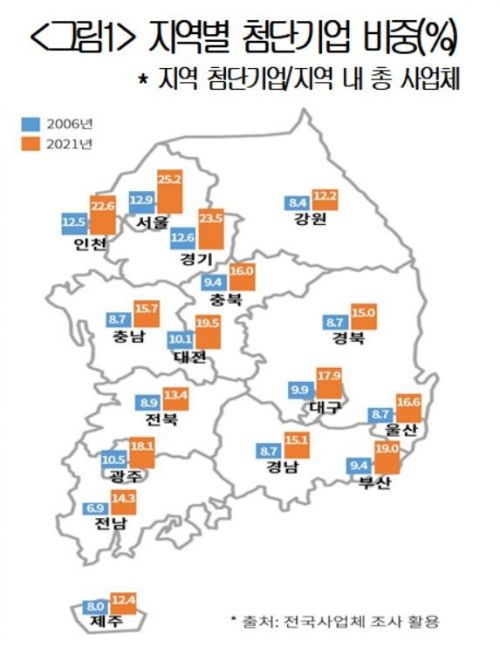
As of 2021, the nationwide average proportion of advanced industry enterprises was 17.5%, with higher concentrations closer to Seoul, such as Seoul (25.2%), Gyeonggi (23.5%), Incheon (22.6%), and Sejong (20.4%). Major metropolitan cities like Busan (19.0%) and Gwangju (18.1%) exceeded the average, whereas provincial areas such as Jeju (12.4%) and Gangwon (12.2%) showed relatively lower proportions.
The concentration of advanced industry enterprises in the Seoul metropolitan area also appeared to influence the concentration of young populations in the same region. In fact, since 2019, the proportion of young people among those moving out from non-metropolitan areas to other regions has exceeded 50%, reaching 51.8% in 2023. Among young people moving out, the share moving into the Seoul metropolitan area has steadily increased from 43.9% in 2015 to 47.0% in 2023, indicating that about half of the young population moving out is concentrating in the metropolitan area.
The report emphasized that advanced industry enterprises have a significant impact on attracting young populations to regions. Based on migration statistics of young people (aged 20-39) over 15 years (2006-2021) and quantitative analysis of various residential environment conditions, it was found that a 1 percentage point increase in the proportion of advanced industry enterprises among total businesses in a region corresponds to a 0.43 percentage point increase in the share of young people among the incoming population.
The KCCI stated that when transportation convenience and cultural facilities are above the national average, a 1 percentage point increase in the proportion of advanced industry enterprises leads to an additional 0.15 percentage point increase in the share of young people moving into the region, expanding the total increase to 0.59 percentage points.
These findings support the results of a communication platform survey conducted by the KCCI in May. When over 600 people in their 20s and 30s nationwide were asked which factor most influences their willingness to live outside the metropolitan area, 41.2% responded "residential conditions," the highest, followed by "salary and jobs" at 29.8%.
The report stated, "A high-quality residential environment that satisfies the cultural needs and transportation accessibility of young people in their 20s and 30s, who value individuality and preferences, is essential to promote their residence outside the metropolitan area. However, for such residential environments to be attractive to young people, good jobs that provide stable income must also be secured."
It added, "The government is making efforts to improve residential environments by building complex cultural centers with cultural and sports facilities within industrial complexes and improving transportation convenience in aging industrial complexes through industrial complex environment creation projects. However, these efforts mainly target existing aging industrial complexes, which differ somewhat from the locations that young people and advanced industry enterprises actually desire. Therefore, a combination of policies to improve residential environments and promote investment in advanced industry regions is necessary."
The report also pointed out that current residential support systems, operated by local governments and public institutions, such as purchased rental housing and jeonse rental housing, mainly focus on low-income groups. If young people do not meet income, asset, or marital status requirements, even if they are employed or wish to be employed by local companies, there are limitations in receiving support.
The KCCI argued that these systems are designed from the supplier's perspective and have limitations in meeting the location and surrounding convenience facilities desired by local companies, the demand side. Therefore, support for worker rental housing based on corporate demand is necessary.
Kang Seok-gu, head of the KCCI Research Headquarters, said, "The concentration of both advanced industry jobs and residential environments, which have a significant impact on attracting young people to regions, is accelerating in the Seoul metropolitan area. To promote young people's migration to regions, efforts to simultaneously establish advanced enterprises and residential environments are needed. For this, systems must be improved so that companies and young people, the demand side, can directly create workplaces and residential environments where young people want to work and live."
© The Asia Business Daily(www.asiae.co.kr). All rights reserved.

















