As of the 30th, 367 cumulative patients
13 areas in Seoul at risk of malaria
Due to hot and humid weather, malaria, which mainly occurred in the northern Gyeonggi region and Incheon, is spreading nationwide. Experts advised that malaria-carrying mosquitoes can thrive in hot and humid places such as valleys frequently visited during vacation season, and emphasized the need for special caution to prevent infection.
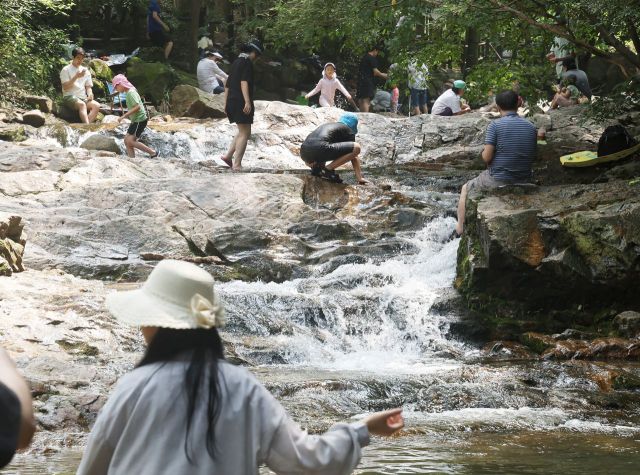 After Typhoon Khanun passed, the heatwave resumed, and on the bridge holiday of the 14th, citizens seeking to escape the heat visited the valley below Bukhansan in Eunpyeong-gu, Seoul, cooling off in the valley. Photo by Huh Younghan younghan@
According to the Korea Disease Control and Prevention Agency, the number of malaria patients recorded from January to July 30 this year was 367, about half compared to the previous year. The number of malaria patients slightly decreased from 559 in 2019 to 385 in 2020, but increased to 420 in 2022 and surged to 747 in 2023. This year, the number has already reached about half of last year's figure, and it is analyzed that it will surpass that by the end of the year.
Looking at the regions, patients who were mainly concentrated in Incheon, northern Gyeonggi, and Gangwon showed a tendency to spread to downtown Seoul. The region with the highest number of patients this year was Gyeonggi Province (196 patients). Seoul (66 patients) and Incheon (55 patients) followed. In particular, the number of 'malaria risk areas,' which totaled 30 places last year combining Incheon, Gyeonggi, and Gangwon, increased to 53 this year with the inclusion of 13 autonomous districts in Seoul such as Gangdong-gu, Gangbuk-gu, Gangseo-gu, and Gwangjin-gu. Malaria risk areas are designated within approximately a 500m radius from the residence of reported patients.

Malaria is designated and managed as a 'Class 3 infectious disease' by the Korea Disease Control and Prevention Agency. It is transmitted by female mosquitoes that carry malaria, and symptoms such as chills, fever, and sweating appear upon infection. Indigenous malaria occurring domestically has a lower mortality rate and is easier to treat compared to tropical malaria, but it can be fatal to vulnerable groups such as pregnant women and children, so caution is needed to prevent infection.
Experts explained that the recent hot and humid climate has influenced the increase in patient numbers and stressed the importance of paying attention to infection prevention especially during the vacation season. Lee Hee-il, head of the Vector Analysis Division at the Korea Disease Control and Prevention Agency, said, "This year, the government strengthened the criteria for designating risk areas to eradicate malaria, which led to Seoul being included as a risk area. Along with this, the recent continuation of hot and humid weather likely caused an increase in the number of malaria-carrying mosquitoes and patients."
He added, "Before leaving your home during the vacation season, it is important to check window screens to prevent mosquitoes from entering, carry mosquito repellent, or wear thin long sleeves to pay attention to infection prevention."
© The Asia Business Daily(www.asiae.co.kr). All rights reserved.
![Clutching a Stolen Dior Bag, Saying "I Hate Being Poor but Real"... The Grotesque Con of a "Human Knockoff" [Slate]](https://cwcontent.asiae.co.kr/asiaresize/183/2026021902243444107_1771435474.jpg)

















