Namdong-gu, Incheon announced on the 30th that it has created a 1.5ha climate-responsive urban forest along the Yeongdong Expressway (Seochang-dong 724) to block fine dust and purify the air.
A climate-responsive urban forest is a forest established around pollution sources such as highways to prevent the spread of harmful substances like pollution into urban living areas.
The district invested 1.4 billion KRW to plant tall trees and shrubs such as Japanese red pine and metasequoia, which are species known to reduce fine dust, to create the forest.
In addition to the urban forest, flowering trees such as Japanese snowbell and cherry trees, as well as herbaceous plants, were planted to create a beautiful path, and four aging rest facilities were refurbished to enhance convenience for users.
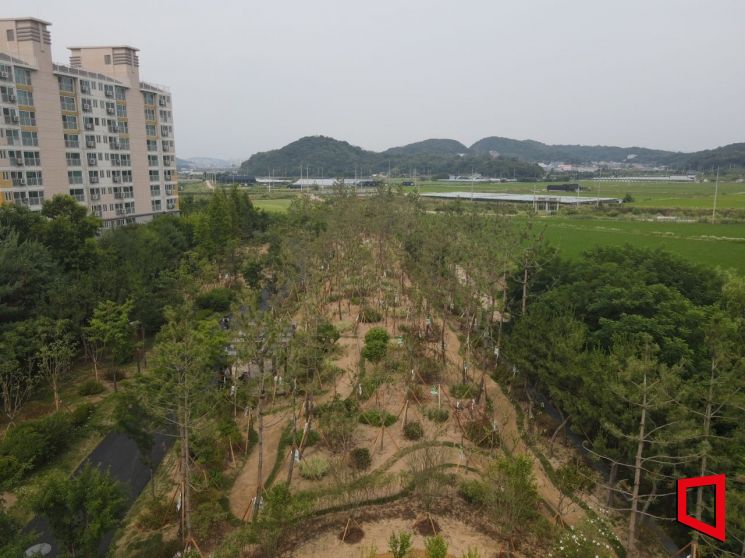 An urban forest created along the Yeongdong Expressway in Seochang-dong, Namdong-gu, Incheon
 [Photo provided by Namdong-gu, Incheon]
Park Jong-hyo, the district mayor, said, "Through the creation of the climate-responsive urban forest, it will be possible to reduce pollution such as fine dust and air pollutants generated along the expressway," adding, "We will continue to establish urban forests around industrial complexes and highways."
Meanwhile, since 2020, Namdong-gu has been creating urban forests in areas such as Sorae Nonhyeon Urban Development Area (2ha), along the 3rd Gyeongin Expressway (3ha), Namdong National Industrial Complex (2ha), and along the 2nd Gyeongin Expressway (4ha).
© The Asia Business Daily(www.asiae.co.kr). All rights reserved.
![Clutching a Stolen Dior Bag, Saying "I Hate Being Poor but Real"... The Grotesque Con of a "Human Knockoff" [Slate]](https://cwcontent.asiae.co.kr/asiaresize/183/2026021902243444107_1771435474.jpg)















