Ministry of Environment Announces 14 Domestic Dam Construction Sites
Capable of Handling 220mm Heavy Rainfall at Once
Newly Supplied Water to Total 250 Million Tons Annually
"Plan to Significantly Increase Dam Budgets for Water Supply and Sewage Systems"
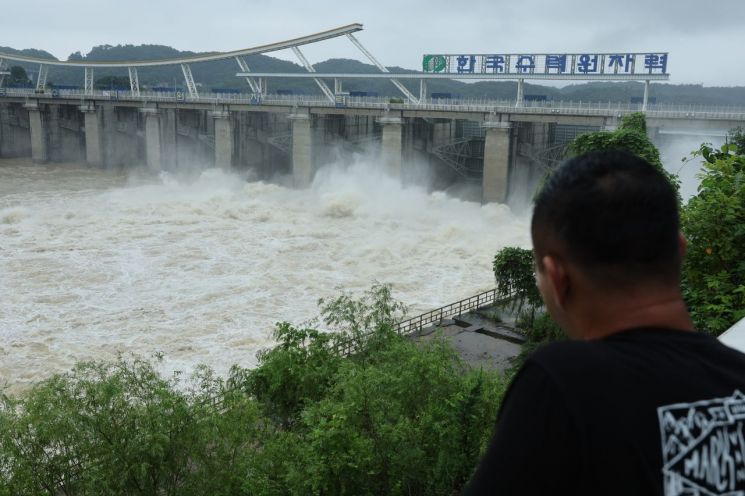 Paldang Dam with its sluice gates opened. The photo is unrelated to the article content. [Image source=Yonhap News]
The government announced plans to build dams on 14 domestic rivers. This is the first new dam construction plan announcement in 14 years. The Ministry of Environment stated that the dams will address floods, droughts, and increasing water demand caused by climate change.
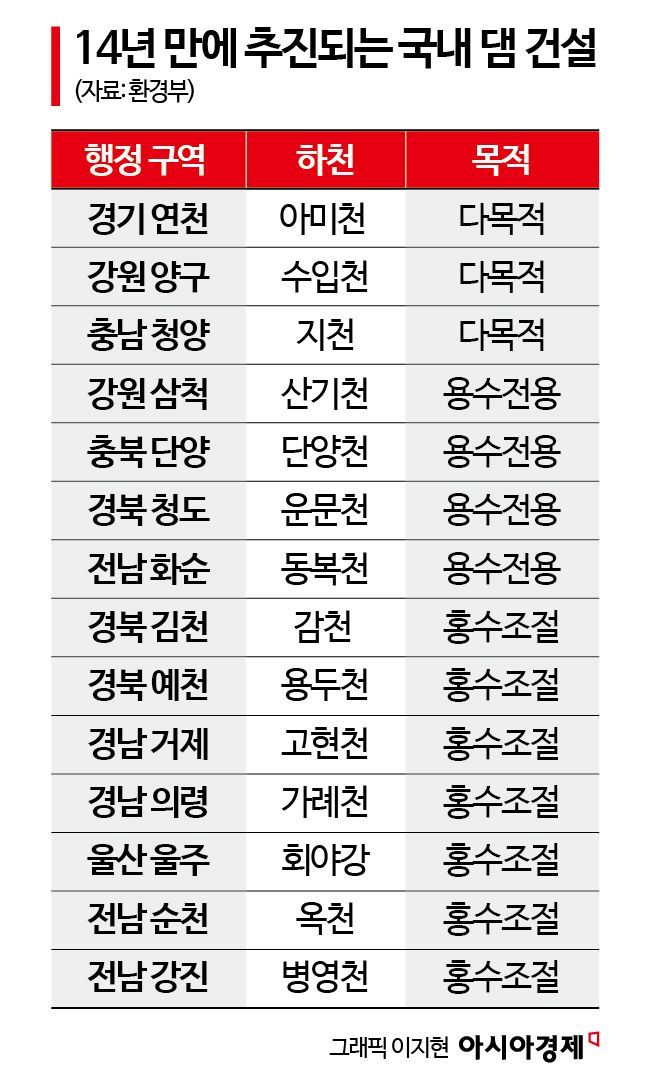
On the 30th, the Ministry of Environment announced 14 candidate sites for climate response dams at the Government Complex Seoul. The dams include 3 multipurpose dams, 7 flood control dams, and 4 water supply-only dams. By watershed, there are 4 sites in the Han River basin, 6 in the Nakdong River basin, 1 in the Geum River basin, and 3 in the Yeongsan and Seomjin River basins. Gohyeoncheon, Garecheon, Hoeyagang, Okcheon, and Byeongyeongcheon will be redeveloped from existing dams, while the rest will be newly constructed.
Dam construction has not been pursued for 14 years since the construction of Bohyeonsan Multipurpose Dam began in 2010. This is because state-led dams and weirs built during the Four Major Rivers Project were heavily criticized for damaging the environment. In September 2018, during the Moon Jae-in administration, the Ministry of Environment announced a plan to shift the dam policy paradigm from construction to management and stated that no state-led dams would be built.
The Ministry of Environment changed its stance due to climate change. Last month, heavy rains exceeding half of the annual precipitation fell in areas such as Paju, Gyeonggi Province (873mm), Buyeo, Chungnam Province (809mm), and Iksan, Jeonbuk Province (704mm). Due to extreme heavy rains caused by climate change, damages over the past three years have exceeded 1.6 trillion won, with 85 casualties. Conversely, in 2022, the southern regions experienced the longest drought on record, lasting 227 days. During that time, agricultural damage covering 4.36 million pyeong occurred in areas such as Sinan and Yeonggwang in Jeonnam Province.
There is also the aspect of securing water for daily use. In the metropolitan area, water is mainly supplied from Soyanggang Dam and Chungju Dam. However, 94% of the total capacity of these two dams is already in use. There are concerns that if the climate crisis worsens, there could be a shortage of daily water supply in the metropolitan area.
The government explained that once the climate response dams are built, they will have flood defense capabilities to accommodate rainfall of 80 to 220mm at once. For example, last year in Yecheon County, Gyeongbuk Province, floods caused 3 casualties and 11.7 billion won in property damage. If the Yongducheon Dam is constructed as planned, it is judged that even a 200-year frequency heavy rain event can be safely protected from flooding downstream.
They also emphasized the effectiveness in drought response. The newly supplied water through the climate response dams will reach 250 million tons annually. This is enough for 2.2 million citizens to use. The Ministry of Environment believes that if the Dongbokcheon Dam in Hwasun County had existed during last year’s drought in Gwangju and Jeonnam, the crisis could have been resolved without reaching a severe stage.
Regarding submerged private houses, they stated that the impact has been minimized. The largest dam, the multipurpose dam on Suipcheon in Yanggu, Gangwon Province, will not submerge any private houses, and measures have been taken to ensure that there are no water source protection zone regulations caused by dam construction. They explained that water source regulations due to climate response dam construction will be minimized or, if unavoidable, minimized as much as possible.
However, environmental groups have voiced criticism of dam construction. They argue that the collapse of biodiversity caused by dam construction must also be considered. The civic group Korea Federation for Environmental Movements issued a statement saying, “The population of freshwater organisms has decreased by 74% on average worldwide, making them the most vulnerable to the climate crisis,” and pointed out that “if the Suipcheon Dam is built, the submerged habitat will face a crisis where it is difficult to maintain its integrity.”
In response, Park Jae-hyun, Director of Water Management Policy at the Ministry of Environment, said, “There were concerns that the habitat of the natural monument, the crane, could be destroyed when the Gunam Dam was built in the border area,” but added, “As a result of creating alternative habitats and continuously feeding activities during the planning and implementation of the dam, the population has increased.” He also stated, “We will continuously establish monitoring of the ecological environment before and after the dam project.”
The Ministry of Environment plans to actively explain and communicate with residents about their questions and concerns through local briefings and public hearings starting in August, and will also go through sufficient consultation processes with related agencies. If discussions proceed smoothly, construction of some small and medium-sized dams is expected to begin in 2027.
Minister Kim Wan-seop emphasized, “Since dam construction takes about 10 years even if started now, considering the recent climate crisis, there is no longer any room to delay dam construction,” and added, “We plan to significantly increase the budget for support in dam surrounding areas such as roads and water supply and sewage to help improve the lives of local residents and revitalize the local economy.”
© The Asia Business Daily(www.asiae.co.kr). All rights reserved.
![Clutching a Stolen Dior Bag, Saying "I Hate Being Poor but Real"... The Grotesque Con of a "Human Knockoff" [Slate]](https://cwcontent.asiae.co.kr/asiaresize/183/2026021902243444107_1771435474.jpg)

















