"France actively supports building wooden structures using timber harvested locally (logging) and considers replanting young trees in the harvested areas as carbon neutrality. This approach will enable sustainable timber production in France in the future."
This is what Georges-Henri Florentin, chairman of ‘France Bois 2024,’ said regarding France's policy to promote wooden architecture locally.
France Bois 2024 is a project aimed at using more than 50% domestic timber for new facilities constructed for the Paris Olympics.
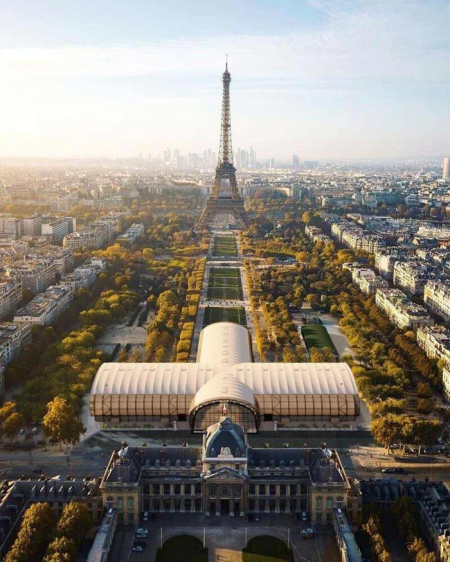 France built a wooden structure, the "Champ de Mars Arena (wrestling venue)," facing the Eiffel Tower in Paris to host the Paris Olympics. Photo by Wilmotte & Associ?s
According to the Korea Forest Service on the 31st, the Paris Olympics is the first Games conducted in line with the International Olympic Committee (IOC)'s 'Greener Agenda.' In accordance, France utilized 95% of the Olympic venues as existing or temporary facilities, constructing only a few new ones such as the athletes' village and swimming pool.
Even the newly constructed facilities primarily used timber. For example, the Paris Aquatic Center, the swimming venue for the Paris Olympics, sourced 30% to 40% of the timber used in the building from domestic Douglas fir and spruce. This building is planned to be dismantled after the Olympics and the timber will be recycled for other uses.
Additionally, the athletes' village, a hybrid wooden structure, will be repurposed into 6,000 social welfare housing units after the Olympics. The building was completed with timber and glass up to the 8th floor, and steel framing supporting floors above the 8th.
Even before the Paris Olympics, France actively encouraged wooden architecture through laws such as environmental legislation and RE2020 (Environmental Regulation 2020). The structure promotes building with local timber so that the wood used in construction can act as a carbon sink.
The Korea Forest Service pays close attention to France's policy to promote wooden architecture. They see the future of wooden architecture in Korea reflected in the policies confirmed during the Paris Olympics.
Wooden architecture sits at the apex of the cycle of ‘afforestation → forest management → harvesting → afforestation,’ aligning with the forest management pursued by the Korea Forest Service. If wooden architecture is activated within this virtuous cycle of forests, it is expected to lead to the revival of the domestic timber industry and the realization of national carbon neutrality.
For example, one wooden building (30 pyeong, 100㎡) can reduce 40 tons of CO2, which is equivalent to the emissions from one car traveling back and forth between Seoul and Busan 400 times. The positive impact of wooden architecture on carbon neutrality is therefore significant.
For the same reason, movements to promote wooden architecture have already begun domestically. The Korea Forest Service’s declaration last August to construct buildings within its affiliated and subordinate institutions using wooden architecture aligns with this trend.
As a first step, the Korea Forest Service will complete the tallest wooden building in Korea in the second half of this year in Seo-gu, Daejeon, standing 7 stories (27.6m) above ground. This building will be used as the ‘Comprehensive Forest Welfare Education Center,’ and the timber used (1,363㎥) is expected to store 1,249 tons of CO2 annually.
Moreover, the Korea Forest Service is investing a total budget of 219 billion KRW to promote projects such as timber-friendly cities, wooden architecture demonstration projects, and wooden observation towers at 23 locations nationwide to create leading public sector examples.
Park Eun-sik, Director of the Forest Industry Policy Bureau at the Korea Forest Service, said, "When France bid for the Paris Olympics, it promised to reduce the Olympic carbon footprint by half compared to previous Games, making the use of timber mandatory for new building construction. Most importantly, the fact that the newly built wooden structures were designed to be used permanently (including recycling) after the Olympics is a point to note."
He added, "The Korea Forest Service is currently working on establishing related systems to activate the domestic wooden architecture market. We will discover and implement effective policies so that wooden buildings can become popular architectural forms in Korea as well."
© The Asia Business Daily(www.asiae.co.kr). All rights reserved.
![Clutching a Stolen Dior Bag, Saying "I Hate Being Poor but Real"... The Grotesque Con of a "Human Knockoff" [Slate]](https://cwcontent.asiae.co.kr/asiaresize/183/2026021902243444107_1771435474.jpg)
















