Selected 86 Innovative Cases from Over 800 Entries in 83 Countries, Seongdong-gu the Only Local Government Nationwide... High Praise for Integrating Advanced Technology to Enhance Convenience and Safety, Solving Urban Issues through Resident Participation and Public-Private Collaboration, Introduced to the International Community
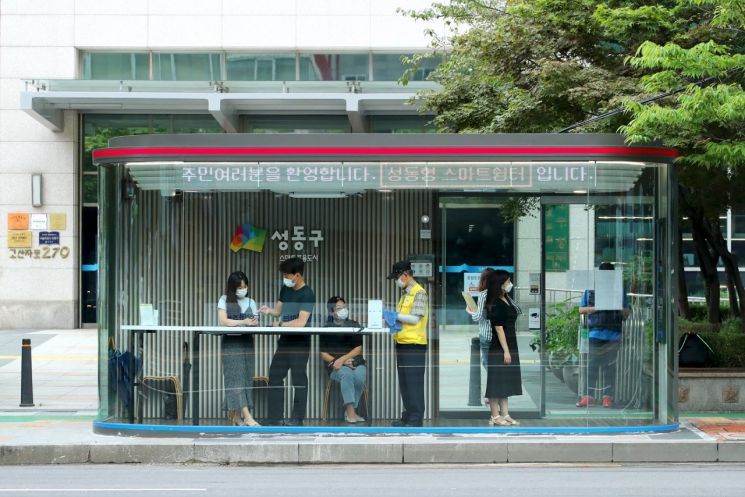
Seongdong-gu, Seoul (Mayor Jung Won-oh) announced on the 24th that the 'Seongdong-type Smart Shelter and Smart Crosswalk' have been selected as 2024 OECD Public Sector Innovation Cases.
The OECD has been operating the Observatory of Public Sector Innovation (OPSI) since 2011 to share public sector innovation cases worldwide and promote an innovation culture. Every year, it calls for and announces public sector innovation cases from countries around the world. The selected innovation cases are published on the OECD website (OPSI), and currently, 990 innovation cases from 98 countries are introduced and shared with OECD member countries and the international community.
This year, over 800 innovation cases were submitted from 83 countries, and a total of 86 cases were selected. Among them, Seongdong-gu's 'Seongdong-type Smart Shelter' and 'Smart Crosswalk' were selected, making it the only basic local government nationwide to be named, which adds special significance. The 'Seongdong-type Smart Shelter' and 'Smart Crosswalk' received particularly high evaluations for integrating advanced technology to secure convenience and safety in daily life, solving urban problems through resident participation and public-private collaboration.
The 'Seongdong-type Smart Shelter' is a future-oriented bus stop that protects public transportation users from heatwaves and cold snaps, and is one of Seongdong-gu’s representative smart life-oriented facilities. By integrating smart technology into the existing bus stop functions, it not only provides real-time traffic information but also offers 18 different convenience services such as public Wi-Fi and mobile phone charging. It enables safe use of public transportation even amid climate changes like fine dust, record-breaking heatwaves, and cold waves, and its crime prevention effect through constant monitoring is also a strong advantage. Currently, the smart shelter receives great response from residents, with an average of 80,000 users per week.
The 'Smart Crosswalk' is equipped with eight functions including smart lighting, automatic vehicle number recognition, and voice guidance assist devices for pedestrian signals. Triggered by traffic accidents in child protection zones, it plays a major role in protecting vulnerable road users such as children and the elderly, and preventing traffic accidents caused by smartphone use while walking.
In particular, the ‘Seongdong-type Smart Shelter’ and ‘Seongdong-type Smart Crosswalk’ were first introduced nationwide by Seongdong-gu and were selected for the Ministry of the Interior and Safety’s '2023 Local Government Innovation Performance Expansion Support Project,' recognizing their excellence as other local governments have adopted them. These exemplary cases of smart technology adoption have spread nationwide and have been benchmarked by more than 20 local governments. In July this year, a policy training delegation from Lima, Peru visited Seongdong-gu to directly experience the smart facilities.
Seongdong-gu is also considering creating a tourism course linking representative Seongdong-type smart projects such as the smart shelter, smart crosswalk, smart smoking booths, and smart rainwater drains to widely share the excellence of its smart policies.
Jung Won-oh, Mayor of Seongdong-gu, said, “The selection of the Seongdong-type Smart Shelter and Smart Crosswalk as OECD public sector innovation cases is a global recognition of the value of the smart inclusive city policies we have steadily pursued.” He added, “We will continue to create a happy and livable Seongdong where everyone feels the innovation policies.”

© The Asia Business Daily(www.asiae.co.kr). All rights reserved.


















