2025 is the De Facto First Year for Full-Time Positions in 'K-Semiconductor Contract Departments'
Considering Military Leave, Securing About 500 Full-Time Positions Annually After 2030
Focusing on Strengthening Practical Training... Building Fundamentals in Process, Devices, and Design
Starting next year, graduates from Korea University's contract departments will be hired as full-time employees at SK Hynix, while graduates from Yonsei University's contract departments will be hired at Samsung Electronics. Engineering talents who have gained theoretical knowledge and practical experience necessary for semiconductor devices and design will join these two companies as regular employees. From 2030 onwards, about 500 semiconductor contract department graduates are expected to join these companies annually. Companies positively evaluate these semiconductor contract departments linked to recruitment as they reduce the risk of talent leaking to competitors or other industries.
 On April 10, 2020, Chung Jin-taek, then president of Korea University (right), and Kim Dong-seop, head of external cooperation at SK Hynix, are taking a commemorative photo at the 'Semiconductor Engineering Department Agreement Ceremony.'
 [Photo by Korea University]
According to the semiconductor industry and academia on the 1st, students from the 2021 cohort of Korea University's Semiconductor Engineering Department, linked with SK Hynix, and Yonsei University's System Semiconductor Engineering Department, linked with Samsung Electronics, are expected to graduate in February next year and join their respective companies.
At Korea University, excluding those enlisted in the military or on leave, 9 students will graduate in February next year. Yonsei University has not disclosed the number of graduates, but considering that the enrollment quota for the semiconductor contract department is about three times larger than Korea University's (30 students per year), approximately 30 students are expected to join Samsung Electronics as full-time employees early next year. Since 2006, Sungkyunkwan University has operated a Samsung Electronics-linked contract department, and the cumulative employment rate of graduates after the department's establishment was 86%. The graduation rate of the first cohort of contract department students at Korea University and Yonsei University, which include many male students enlisted in the military and those on leave, is expected to be lower than that of Sungkyunkwan University.
This year, 100 first graduates will be produced from the newly established Ulsan National Institute of Science and Technology (UNIST), Daegu Gyeongbuk Institute of Science and Technology (DGIST), and Gwangju Institute of Science and Technology (GIST). They are expected to join Samsung Electronics as early as early 2028, or by around 2030 at the latest. Samsung Electronics and SK Hynix have an annual enrollment quota of 510 students across 10 universities operating recruitment-linked semiconductor contract departments, and from 2030 onwards, they will be able to secure about 500 undergraduate students annually.
With the activation of semiconductor contract departments, Samsung Electronics and SK Hynix have been able to secure engineering talents with theoretical and practical experience related to memory and non-memory device design. Companies positively evaluate this not because these talents will immediately produce results after joining, but because it prevents talent from leaking to overseas companies or other industries (IT, heavy chemical, etc.) and allows for stable talent acquisition.
It is known that companies have signed agreements with universities to restrict job changes for a certain period after graduation. According to Pohang University of Science and Technology (POSTECH), the mandatory work period for undergraduate students who received Samsung Electronics scholarships is twice the duration of the scholarship period. Similar principles are reportedly applied at other universities. Semiconductor contract departments typically operate on a 4-year system, while UNIST, DGIST, and GIST operate on a 5-year system.
Samsung Electronics and Hynix fully support tuition fees for 8 semesters. Samsung Electronics provides academic subsidies to several universities, including Sungkyunkwan University. SK Hynix also provides full tuition, tuition subsidies, and scholarships for outstanding students to contract department students (100 students annually) at Korea University, Sogang University, and Hanyang University. In some cases, if graduates do not work at the company after graduation, they must return the support funds received during their undergraduate studies.
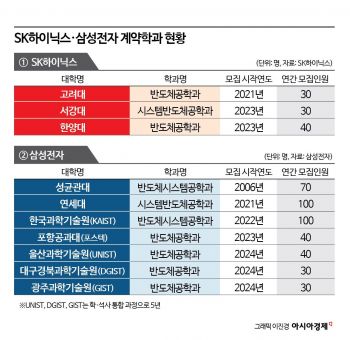
Recently, universities strengthening undergraduate practical education is also positive for companies. Korea University has operated a regular course in the first and second semesters of the senior year since the 2021 cohort, where students jointly participate in graduate students' research practice. Additionally, universities are trying to expand the Multi-Project Wafer (MPW) education courses for students. MPW is a process where multiple chip projects are carried out on a single wafer. Three universities contracted with SK Hynix?Hanyang University, Korea University, and Sogang University?are reportedly forming a consensus to explore specific plans to increase MPW classes. Although specific MPW programs and credit exchanges have not yet been implemented, Hanyang University has included a course on directly fabricating semiconductor devices in the curriculum starting from the third year.
However, compared to overseas industry-academia cooperation programs such as TSMC and Intel, domestic semiconductor education is criticized for lacking diversity and depth. TSMC operates educational programs at various universities covering fields such as application systems (Stanford), low-power computing (Berkeley), 3D system packaging (Georgia Tech), artificial intelligence (AI) hardware (MIT), 5G mobile communications (Illinois), and lithography equipment (EUV) practice (Tsinghua University). Intel operates undergraduate-level microfabrication and semiconductor simulation research, as well as computer hardware technology minor programs at Central State University in Ohio.
Experts judged that it is more desirable to provide undergraduates with comprehensive education covering basic topics such as memory and non-memory processes, devices, and design rather than education limited to specific fields. They emphasized that such comprehensive education will help students, when they become professional engineers, to broadly apply learned theories to next-generation technologies and develop more innovative products.
Professor Kwon Seok-jun of the Department of Chemical Engineering at Sungkyunkwan University, a semiconductor expert, said, "For example, a student who only learned the process dedicated to High Bandwidth Memory (HBM) could be evaluated as a 'half-baked' talent," adding, "They need to understand which device their process is specialized for to apply it more broadly to next-generation technologies." He continued, "Even if they get a job at Samsung Electronics or SK Hynix, there is no guarantee they will work in one field for life," adding, "Process engineers may need to change careers to circuit designers or material developers, and if they do not gain sufficient experience in various fields during their undergraduate years, their perspective may become narrow."
© The Asia Business Daily(www.asiae.co.kr). All rights reserved.
![Clutching a Stolen Dior Bag, Saying "I Hate Being Poor but Real"... The Grotesque Con of a "Human Knockoff" [Slate]](https://cwcontent.asiae.co.kr/asiaresize/183/2026021902243444107_1771435474.jpg)

















