Issues on Preventing Consumer Harm Due to Growth of Resale Market and Exploring Multifaceted Measures to Protect Consumer Rights
 [Group Photo of Participants at the 2024 Korean Consumer Society Special Seminar 'Activation of Resale Platforms and Consumer Experience']
The Korean Consumer Studies Association (co-chairs Professors Ok Kyung-young of Sookmyung Women’s University and Lee Sung-soo of Sunmoon University) held a special seminar on July 26 at the FKI Tower in Yeouido (formerly the Federation of Korean Industries building) under the theme “Activation of Resale Platforms and Consumer Experience,” exploring ways to develop resale platforms.
The seminar was moderated by Professor Boo Soo-hyun of Gyeongsang National University, and featured presentations by Professor Nam Young-woon of Seoul National University’s Department of Consumer Studies and Professor Nam Ki-yeon of Dankook University’s Department of Law, who examined the balance between consumer rights and legal regulations regarding resale.
As the first presenter, Professor Nam Young-woon introduced the background, utility, and key issues of the resale market under the topic “Current Status and Issues of the Resale Market.” Professor Nam pointed out, “The resale market can provide flexibility in pricing for the primary market and enhance the experiential value of products, but problems such as defective product quality, counterfeit sales, and price surges also exist.” Therefore, to improve the welfare of market participants, he emphasized that “platforms need to make autonomous efforts to prevent harm and create a fair trading environment in the resale market.”
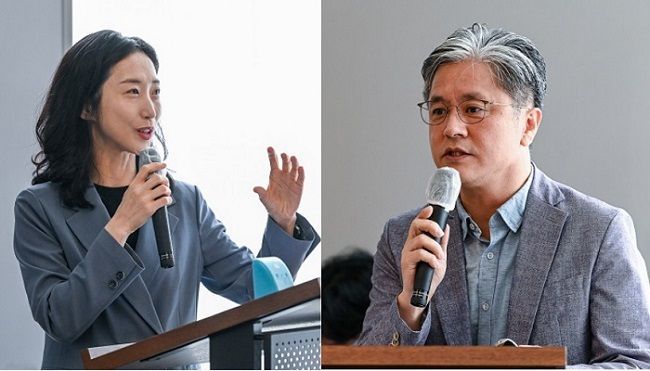 [From the left, Professor Nam Young-woon, Department of Consumer Science, Seoul National University, and Professor Nam Ki-yeon, Department of Law, Dankook University]
The second presenter, Professor Nam Ki-yeon, gave a presentation titled “A Study on the Problems and Improvement Measures of Performance Ticket Resale,” highlighting the issue of indiscriminate regulation that does not distinguish between scalping and ticket resale. Professor Nam stated, “Considering constitutional fundamental rights such as property rights and consumer rights, not all online ticket resale activities can be defined as illegal acts,” adding, “A blanket ban on peer-to-peer ticket resale in a free market economy may violate the principle of private autonomy and property rights, constituting a breach of due process.”
Professor Nam argued, “It is necessary to include ticket resale services conducted underground within the scope of legal regulation to prevent consumer harm and recognize them as a new industry under reasonable regulation,” and raised the need to “clearly distinguish permissible activities from illegal acts, establish criteria for judgment, and efficiently manage and supervise the resale market,” advocating for the legalization and normalization of the resale market.
Following the presentations, a panel discussion was chaired by Professor Ok Kyung-young, with participation from Professor Na Jong-yeon of Seoul National University’s Department of Consumer Studies, Senior Researcher Bae Soon-young of the Korea Consumer Agency, Secretary-General Lee Jung-soo of the Korea Consumer Organization Council, and Senior Researcher Lim Eun-jung of the Corporate Consumer Experts Association.
The discussion participants engaged in in-depth dialogue on desirable development plans for the resale market, including tickets, and the roles of various market participants such as the government, platforms, and consumers. They reached a consensus on the need to seek a balance that guarantees consumer freedom of choice and rights.
Co-chair of the Korean Consumer Studies Association, Professor Ok Kyung-young, commented, “Through this seminar, we were able to comprehensively examine the development direction of the resale market and the current status of resale platforms, consumer awareness, and legal regulations to protect consumer rights,” adding, “Continuous research, investigation, and policy efforts will be necessary for the secondary market to grow in a way that protects consumer rights.”
Meanwhile, the Korean Consumer Studies Association was established in May 1989 to contribute to the advancement of consumer research and the enhancement of consumer welfare through basic, applied, and interdisciplinary research on consumers. It is a leading academic organization in the domestic consumer-related field with over 2,700 members.
Through academic activities that observe, diagnose, and predict consumers in a changing society from various methodologies and perspectives, and through flexible communication, the association contributes to ensuring that academic research results are reflected in policies and corporate activities aimed at the practical enhancement of consumer welfare.
© The Asia Business Daily(www.asiae.co.kr). All rights reserved.

![A Woman with 50 Million Won Debt Clutches a Stolen Dior Bag and Jumps... A Monster Is Born [Slate]](https://cwcontent.asiae.co.kr/asiaresize/183/2026021902243444107_1771435474.jpg)
















