Practical Exam Registration for National Medical Licensing Closes on 26th... "At Least 95.5% of 4th-Year Students Did Not Apply"
Medical Professors Urge "Government Must Make a Grand Decision"
Most fourth-year medical students are expected not to take the national medical licensing examination (Kuksi), which is likely to disrupt the supply of doctors next year. The government is taking a stance that it may consider conducting additional exams while persuading medical students, and is determined to steadily push forward medical reform, including the transition to specialist-centered hospitals.
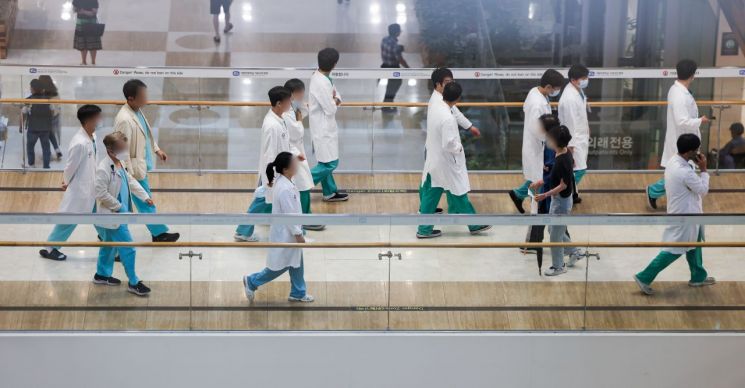
According to the government and the medical community on the 26th, the registration for the practical exam of next year's national medical licensing exam closed at 6 p.m. that day. Although the registration results have not been disclosed, the medical community believes that most medical students did not register.
The Emergency Response Committee (ERC) of professors from the medical schools of Seoul National University, Sungkyunkwan University, Yonsei University, Ulsan University, Catholic University, and Korea University stated in a document that "the non-participation rate of fourth-year medical students in the national medical licensing exam is expected to be at least 95.5%," adding, "Without drastic measures, it will be difficult to avoid a situation where only a very small number of doctors are produced next year."
According to a recent survey conducted by the Korean Medical School and Graduate Medical School Student Association (KMSA) targeting 3,015 fourth-year medical students nationwide, 95.5% (2,773 out of 2,903 respondents) answered that they did not submit the 'Consent Form for Personal Information Provision' required to register for the exam. Students who do not submit the consent form cannot register for the practical exam, and considering those who submit the form but do not actually register for the practical exam, the ERC expects that more than 95.5% of fourth-year students will not take the exam.
Previously, in 2020, when conflicts between the government and medical community over increasing medical school admissions occurred, about 2,700 fourth-year students also did not take the practical exam.
The ERC emphasized, "It is the government's responsibility to propose solutions to prevent the worst-case scenario where no new doctors or specialists are produced and there are no residents," and added, "The government must prepare a grand consensus and breakthrough plan through a magnanimous decision based on a harsh recognition of the current medical community situation."
As medical students refuse to attend classes and also refuse to take the national medical licensing exam, the number of doctors graduating next year is expected to be extremely low. This effectively cuts off the supply of about 3,000 new doctors produced annually. Since only a small number of residents have returned to training hospitals and the possibility of resigned residents returning to training hospitals in September is low, the gap in medical field coverage is expected to be prolonged.
The government plans to persuade medical students to take the national medical licensing exam and residents to return, while focusing on medical reform to minimize confusion in the medical field even if the number of residents drastically decreases.
A Ministry of Health and Welfare official stated, "We have repeatedly expressed that if medical students return, we will actively consider conducting additional medical licensing exams," and emphasized, "We will accelerate the project to transform the structure of tertiary hospitals centered on specialists."
Furthermore, the government intends to focus on maintaining an emergency medical system rather than responding to each issue related to medical students and residents individually. To this end, starting next week, the frequency of the Central Disaster and Safety Countermeasures Headquarters (CDSCH) meetings on doctors' collective actions at the intergovernmental level will be reduced from twice a week to once a week.
© The Asia Business Daily(www.asiae.co.kr). All rights reserved.

















