"Discussion Needed to Reflect Outpatient-Related Training Programs in Resident Education"
"Government Distorts Causes and Shifts Blame... Repeating Empty Talk"
The medical community, under the auspices of the Special Committee for Proper Medical Care (Olteukwi) of the Pan-Medical Community, held the "1st National Doctors' Grand Debate on the Survival of Korean Medicine," asserting that "the wrong medical reform must be corrected even now." Discussions also continued on improving the training environment for residents and alternatives for Korean medical reform.
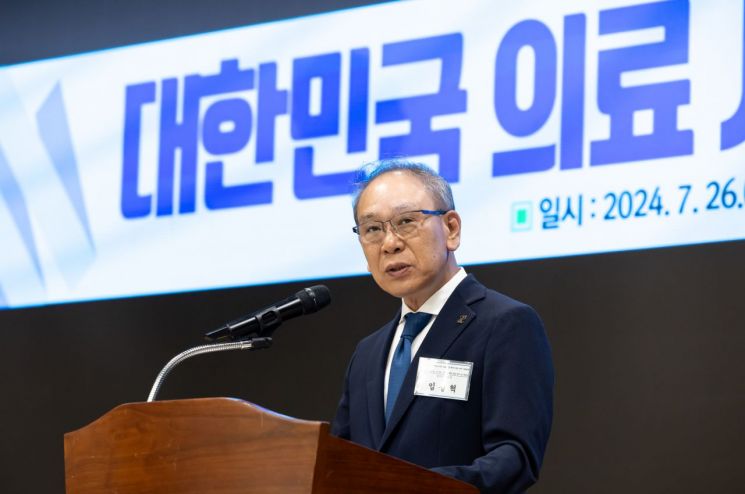 Im Jeong-hyeok, co-chairman of the Special Committee for Proper Medical Care (Olteukwi) and president of the Daejeon Medical Association, is delivering the opening address at the "1st National Doctors' Grand Debate on the Survival of Korean Medicine" held at the Korea Medical Association building in Seoul on the afternoon of the 26th.
 [Image source=Yonhap News]
Im Jeong-hyeok, chairman of Olteukwi and president of the Daejeon Medical Association, stated this during the opening remarks on the 26th at the Korean Medical Association (KMA) headquarters in Yongsan-gu, Seoul. He said, "A nation's health care policy is never something that can be decided simply by majority logic like a public opinion poll," adding, "Let us exert the power of collective intelligence to protect the advanced Korean medical system that has been hard-earned by making efforts to correct the wrong parts even now."
Im Hyeon-taek, president of the KMA, also encouraged the attendees in his speech, saying, "The medical community has continuously warned how ineffective and dangerous the government's policies are and has fought to stop the promotion of wrong medical policies," and "Fortunately, through the medical community's struggle over the past five months, public opinion trends are changing regarding the government's forced increase in medical school quotas and essential medical package policies."
He added, "We will never submit to the government's arrogance and stubbornness in insisting on pushing through wrong policies," and "We will definitely achieve the goal of normalizing Korean medicine."
At the grand debate, discussions were held on topics such as "Korean Medicine, Young Doctors, and the Future" and "Contradictions in Korean Medicine and New Governance."
Park Yong-beom, director of training and education at the Korean Academy of Medical Sciences, who presented on "Korean Medicine, Young Doctors, and the Future," suggested, "It is necessary to create a standardized education plan for intern training to systematize education, designate dedicated supervising specialists for interns, and establish a system for actual training and evaluation," adding, "There must be an entity responsible for intern training education, and a proper education and evaluation system should be prepared considering realistic issues to improve the quality of intern competency training education."
He continued, "It is necessary to institutionalize the intern supervising specialist system to ensure that intern competency training is properly conducted, and appropriate rewards for supervising specialists in major departments are needed," adding, "This requires the effort and time of supervising specialists. A compensation system, funding, and support system for this are necessary."
Regarding the training environment for residents, he said, "I believe outpatient training for residents is necessary, and discussions are needed to reflect outpatient-related education programs in the training curriculum by year and specialty," adding, "Cooperation between large hospitals and smaller training hospitals, as well as rotation programs, can also be alternatives."
Park Hyeong-wook, vice president of the Korean Academy of Medical Sciences, who presented on "Contradictions in Korean Medicine and New Governance," mentioned that the normal delivery fee in Korea is 1 million KRW, whereas in the U.S. it is at least 20 million KRW, and argued that the government distorts the cause of the problem and shifts responsibility. He questioned, "Health insurance fees are forcibly decided by the Ministry of Health and Welfare, so why is this considered a market failure?" and said, "The government shifts responsibility by blaming doctors' selfishness for ultra-low fees."
He also criticized the government for repeating empty talk without concrete policy indicators. Park said, "The essential medical policy package in February 2024 does not mention any policy will to raise health insurance premiums in the future," and "Without a policy will to increase health insurance premiums, essential medical support will end up being a zero-sum game."
Furthermore, he emphasized, "The Korean medical system forcibly makes expensive medical services cheap to provide medical coverage. Medical accessibility improves greatly, but medical institutions operate by compensating income through high volume and non-reimbursable services," adding, "University hospital emergency rooms are extremely strained, residents are not recognized basic rights as citizens, and with increasing civil and criminal medical liabilities, the departure from essential medical care is accelerating."
He argued that the medical system should be composed in various forms according to the abilities and demands of social members. He said, "The state should take responsibility for those who cannot afford medical expenses themselves, those with some financial ability should receive medical services through social solidarity (social insurance), and those with the financial ability to receive high-quality medical services should solve it themselves," adding, "Thus, a medical system fundamentally having both public and private wings should be constructed."
He also stated, "Consistent operating principles should be applied within each medical system because the inconsistency of operating principles is one of the major causes distorting our medical system," and "Public medical care should control fees but guarantee proper operation of medical institutions, and medical accidents, especially when they occur, should primarily be the responsibility of the state or insurer to compensate."
Meanwhile, Olteukwi will cease operations after the grand debate. Earlier, the KMA stated in its "Position on the Operation of Olteukwi," "Several operating committee members of the KMA Delegate Council gave various advice on the operation of Olteukwi to the executive branch, and it was agreed to leave the direction of Olteukwi's operation to the executive branch," adding, "To sufficiently reflect the opinions of residents and to carefully consider and listen to various opinions on the major revision and continuation of Olteukwi's direction, Olteukwi will cease operations after the debate scheduled on the 26th."
© The Asia Business Daily(www.asiae.co.kr). All rights reserved.
![Clutching a Stolen Dior Bag, Saying "I Hate Being Poor but Real"... The Grotesque Con of a "Human Knockoff" [Slate]](https://cwcontent.asiae.co.kr/asiaresize/183/2026021902243444107_1771435474.jpg)
















